
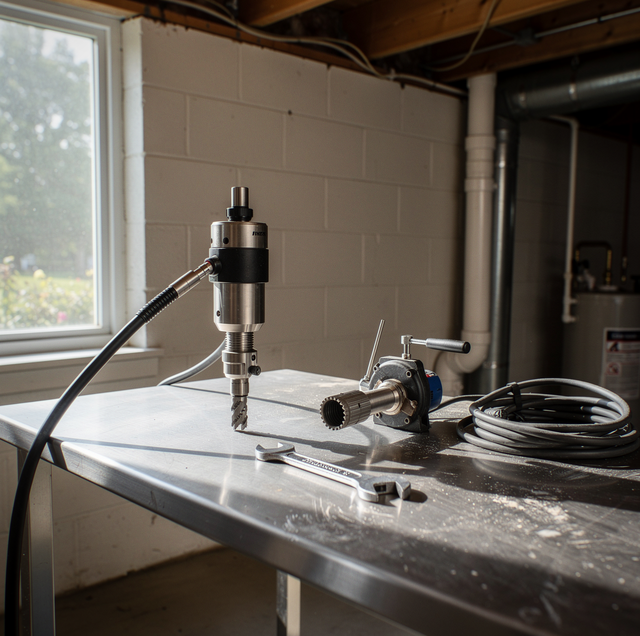
Pipe milling attaches a rotating cutting head to the end of a flexible shaft, feeds it into the line through an existing cleanout, and spins it against whatever is blocking the pipe until the material is ground away. Nothing gets pushed aside or dissolved. A blockage hard enough to shrug off a cable and withstand a jetter's water pressure gets ground down, piece by piece, until the pipe's original diameter opens back up. It's a step up from snaking and jetting, rather than a replacement for either, reserved for the material those two tools pass over rather than clear.
Snaking, jetting, and milling all clear a line, but they don't clear the same kind of blockage. Which one fits depends on what's sitting in the pipe. Each blockage type pairs with the method suited to it:
| Blockage Type | Best-Fit Method |
|---|---|
| Fresh grease clinging to the wall | Jetting |
| Hardened, calcified grease deposits | Milling |
| Heavy, hardened mineral scale and tuberculation in cast iron | Milling |
| A lateral tap protruding into the main line | Milling |
| Calcified root masses | Milling |
| Concrete or hardened debris in the line | Milling |
How a Milling Head Works
A milling head is built to grind, not to slice cleanly through in a single stroke. Some heads use a chain fitted with small hardened links that flail outward as the shaft spins, wearing down whatever the chain contacts. Others use a fixed carbide-tipped cutter chosen for the obstruction. Either way, the shaft is fed forward in short increments rather than driven straight through, and the head is pulled back and reset between passes so the crew can check how much material is left before pushing forward again.
That slow, incremental approach is what separates milling from simply cutting a channel through and calling the job done. A root saw or a jetter nozzle is built to move down the pipe. A milling head is built to stay in one spot and remove material from it, working the full opening back toward the pipe's original width instead of just the narrow gap a smaller tool could pass through. Feed speed and how hard the head is pressed forward are both adjusted by hand at the machine's controls, based on how much resistance the operator feels coming back through the shaft, rather than running on a fixed setting from the start of the pass to the end.
What Milling Removes That Snaking and Jetting Do Not
A cable machine hooks and pulls, or shears through what it can grab. That works fine on roots still soft enough to cut and on debris loose enough to drag free, but a cable head skates across something denser instead of biting into it. Jetting works differently: water under pressure erodes and scours a surface, stripping the grease film and flushing loose material, but water pressure alone doesn't remove hardened mineral deposits or grind through something solid like concrete.
Older cast-iron sewer pipe can build mineral scale on its interior wall, a rough buildup called tuberculation that narrows the pipe from the inside; older clay pipe brings a different hard obstruction, root masses that grow in through the joints between its sections and can harden in place. A home whose sewer line was laid in plastic from the start has neither material underground nor any of those reasons to mill apply to it. Where that older pipe carries tuberculation, jetting can knock loose surface debris but leaves the hardened ridge underneath; a milling head is what grinds that ridge down to bare pipe wall. A protruding lateral tap, a spot where a branch line was tied in and now juts into the main instead of sitting flush, is the same story: no amount of water pressure trims a solid protrusion back, but a mill head shaped for the job cuts it flush.
A root mass left in a pipe for years can end up in that same hard category. Standing water and mineral content in the flow settle into a thick root tangle over time, and what starts as fibrous material a standard root saw would shear cleanly can calcify at its core into hard, mineral-dense material rather than pliable root tissue. A cutting chain built for that condition grinds through the mineralized core rather than bouncing off it, as a root saw's blade would.
A milling head spins hard enough to gouge pipe already thinned by corrosion, and a spinning shaft at an open cleanout can catch clothing or a hand. Stay clear while it runs; the technician stages each cut from the camera footage.
Milling Before Pipe Lining
A liner needs bare pipe wall to bond against, not a surface still coated in scale or interrupted by a protruding tap. Where a line is headed for a cured-in-place liner rather than a simple clean-out, milling is the step that gets the interior down to a surface the resin can grip, and a protruding tap left uncut can puncture or wrinkle a liner as it's pulled or inflated into place. That order also protects the liner: a liner cured over leftover scale carries those ridges into the finished bore, and cutting a missed tap out of a cured liner afterward risks gouging it.
Camera Inspection Before and After
Milling is done through the same cleanout that a cable or jetter would use, so it doesn't require a new access point to be cut into the line. Milling starts with a camera, not a guess. The footage shows whether an obstruction is soft enough for a cable or jetter to clear or hard enough to call for a mill head, and it maps exactly where the material sits so the crew isn't grinding blind. The footage carries a running distance readout from the cleanout, which is how the crew knows how far to feed the shaft before the head reaches the obstruction. Concrete or construction debris inside a line, sometimes left behind from a nearby dig or washed in through a cracked joint, shows up on camera as a solid mass rather than the softer profile of grease or a root tangle, which is what tells the crew to bring a mill head to the job in the first place rather than start with a cable.
A second camera pass after the cut confirms the pipe opened back up to something close to its working diameter, and it's also the point where a technician gets a look at the wall's remaining condition: whether it held up fine, or whether the milling exposed a section thin enough to need lining or a repair next.
Ask to see the before and after camera footage side by side at the same distance markers. Matching the markers pins down exactly where any thin section sits if a liner or spot repair comes next.
When a Pipe Is Too Far Gone to Mill
Milling grinds material off a wall that's still structurally sound enough to hold that pressure. A wall that's cracked, badly corroded, or partly collapsed doesn't have that margin, and pushing a cutting head against it risks widening a failure that was otherwise contained. In those cases, the camera footage steers the job away from milling and toward a different repair: a cracked or thinned section can be lined or spot-repaired once it's identified, and a fully collapsed run has to be dug up or replaced outright, since there's no continuous pipe wall left for either a liner or a cutting head to work against. Deciding which path applies is a technician's call, based on what the footage shows rather than on how the blockage first presented.
Frequently Asked Questions
No. The head carries no lens, so the condition read comes from a separate camera run; on some setups a camera rides in the line behind the head during the cut, so the operator can watch material come off without stopping to check.
It can. A head running hard against a pipe already thinned by corrosion or cracked can cut into the wall, which is why the cut is staged in the camera footage and the head is sized to the pipe's inside diameter.
A root saw is a rigid cutter set to shear fibrous roots at the pipe wall. A chain-type milling head folds in when it isn't spinning and throws its links out to the wall when it is, which lets it pass through bends and fittings a rigid cutter can hang up in.
Milling is done in stages. A crew works the obstruction down with a series of passes, sometimes stepping up to a slightly larger head once the first pass has opened room for it, rather than opening the full pipe diameter in a single run.
The debris doesn't ride back out on the milling shaft. It gets flushed toward the main, either by water fed in during the pass itself or by a follow-up jetting pass once the cutting is finished.
A crew asks the household to hold off on running water during the cut, where possible, since upstream fixtures can back up into the open cleanout while the line is still partly blocked.
Line up camera-confirmed pipe milling for hardened scale, a protruding tap, or debris set solid in the line — the footage sets where the head cuts, and a second camera pass checks the wall underneath. Clog Squad serves Holland, Grand Rapids, and Grand Haven. Call (616) 779-7675.