
Sewer Backup Emergency: What to Do in the First 30 Minutes
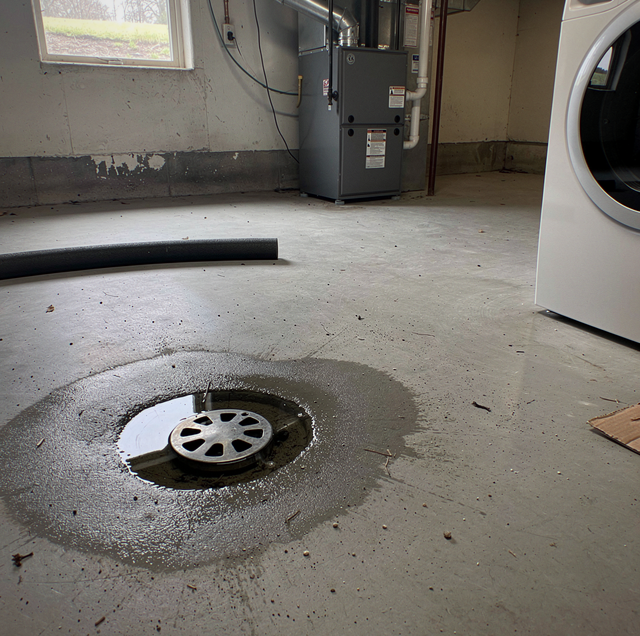
You go down for the laundry basket, and the bottom step is wet. Not damp. Wet, with a dark ring already setting on the concrete a few inches out from the floor drain, and the drain itself holding a slow, turning column of water that is going nowhere. Upstairs, the dishwasher is still running its rinse.
That last detail matters more than the mess does. Water standing in the floor drain, the lowest opening on the lowest floor, puts this restriction below that drain, past the point where the fixtures feeding it have already merged into one line. Nothing sent down from those fixtures has anywhere left to go, so it surfaces at the first opening below the level it reaches. For the next half hour, every fixture still running upstairs adds to what is coming up through that drain.
Each step below exists because of what the one before it did or failed to do, and the two easiest to skip are the two you pay for afterward.
Stop Adding Water Before You Do Anything Else
The dishwasher upstairs is still filling the basement while you stand there looking at the floor. A drain pump does not know the line is blocked; it pushes its tub volume into the same pipe on the same timer it always uses, and a top-load washing machine sends 15 to 20 gallons through that pump in under two minutes, two or three times per cycle. A water softener regenerates on its own clock and rinses dozens of gallons of brine to a drain with nobody awake to notice.
Go to whatever is running and stop it mid-cycle: pause or cancel the washer, open the dishwasher door, put the softener into bypass if you know where its valve is. Then say it out loud to everyone in the house, because the person upstairs about to start a shower has no idea any of this is happening, and one eight-minute shower undoes everything you do downstairs.
If the main shutoff is somewhere dry and easy to reach, closing it removes the possibility entirely. It stops the house producing more wastewater, though it does not move what is already standing in the line and it clears nothing. It also means no toilets and no taps until the line is open, so make that call deliberately.
Decide Whether the Space Is Safe to Enter at All
Standing water is a single flat plane at a single elevation, and everything at or below it is now part of it: a receptacle low on the wall, the sheet-metal base of the washer, the burner compartment of the water heater, the blower and control board at the bottom of the furnace. Household wastewater carries dissolved salts and organic solids, which makes it a ready conductor, and a fault that energizes an appliance cabinet turns that whole plane into the path between the cabinet and your feet.
There is no partial version of staying out. Not for a look, not to grab one box, not for ten seconds on tiptoe. Current gives no warning, and the water conducts the same in a moment as in a minute.
Standing water touching a receptacle, an appliance cabinet, or the furnace makes the entire floor a single conductive plane. Open the main breaker before anyone steps in, and only if the panel is dry and reachable without crossing the water.
Killing power to the affected circuits is reasonable when the panel is dry, well away from the water, and reachable from a dry floor. Once it sits in or near the water, or reaching it means stepping into the water first, the job belongs to the utility or a licensed electrician: the service conductors land on that panel ahead of the main breaker and stay live whatever position the main is in. A drain technician will not enter that room either.
Gas equipment gets its own rule. A water heater or furnace whose burner compartment, gas valve, or control board took water does not get relit and does not get reset. Manufacturers' instructions for a gas control that has been under water is to replace it.
Contain the Spread Before You Clean Anything
The restoration trade sorts water into three categories, and sewage sits in Category 3, grossly contaminated. If the blockage is out toward the street, what is on your floor came from more than one household. Keep skin and any open cuts out of it, and keep children and pets off the floor and the stairs. Questions about exposure belong to a doctor; nobody working on the pipe can answer them.
Cleaning right now is wasted effort for a mechanical reason: the line is still blocked. The level standing in that floor drain reads the head the blocked pipe is holding, and it returns as fast as you take it away.
What pays off in the first thirty minutes is keeping the water inside one room. A rolled towel or a length of foam pipe insulation across a doorway threshold holds a shallow spread long enough to matter, and closing the door does more than the towel. Keep foot traffic at zero: the fastest route for contamination out of a basement is the sole of a shoe on carpeted stairs. And do not squeegee anything toward the floor drain. That is where it came from.
If a cold-air return sits at floor level in the affected room, shut the furnace off at the thermostat. A return in that room pulls its air into the ductwork and pushes it back out every register in the house.
Protect What Is Not Wet Yet
Water finds its level and stops there. Wicking carries it higher. Corrugated cardboard standing in a quarter-inch of water draws it several inches up the flutes within the hour; drywall paper and gypsum pull it vertically the same way, and particleboard furniture legs swell and delaminate from the bottom up. The damage line ends up well above the waterline, which is why the useful work here is vertical.
Get porous things off the floor and onto something: a workbench, a shelf, concrete blocks, an upturned plastic bin. Paper, photo albums, upholstered furniture, rugs, anything with a fabric or paper face. Restoration practice treats porous materials that have already absorbed Category 3 water as unsalvageable, so the items worth spending minutes on are the ones still dry.
None of this happens if the room failed the previous step. Nothing stored on that floor is worth a shock. When the room is a no-go, the work moves upstairs: get anything porous off the floor of the level above, clear the bottom stair treads, and leave the rest.
Photograph the Room Before Anything Moves
The room will not look like this again. Once a mop, a shop vacuum, or a helpful neighbor touches it, the depth is gone and cannot be rebuilt from memory or from a dry floor.
Shoot wide first, from the doorway, or from the top of the stairs if entering is out. Then the drain or fixture the water is coming through. Then each affected item where it sits. Then the water line itself against something fixed: a wall, the base of the water heater, the bottom stair riser. A short video with narration beats stills: you can say the time, name what's running, say whether it's been raining, and list which fixtures are affected.
Everyone who asks about this later asks the same two things: how deep, and how long. An insurer asks. The utility asks whether a shared main is involved. Neither is answerable from a floor somebody already cleaned. Who owns which section of pipe, and what has to be reported, vary by municipality and by where the blockage sits relative to the property line, so ask the local water or sewer utility.
The Five Details That Change What the Plumber Brings
Five things about the backup change what comes off the truck, and the first is when it happened. A basement that filled overnight with every fixture idle had nothing inside the house pushing water at the time, which puts the restriction somewhere past the foundation. One that surfaces the moment the washer drains puts it in the pipe between that fixture and the street. The two get opened from different access points, so the answer decides where the technician starts.
Which fixtures went under narrows the same question again. The basement group alone puts the restriction below the last connection into the main. An upstairs toilet backing into a first-floor tub puts it on a branch above that, and a branch gets rodded from the fixture it serves, never from a cleanout in the yard.
Whether there is a cleanout, and where, decides how anyone reaches either one. A capped fitting outside near the foundation, or one inside at the base of a stack, gives a cable or a jetter hose a straight run at the blockage. Nothing means pulling a toilet to make an opening, which changes the time on site and the gear that has to come through the door.
The pipe material determines what goes at the end of that cable. A root mass in a clay joint takes a cutting head or a jetter nozzle built to shear roots; a cast-iron line coated in cooled grease takes something that scours the wall. Which of the two it turns out to be is a diagnosis that comes after the water stops, and none of it changes the order of the last thirty minutes.
The fifth detail protects the technician. Caustic or acid drain product sitting in standing water gets splashed the instant a cable or jetter hose goes in, so say what went down and roughly how much. Say too when the line was last cleared: one cleared eight weeks ago and backing up again makes the shape of the pipe the suspect, and a camera answers that faster than a second cable pass.
Frequently Asked Questions
No, because the flush becomes part of what you are trying to read. A single flush puts 1.6 gallons into the line, or 1.28 from a high-efficiency bowl, straight into the standing column you are reading. Watch the lowest opening instead: if the level in the floor drain drops with nobody running anything, the line is passing water again.
Not necessarily. A partial blockage lets a trickle through, so the standing column drains down over a few hours, and the floor drain looks normal again. The real test is volume delivered fast: a bathtub holds 40 to 50 gallons and empties in two or three minutes, the largest single slug a house sends down at once.
Ask where it goes afterward. Every household drain you could empty it into feeds the same blocked line, so it comes straight back. The vacuum is the other problem: the motor exhausts through the filter into the room, and the drum, hose and filter are contaminated equipment once they have handled sewage.
Follow the discharge pipe first. If it leaves through the rim joist to the outside, the sump is not feeding the sewer and running it is fine. If it drops into a pipe that heads down into the floor, it may tie into the sanitary line, and running it pushes more water into the same blockage. A sewage ejector pit serving a basement bathroom is, by definition, on the sanitary side.
Either order works. If houses in the same block are backing up through the same window, the shared main is the suspect, and the utility can check it directly. Otherwise, a camera settles it: the footage counter reads the distance from the access point, and comparing that number to the distance to the property line shows which side of the connection the blockage is on.
Because that mark is a pressure reading. Water climbed the drain system until it found an opening low enough to spill from, so the stain's height above the floor is the head the blocked line was holding at its peak, and every foot of it is about 0.43 psi of back pressure at the blockage. Photograph a tape against the stain before anyone wipes the wall, because a washed wall reads as zero.
A blocked sewer line does not wait for business hours — 24-hour emergency service gets the line cleared, camera-inspected, and the cause identified before the water comes back. Clog Squad serves Holland, Grand Rapids, and Grand Haven. Call (616) 779-7675.
