
Ask five plumbing companies how often a sewer line needs cleaning, and you'll often get the same tidy answer, one number that's supposed to apply equally to a decades-old bungalow with a mature maple over the yard and a newer ranch with no trees anywhere near the property line. That answer is convenient. It's also wrong for most of the houses it gets handed to. A line's real cleaning schedule moves with what the pipe is made of, what grows near it, how the household uses it, and what a camera shows inside it.
The Fixed-Schedule Myth
A single number sounds reassuring because it removes the guesswork, but a sewer line's condition isn't tied to the calendar. Two houses built in the same year on the same street can carry entirely different risks once the differences underground are accounted for. One line runs through pipe that's held up for decades with almost nothing growing near it. Another runs the same distance but sits under root systems that have been probing at it since before either house had an owner. Applying one interval to both treats them as identical problems, even though the only thing they share is that they both need a drain to work.
The interval also assumes every line starts from the same condition, which ignores what the pipe is made of, what's rooted nearby, how much material passes through it in an average week, and whether it has already shown signs of trouble.
Pipe Material Sets a Different Starting Point
The material a line is built from sets a different starting point before any other factor comes into play. A line laid decades ago is more likely to be clay or cast iron, standard through most of the twentieth century, and both age in ways plastic doesn't: clay grows brittle and can develop hairline fractures at its joints, and cast iron's interior roughens and narrows as the metal corrodes and scales over the years. A newer line is more likely to be plastic, with longer sections, fewer joints, and a wall that resists the corrosion clay and cast iron are prone to. That difference alone means an older clay or cast-iron line can be carrying more hidden wear at the same point in its life than a newer plastic line down the street, even if both have been used exactly the same way.
Age and material together: They don't guarantee a problem, but they change how much benefit of the doubt a line has earned.
Chemical drain cleaner poured into an old cast-iron line sits against pipe walls already corroded by age, and a line that then needs clearing leaves the technician working in caustic residue. Leave the clearing to the technician from the start.
Root Exposure Raises the Ceiling
How much a line has to contend with from outside the pipe matters just as much as what the pipe itself is made of. A line running near mature trees faces an exposure that a line with nothing growing nearby never faces, since a root does not need to know the pipe is there before it starts probing every joint within reach. A yard with nothing growing near that run carries one fewer variable than a lot with a mature canopy, though that alone does not guarantee it stays trouble-free forever. A cleaning cuts the roots out of the pipe but leaves the joint they came through, so the growth comes back, and the cleaning comes back with it until that joint is lined or repaired.
Household Usage Changes the Math
What travels through the line day to day is a third variable, and it has nothing to do with the pipe's age or what's planted in the yard. A household running several loads of dishes, laundry, and showers through the same line every day is pushing more material past any existing narrow point than a smaller household would, simply because more water and more solids pass through in the same stretch of time. A kitchen that cooks often, or a laundry room running frequent loads, adds its own steady contribution of hair, lint, soap residue, and food particles into that same shared line. None of that means heavy household use causes a problem on its own (a sound line handles normal use without issue), but at the same time, a heavily used line has simply carried more material past its weak spots than a lightly used one has.
Past Incidents Are the Strongest Signal
Of everything that shapes a cleaning schedule, a line's own history carries the most weight, because it's the one factor that's already proven itself rather than just raising the odds. A line that has never slowed, backed up, or needed emergency attention is telling you something real about its current condition, regardless of its age or what's nearby. A line that's already needed clearing once is telling you something too: whatever put it in that position, whether buildup, root exposure, or a spot where the pipe itself has a problem, is still there unless it was specifically addressed. Treating a line with no history the same as one that already needs attention ignores the clearest available evidence.
What the Camera Shows Inside the Line
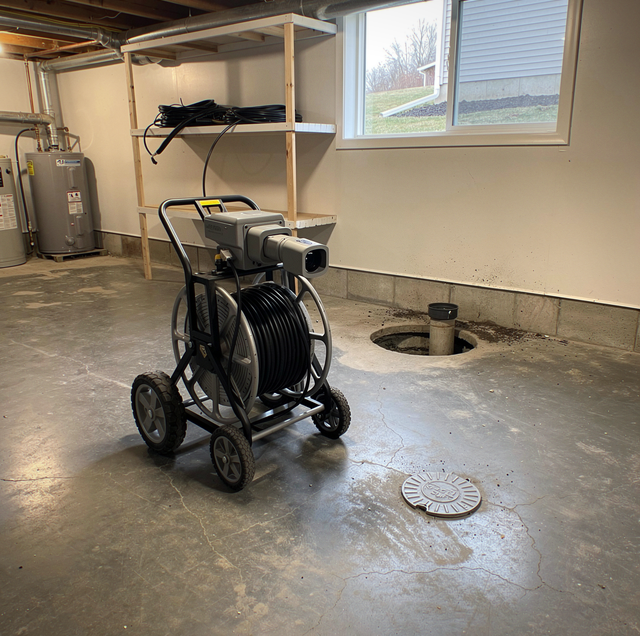
None of these factors on their own tell you exactly when a line needs cleaning again. They tell you how much benefit of the doubt the line has earned. What answers the question is looking inside it. A plumber running a camera through the line can see how much of the interior is still open, whether a coating is forming along the walls, and whether anything from outside the pipe has started working its way in. That direct look replaces every assumption built from age, material, trees, and usage, which is why a schedule built around what a camera shows holds up better than one built around a date circled on a calendar months or years in advance.
Building a Schedule Around Your Own Line
A schedule that fits one line doesn't automatically fit another, even next door.
| Condition | Effect on the Schedule |
|---|---|
| Older clay or cast-iron pipe | Starts with less built-in tolerance for buildup or damage |
| Newer plastic pipe | Starts with a cleaner baseline and fewer failure points |
| Mature trees near the line | Adds an outside pressure that never lets up |
| No trees within reach of the line | Removes that variable, though not every risk |
| Heavy household or kitchen use | Pushes more material past any existing narrow point |
| History of slow drains or backups | The strongest signal that attention is already due |
A newer plastic line with no trees nearby and a clean history can go a long stretch of ordinary use before it needs a look at all. An older clay or cast-iron line under a mature yard, serving a busy kitchen and already carrying a history of slow drains, is a different case; if roots are behind that history, clearing them again only restarts the cycle until the entry point is repaired.
Frequently Asked Questions
Yes. Buildup gradually narrows a line along the bottom of the pipe, where solids settle, so a line can be building a real coating long before flow slows enough for anyone upstairs to notice.
By where the buildup or root mass sits along the run, not only by how much of it there is. Growth clustered at one or two joint points to an entry point that refills after each cleaning, while an even coating from end-to-end points to what the household sends down the drain, and those two lines come due on different clocks.
It can, for a narrower reason than age. Where a plastic replacement ties into an older clay or cast-iron section at the city tap or the foundation, that transition fitting is a joint like any other, and it can pick up wear or catch debris at a different rate than the smooth plastic run on either side of it.
It can add a second thing to maintain. Fixtures below the main line drain into an ejector basin that pumps up to it, and that basin collects solids and grease between cycles, so it needs its own attention apart from the gravity line.
Yes. Bar soap is made from fats, and it reacts with the minerals dissolved in tap water to form a waxy scum that clings to the pipe wall, much as grease does, so a household that showers and does heavy laundry can build up a coating without cooking grease at all.
Buildup left long enough can harden into ridges too fused to strip with water pressure alone, which moves the fix from a routine cleaning to pipe milling or replacing the affected section outright, a bigger job than the one a timely cleaning would have been.
Scope the line first, then set the cleaning schedule — the footage shows the pipe material, any roots at the joints, and how much of the pipe is still open. Clog Squad serves Holland, Grand Rapids, and Grand Haven. Call (616) 779-7675.