
The first clue is the floor drain by the water heater — a faint halo of rust-stained concrete circling the cover, dry today but darker than it was last summer. The second is the sound the upstairs toilet now makes on the way down. A watery hesitation, half a second long, somewhere under the laundry room floor.
Cast iron doesn't usually fail the way you'd expect it to. There's no dramatic rupture along the outside of the pipe, no obvious crack at a joint, no leak you can point a finger at. The metal stays solid on the outside long after the inside has eaten itself thin. The signs are quiet, scattered across the basement and the fixtures, and easy to write off one at a time. Read together, they say the wall is closer to gone than the pipe looks.
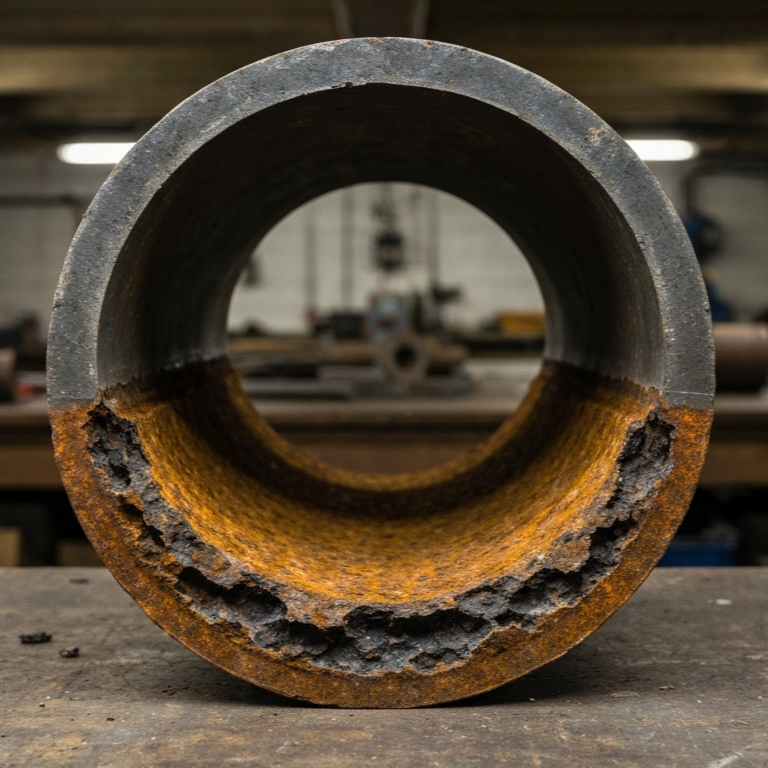
How cast iron fails from the inside out
Cast iron drain pipe is strong stuff. Installed in American homes from roughly 1900 through the late 1970s, it's heat-tolerant, quiet, and outlasts most other plumbing material on the planet. The catch is that it rusts. Water sitting in any iron container rusts it, and the inside of a drain pipe sees water — warm, oxygenated, full of food acids, soap, detergent, and biological activity — every day of its working life.
Corrosion runs from the inside out, not the other way around. Oxygen and moisture meet the inner wall, iron oxide forms a few molecules deep, and the next layer of corrosion sets up faster than the first. Bacteria add a second pathway — they break organic matter into hydrogen sulfide, which combines with moisture above the flow line to form weak sulfuric acid that etches the upper bore. Decade by decade, the pipe loses wall thickness from the inside while looking unchanged from the outside.
There is a second factor that decides where the failure shows up first. Horizontal drain pipe carries water along the bottom of the bore. The top of the pipe stays in the air, the bottom stays in flow. The bottom half corrodes years — sometimes a decade or two — before the top, until the bottom of the pipe is paper-thin and the top still measures full wall thickness. That's why the failure pattern is consistent: bottom out, top intact, exterior unmarked.
Rust stains around the cleanout or floor drain
Bare concrete picks up iron stains the way a paper towel picks up coffee. A halo of rust around the cap of a floor drain or a cleanout that wasn't there a year ago means iron-bearing water has been migrating to the surface — and the cleanest source of iron-rich water in a basement is the inside of a corroding cast iron pipe.
The stain doesn't have to be wet today. A dry orange-brown ring is what's left after water surfaced, sat, evaporated, and deposited the iron oxide it was carrying. The ring grows over months as more water surfaces and dries. A clean basement floor that develops faint rust halos in the same spots every year is reporting an active interior corrosion source nearby.
Sometimes, the stain shows up at a stack base — the vertical pipe meeting a horizontal run inside a wall — and the discoloration appears on the drywall an inch or two above the slab. Same cause, different location.
Black or rust-orange flakes at the floor drain
A more direct symptom is the line shedding pieces of itself. Lifting the cover on a basement floor drain and seeing flakes the size of fingernail clippings — rust-orange on one side, dull black on the other, brittle enough to crumble between two fingers — means the inner pipe wall is sloughing material into the flow.
The flakes aren't sediment. They're the corroded skin of the pipe itself. Iron oxide layers up on the wall, the underlying metal continues to corrode, and the layered crust eventually loses its grip and breaks off in pieces. Heavy use moves the flakes downstream until they catch at the next change of direction or at the floor drain trap, where they pile up where you can find them.
A handful of flakes in a year is one report. A small drift of flakes in a basket strainer six weeks after the last clean-out is a louder one. By the time the flakes are showing up consistently, the wall the flakes came off is measurably thinner than it started.
Toilet paper catching where it shouldn't and a recurring snaking calendar
Smooth cast iron lets a flush carry paper past every elbow in the system. Roughened cast iron snags it. The interior surface of a corroded line looks like coarse sandpaper under a camera lens — pitted, irregular, with shelves of scale standing proud of the wall. Paper and lint hook on those shelves and start collecting on every pass.
That's why a household with a 60-year-old cast iron stack often finds itself on a snaking calendar — every five or six weeks for the kitchen line, every couple of months for the main, paper visible in the cleanout after a flush, the same elbow backing up over and over. The cable opens a working channel, the line runs for a window, the roughened wall starts catching solids again.
A recurring snaking pattern on the same fixture isn't a sign that the snake operator missed something. It's a sign the pipe wall is no longer a smooth channel. A snake against that texture is the wrong tool. Pipe milling — a carbide cutter that grinds the corroded layer back to the metal underneath — is the cleaning that ends the cycle if the wall behind the scale is still sound enough to hold.
Sewer smell that intensifies after heavy water use
A horizontal cast iron drain with a pinhole on the bottom doesn't always leak visibly. The hole sits below grade, soil packs around it, and water finds the soil and disappears. What rises is the gas above the water.
A faint sewer smell that gets stronger an hour after the dishwasher or laundry runs is reporting that wastewater is escaping the pipe somewhere underneath — and bringing sewer gas up through the surrounding soil into the basement air. The smell isn't sharp like a fresh backup. It's earthy, slightly sweet, almost like compost, and it fades when the line hasn't been used for a while.
A smell with no visible leak is harder to chase than a wet patch. But the pattern — strongest after high-flow events, weaker on quiet days, settled in the lowest part of the basement — points underneath the slab. A push-camera survey through the cleanout is what finds the hole.
What a camera shows when cast iron is failing inside
The diagnostic step that converts scattered symptoms into a specific report is a push-camera run through the line. Three to ten minutes of footage from a 60-year-old cast iron lateral shows several signatures at once.
Channeling is the most common — a dark groove running along the bottom half of the bore where the wall is markedly thinner than the top. Pitting shows as a field of small craters scattered across the corroded zone. Scale shows as crusty, irregular ridges sitting on top of the corroded surface. Pinholes show as a sudden bright spot where light leaks through from outside, or an active drip glistening on the bottom of the pipe at the lens. Bottom-out — the full failure mode — shows as a stretch where the bottom of the pipe simply isn't there. The camera frames soil instead of metal, and water from the line is running on dirt.
Each one of those is a different stage on the same arc. Channeling is early. Pitting is mid-life. Pinholes are late. Bottom-out is over. A line with channeling and a few pits has years of service left if the wall is treated. A line with multiple pinholes is months from one of them widening into a real leak. A line with a bottom-out section is past cleaning and into repair.
What the floor and the fixtures tell you in the late stage
When the bottom of a horizontal drain has rusted through across more than a few feet, the structural support for the soil above the pipe changes. Settled spots can appear in basement slabs over the line — a section of concrete that's a quarter inch lower than its neighbors, sometimes with a hairline crack tracking the pipe path. The same thing can show as a soft patch of yard above a buried lateral, a depression that holds water after rain, or a stripe of grass that stays noticeably greener than the lawn around it because the leaking line is feeding it.
Inside the house, the late signs show up at the fixtures connected to the failing line. Toilets that go from flushing normally to occasionally rocking on the flange — the wax ring loses its seal because the closet bend underneath has started to drop. Floor drains that hold standing water that wasn't there before. A laundry tub that takes a beat longer to clear. Sewer roaches turning up near a basement drain stack that never had them — pests follow the gap a cracked pipe opens into the soil, and a sudden pest issue at a fixture is sometimes the most direct evidence the pipe is no longer sealed.
Late-stage signs don't usually arrive in isolation. By the time the slab is reporting movement, the camera is going to find more than one defect on the line.
Pipe age plus household plus water type — when to start looking
A house plumbed in cast iron between 1940 and 1975 — the bulk of the cast iron drain inventory under West Michigan basements — is in the age range where interior corrosion is far enough along to matter. Two houses on the same street, both with 1955 cast iron, can score very differently on a camera. The variables that make the difference are knowable.
Heavy cooking loads the kitchen branch with cooled fat that holds acidic residue against the wall. A five-person household drains more water through every line than a one-person household, and the rate of attack runs with volume. Soft municipal water is slightly more aggressive on iron than hard water — fewer dissolved minerals lay down a protective scale layer. A house on well water with high iron content is a different chemistry again.
For most homes in the 1940-to-1975 cohort, a baseline camera survey at the 60-year mark, repeated every five years afterward, is the cadence that catches interior failure while the line still has options. After 75 years, the survey moves to every two or three years, because the rate of change tightens.
Frequently Asked Questions
Why does cast iron rust from the inside before the outside?
+Inside is where the water is. The exterior of a cast iron pipe sits in dry soil, dry concrete, or open basement air — all benign environments that take decades to mark the metal. The interior sees warm, oxygenated wastewater every day, plus the soaps, acids, and biological activity that come with it. Corrosion needs water and oxygen, and the inside of the pipe has both in constant supply.
Are pinhole leaks always a sign the whole line needs to be replaced?
+Not always. A line with one or two pinholes in an otherwise sound run can be spot-repaired or lined through the affected stretch. A line where the camera shows multiple pinholes across long sections, or active bottom-out, is past the point where spot work makes sense — the rest of the wall is close behind, and replacing or lining the full run is the better long-term call.
Could rust flakes at the drain be coming from something other than the pipe?
+In a few cases, yes. An old galvanized water heater dumping sediment into the drain pan, a corroded floor-drain ring, or sediment from a softener regen line can produce rust-colored debris, too. The way to separate them is the source. Flakes appearing without any of those upstream sources, settling at the same fixtures over and over, almost always trace back to the interior pipe wall.
How fast does interior corrosion progress once it starts?
+The early decades are quiet. The first ten or twenty years of a cast iron line show minor surface oxidation that doesn't change diameter or strength. After year forty, the rate picks up as the rougher surface holds more material against the wall. The last few years before pinhole failure can change the wall faster than the previous twenty combined. That's why a clean camera at year 50 doesn't promise much at year 60.
Will a water softener slow down cast iron corrosion?
+It changes the chemistry but doesn't stop the process. Softened water carries fewer dissolved minerals, which means less protective scale lays down on the inside of the line — but also fewer dissolved minerals to drive certain kinds of corrosion. The net effect on cast iron drain wall is small either way. A softener helps water-heater life and fixture life much more than it helps drain pipe life.
What does a failing cast iron drain sound like under the floor?
+Two patterns show up. A watery hesitation half a beat after a toilet flushes — water hitting bare soil instead of pipe wall — points at bottom-out. A muted hissing or gurgling after high-flow events points at wastewater finding its way out through a pinhole and settling in the soil. Both are subtle, and both are easier to hear in a quiet house at night than during the day.
Catching cast iron before the bottom drops out
A cast iron drain that's failing from the inside doesn't ring an alarm. It writes its symptoms across the basement in small handwriting — a halo around a floor drain, a few flakes in the trap, paper hooking at the same elbow every month, a faint smell that rises after the dishwasher runs. Any one of them is something you can talk yourself past. Three of them on the same line are a single message: the wall is no longer doing what it was installed to do.
The line still has options at that stage. Milling restores the diameter on a wall that's thin from scale but sound underneath. Trenchless lining rebuilds the structural surface from the inside on a wall that's lost too much thickness for milling alone. Spot replacement closes off a localized bottom-out section. What forecloses those options is waiting until the bottom is gone across long stretches, the slab is settling, and the conversation moves from cleaning to excavation. A push-camera survey before any of that happens converts the scattered handwriting into a specific picture — and the picture is what tells you which fix the line still qualifies for.