
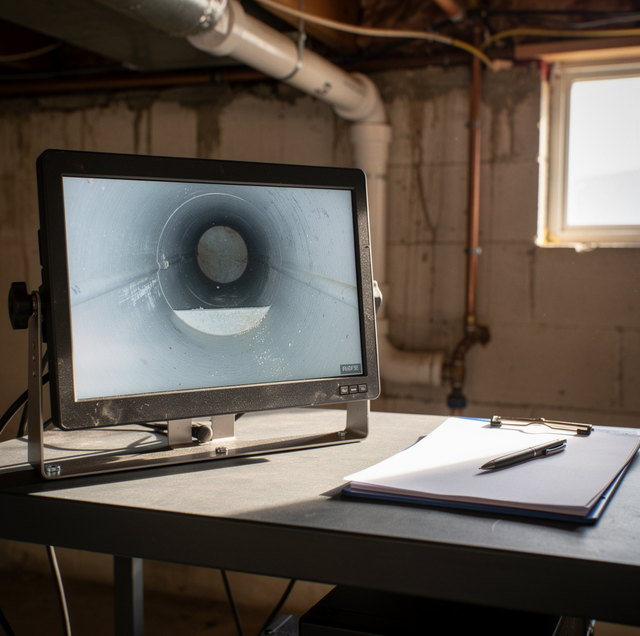
An offset joint is a spot in the sewer line where two pipe sections have become misaligned, leaving a step or lip inside the pipe instead of a smooth, continuous run. A camera report can flag an offset along any jointed run, and the note on the page does not always say how much it matters. A hairline lip and a joint pulled apart into a visible gap both get written up under the same word, offset, even though one calls for nothing more than a routine cleaning and the other calls for repair. Even a small lip is enough to catch paper and grease as they pass, and once a joint has opened rather than just stepped, the same gap that lets water vapor escape into the soil also lets soil and roots find their way back in.
An offset on the footage falls somewhere between a small lip and a separated joint, and where it falls changes the next step:
| What the Report Shows | What It Means for the Line | Next Step |
|---|---|---|
| A small lip the camera passes over without slowing | A little more surface for debris to catch than a flush joint | Monitor it and keep the line on a routine cleaning schedule |
| A step the camera head has to work around or catches on | A fixed catch point that narrows the opening at that exact spot | Jet the line and camera it again to see how fast buildup returns there |
| An open joint with roots or soil showing, the pipe on both sides still round and in line | The gap is letting more than water through | A liner that bridges and seals the joint |
| An offset paired with a belly or a crack alongside it | The pipe has lost more than its alignment | A structural repair beyond what a liner is built to bridge |
How a Joint Shifts Out of Line
A pipe joint does not shift on its own; something around it moves, taking the joint with it. Settling soil is one driver: the bedding a pipe was laid in compacts unevenly over years, and where one section settles more than its neighbor, the joint between them opens or steps instead of staying flush. Ground movement adds to that from outside the trench, soil that shifts as it dries and re-wets, an excavation dug nearby for another job, or new weight added above the line, such as a driveway or a structure built after the pipe went in. The joint material itself sets a ceiling on how much movement it can absorb before it shows. Clay and cast-iron pipe from an older run was joined with mortar or an oakum-and-lead seal, and both shrink and crack with age rather than flex, so once the bedding beneath a joint like that settles, the joint has little room left to give. A rubber-gasketed joint in newer pipe tolerates more movement before it opens, but the gasket still depends on the pipe on either side staying supported, and if the bedding under it settles the same way, that joint can step out of line too.
How an Offset Starts Clogs at the Same Spot
An offset's lip does not care what else is happening in the rest of the line. Paper, wipes, and grease moving through the pipe can catch on the edge each time they pass it, whether the rest of the run is clean or already coated in buildup elsewhere. That is different from ordinary buildup, which narrows a pipe gradually and fairly evenly along its length. A joint that has stepped out of line creates one fixed catch point, and material collects there first no matter how far it traveled to get there. A drain that clogs in the identical spot every time, even right after a thorough cleaning, can have a structural reason like this behind it; a root entry or a belly at that spot can do the same, rather than the clog being a fluke of whatever happened to go down the pipe that week. Once a joint has opened into a real gap rather than just a step, the same opening that lets soil in also gives a nearby root a path to the moisture escaping through it.
Cleaning Past an Offset Without Catching the Lip
A joint that is stepped rather than smooth changes how a technician runs a cable or a jetting hose through it. Instead of feeding the head through at a steady pace, the approach to a known offset can slow down right at the joint, easing the head across the lip in short pushes rather than forcing it straight through. A cable head driven hard into a stepped edge can hang up on the lip instead of riding over it, and freeing it after a snag takes longer than passing it through carefully in the first place. A jetting nozzle can hang on a raised lip the same way, so the pass through a marked offset can be slowed and eased across the joint rather than run as one continuous pull.
Reaching into a cleanout or a backed-up line exposes a person to raw sewage, and a cable head forced into a stepped joint by hand can jam against the lip. A technician handles both, not a resident.
If sewage is already backing up into the house, running more water into the line only adds to what is coming back up, and getting a technician out is the next move rather than more troubleshooting at the fixture.
When a Liner Can Reinforce the Joint and When the Step Is Too Large
A liner goes in soft and gets pressed tight against the host pipe's own wall before the resin cures, so it needs a continuous surface to take its shape from. A joint that has shifted a little still gives it that: the liner presses across the step, bonds along both sides of it, and cures as one continuous tube with the offset sealed rather than open. Because the liner conforms to the pipe it cures against, the step that was there remains underneath, just sealed rather than exposed, so the finished bore can carry a slight ridge at that point rather than coming out perfectly smooth. A joint that has shifted sharply, or one that has pulled apart into a wide gap, does not offer that continuous surface, so the liner has nothing to press against across the break and can wrinkle or fail to bond right at the joint instead of sealing it. That is the line where a liner stops being the fit and a structural repair, addressing the joint itself rather than lining over it, becomes the step that follows.
What to Keep from the Report for Later Decisions
A report that only logs an offset without pairing it to a decision is easy to lose track of later. The footage itself is worth keeping, because the joint's logged position is what lets a later scope find it again.
The distance counter reading at an offset is measured from wherever the camera entered the line, so a reading taken from one cleanout will not match a reading taken from a different access point on the same run.
Noting which side of the property the joint sits on and roughly how many other joints the run has rounds out a report worth keeping rather than one that gets skimmed once and filed away.
Frequently Asked Questions
Not necessarily. A stretch of line that carries only clear water, such as a floor drain segment with no kitchen or laundry line feeding into it, has less material passing over the lip to catch, so a minor offset there can sit for a long stretch without narrowing the flow enough to matter.
Yes. A line can carry several, and each one can be logged separately on the footage rather than treating the whole run as a single pass-or-fail, because a joint near the house and a joint near the property line can be aging at different rates in different soil and can call for different next steps.
It can, though not by material alone. An older clay run that was extended or repaired with plastic pipe treats the transition between the two materials as a joint of its own, and that transition joint can shift out of line just like any other joint.
The way it gets found is. A branch line carries one or two fixtures over a shorter run, so a stepped joint there can show up as a slow drain at just that sink or tub, while the same defect in the shared main line can show only once several fixtures back up together.
Yes. A bend fitting, or a wye where a branch enters the main, changes the pipe's direction and can appear as a shift on the footage, so a change in direction can be checked against the fitting at that point before it is logged as a fault.
It affects how the repair gets reached. An offset within a few feet of an existing cleanout gives a crew access that is already there, while one in the middle of a long run between cleanouts may require opening an access point before a liner can go in.
Commission a sewer camera inspection of the main line — the footage records each joint's location and condition along the run. Clog Squad serves Holland, Grand Rapids, and Grand Haven. Call (616) 779-7675.