
Snake vs Hydro Jet: What Each Tool Can Actually Remove
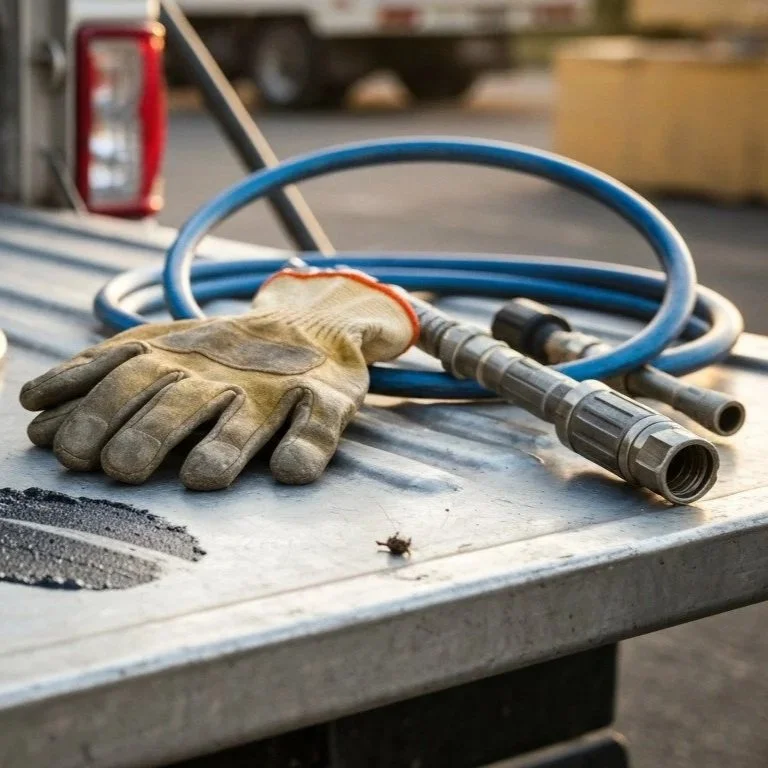
On the tailgate of a plumbing truck after a service call, there's usually a small pile of evidence. A wad of paper towels matted with hair. Sometimes, a chunk of root the size of a fist. Sometimes, a long brown ribbon of grease scraped off the pipe wall. The pile tells you which tool ran the job — because a cable snake and a hydro jetter pull two very different kinds of material out of the same drain.
Two big pieces of gear ride in most drain trucks. A cable machine, with a steel snake coiled inside a drum. And a jetter, with a high-pressure hose on a reel and a handful of nozzles. They look like they do the same job. They don't.
What follows is the part-by-part rundown — which tool removes which material, what it tunnels past or leaves behind, and which clogs need both in sequence.
How each tool works (it changes everything that follows)
A cable snake is a mechanical tool. The drum spins a length of steel — 3/8 inch to 5/8 inch in residential work, larger on commercial jobs — that pushes down the pipe under torque. The tip might be a cutting head, a spring-loaded auger, or a chain-flail attachment that whirls outward when it spins. The cable goes until it hits the obstruction, the operator lets the head bite, and works it through. Whatever was blocking the line gets chewed, shredded, or shoved past the end of the cable's reach.
A hydro jetter is a hydraulic tool. A small engine drives a pump that sends water through a hose at 1,500 to 4,000 psi for residential work, sometimes higher for commercial lines. At the business end of the hose is a nozzle with two sets of jets — rear-facing ones that pull the hose forward through the pipe and scour the wall as they move, and a forward-facing one that breaks up debris ahead of the nozzle. The water doesn't tunnel through anything. It strips the inside of the pipe back to bare interior and flushes whatever was attached to the wall downstream to the city sewer. The pressurized water that drives hydro jetting is the difference between making a path through a coating and removing the coating entirely.
The two tools approach a clog from opposite directions. The cable goes through the middle of whatever is blocking the line. The water comes against the wall that the blockage is sitting on. That difference decides what each tool leaves in the pipe when the job is done.
What a cable snake actually removes
A snake earns its keep on discrete obstructions — anything sitting in the line as a distinct object that can be punched, chewed, or pushed past.
A paper plug. Toilet paper bunches up in low-slope sections of older lines, and a cable head breaks it apart in seconds.
A hair mat in a bathroom branch line. An auger tip catches the mat, twists it onto the head, and pulls it back up the line — debris comes out at the cleanout with the tool instead of being pushed past it.
A foreign object. A kid's toy, a toothbrush, a wad of dental floss bound around a peach pit. A cable head can catch and retrieve, break apart, or push it through to a section of pipe where water can move it.
A soft food clump in a kitchen drain. A pasta-and-grease ball that hasn't fully hardened, a clump of coffee grounds — the cable breaks it up, and water moves the pieces along.
Light root infiltration. A cable with a chain-flail or root-cutter head can shear off fine root hairs that have grown through a joint. The roots come back, but the line opens.
In every one of those cases, there is a clear point of restriction that the cable can find, break, and pass. The line opens because the obstruction is gone.
What a snake doesn't remove — and why
The shorter list, but the more important one. Anything stuck to the pipe wall instead of plugging the line, a cable will not strip.
Grease coating a kitchen line. A snake spinning down a four-inch line punches a channel through the grease ring on the inside. The tunnel restores flow for one to four weeks. The grease layer behind it is still there. Fresh food residue catches on the same wall. The drain slows again.
Soap film and biofilm in bathroom lines. A thin slick that lines a 1.5-inch shower line drops the diameter by a third or more. The cable scrapes the center but cannot strip the wall.
Mineral scale inside cast iron pipe. After fifty to eighty years, older cast iron lines build hard knobs of rust scale on the wall — tuberculation, the same chemistry that lines the inside of a teakettle that's never been descaled. A cable spins past those knobs. They stay.
Settled sludge in low spots. Sand, fine sediment, and decomposed organic material settle into the bottom of a low-slope section or a developed dip in the line. A cable passes through that material without lifting it out.
In all four cases, the same pattern shows up — the line gets snaked, runs clear for a few weeks, then slows again. The cable cleared a path but didn't clean the pipe.
What a hydro jetter actually removes
A jetter's job is to clean the inside of the wall. Anything that is coating, lining, or settled on the pipe — and most things mechanically obstructing the line — can be stripped or flushed by water at the right pressure.
Grease. The whole point of running a jetter on a kitchen line. High-pressure water scours the hardened-fat ring off the pipe wall, the rear jets pull the hose forward as it cleans, and the line comes back to its original interior. Residential kitchen lines cleaned wall to wall; this way, they typically stay clear one to three years instead of weeks.
Soap film, biofilm, and the slick organic layer that coats bathroom branch lines and main sewer lines. Water cuts through the film and flushes the residue out. Recurring shower smell and sluggish bathroom drains often clear at the same time the visible film does.
Soft sludge and settled debris in main lines. The volume of water at high pressure picks up sediment along the floor of the pipe and carries it the full distance to the city main. A cable can't move that material. A jetter moves all of it.
Small and medium roots. Fine root hairs and pencil-thick roots that have come through a joint get cut and flushed by a jetter. The line opens. Larger root masses — woody, several inches across — need a Flex-Shaft cutter first, then jetting to clean up after.
Paper, food residue, and most discrete clogs in the line. A flush-style nozzle handles standalone debris and clears the path on its own. The line ends up cleaner than a snake leaves it because the jet flushes the debris downstream instead of punching past.
What a jetter can't strip on its own
Hydro jetting is a more thorough cleaning, but it isn't universal.
Mature tuberculation in cast iron. Hard rust knobs growing inward from the pipe wall in old cast iron sections do not come off at residential jetting pressures. Pipe milling — a separate process that uses a rotating chain head to mechanically grind the wall back to bare metal — is the tool for that material. A jetter follows the milling to flush what gets dislodged.
Heavy woody root masses. Roots that have built into a thick, dense bundle inside a joint resist a residential jetter. The forward jet has trouble cutting through the woody core. A Flex-Shaft cutter handles the mass first, then a jetter flushes what's loose.
Solid foreign objects lodged in the line. A jetter can sometimes push a stuck object downstream, and sometimes can't. A camera locates the object first, and a cable with the right head retrieves or repositions it before any jetting begins.
Structural damage. A line with offset joints, a collapsed section, or active rust-through is not a cleaning problem — it's a repair problem. Jetting won't fix the issue, and on a pipe with active deterioration, the high-pressure water can find weak points and make them worse. A camera inspection tells you whether the pipe is sound enough to jet.
Three materials where the tools split
Most slow drains come down to one of a handful of materials. Three of them are where the snake-versus-jetter decision matters most.
Grease. Kitchen drains, restaurant lines, and households that fry a lot. A snake punches; a jetter strips. Grease is the single most common material that gets snaked repeatedly and never resolved, because the cable can't reach the layer.
Roots. Light infiltration gives way to a snake with a root-cutter head. A mature root mass needs a Flex-Shaft cutter to chew it edge to edge, then jetting to flush the debris. A regular cable on a thick root mass leaves more roots in the line than it removes.
Scale and sludge. cast iron tuberculation needs milling first, not jetting alone. Once the line is milled — or in any line where the coating is sludge rather than hard scale — jetting is the only common tool that flushes the material the full length of the pipe. A snake leaves sludge in place.
The cleanest one-line summary: discrete plug, snake. Coating or sediment, jetter. Hard scale or thick roots, mill or Flex-Shaft first, then jetter.
When neither tool finishes the job alone
Several common situations need two tools in sequence, not one.
A root and grease pattern in the main line. The Flex-Shaft cuts the roots edge-to-edge. Jetting follows to scour the grease layer and flush chopped root material out of low spots. Either tool alone leaves the line half-treated.
A scaled cast iron line. Pipe milling grinds the rust scale back to clean metal, then jetting flushes the milled debris through the system. A single pass with either tool gets only part of the way.
A line in poor structural shape. Trenchless lining repairs the pipe wall first — a resin-saturated felt liner cured in place creates a new smooth interior. Without the repair, no amount of snaking or jetting keeps the line clear.
A camera inspection ahead of the work is what tells you whether one tool is enough or whether the job needs two.
How the diagnostic actually picks the tool
The piece most homeowners never see is the camera that should run before the cleaning. A push camera goes down the line from the cleanout, and the picture shows what's in the pipe — a discrete object, a coating, a root mass, a scaled wall, a structural break. The picture decides which tool is right.
Without the camera, the tool gets picked by whatever happens to be on the truck. That's how a kitchen line ends up getting snaked four times in twelve months. The cable was on the truck. The grease coating was never going to come off with it.
With the camera, the question stops being "is this a snake job or a jetter job" and becomes "what's in the pipe, and which tool gets that out." Sometimes the answer is one tool. Sometimes two. Sometimes the cleaning options are off the table entirely because the line needs a repair first.
Frequently Asked Questions
What's the difference between a snake and a cable machine?
+Same family of tool. "Snake" is what most homeowners call the spinning steel cable that goes down a drain. "Cable machine" is the trade term for the powered drum that spins it. A handheld drum snake, a closet auger, and a sectional cable machine are all in the same family — they differ in size, motor, and head options, not in mechanism.
Is hydro jetting worth paying extra for on a small bathroom line?
+Most of the time, no. Bathroom branch lines — sink, tub, shower — are short and narrow, and the typical clogs are hair, soap, and stopper-assembly debris. A flex-shaft or basic cable handles those in minutes. Jetting earns its keep on lines with coatings — kitchen drains, main sewer lines, laundry drains with detergent film — not on single-fixture bathroom clogs.
Should I ask for hydro jetting if a snake already didn't work?
+If the snake cleared the line and the line slowed again within weeks, yes — that pattern is the strongest sign the cable wasn't reaching the actual cause. If the snake didn't clear the line at all, a camera inspection tells you what comes next. Running a jetter into a line with an unknown obstruction is less efficient than diagnosing the cause first.
Does a snake leave debris in the line?
+Often, yes. A cable head shreds and pushes the obstruction past itself. The debris ends up downstream of where it started, in any low spot where settled material collects, which is part of why some lines slow again a few weeks after a snaking. A jetter flushes that material all the way out to the city sewer instead of leaving it inside the line.
When do plumbers use both tools on the same job?
+On root masses combined with grease, on cast iron lines with both scale and sludge, and on commercial lines that have collected multiple kinds of debris. The pattern is mechanical first, hydraulic second — Flex-Shaft or pipe milling to clear and grind what jetting can't strip, then jetting to flush debris and scour the wall.
Is a hydro jetter safe in a fifty-year-old house?
+It depends on the pipe condition, not the age. A cast iron line that's structurally intact handles residential jetting pressures fine. A line that's been corroding for decades — pitted, eaten thin, with active rust-through — needs to be camera-inspected first. If the picture shows the pipe is sound, jetting works. If it shows active deterioration, the line needs repair or lining before any cleaning.
Matching the tool to what's actually in the pipe
There's a real difference between clearing a drain and cleaning a drain. A snake clears. A jetter cleans. The right answer to a slow line is in the picture of what's actually inside the pipe — and the camera that takes that picture is usually the cheapest line item on the bill, not the tool that follows it.
The trap to avoid is paying for the same line to be snaked over and over while the actual material on the wall keeps building. After the second visit on the same drain in the same year, the question worth asking is what shows up on a camera and what tool the camera says is needed. Sometimes that's still a snake. Sometimes a jetter. Sometimes both, in order. The answer comes from the pipe, not the truck.
