
What to Do When the Plunger Won't Clear the Toilet
The plunger is in the bowl. You are on attempt fifteen. Water sloshes up the rim, then settles back to the same waterline it's been at since the last flush. Your arm is tired. The bowl is full. And the standing question is whether the next twenty pushes will do anything the first twenty didn't.
Most of the time, the answer is no. A plunger either clears a toilet in the first few minutes or it doesn't. When it doesn't, the problem is usually further than the plunger can reach — or it's the wrong tool for what's actually in the line
Here is the order to work the next five minutes, what to stop before you make it worse, and the signs that say to put the handle down entirely.
Stop flushing — and stop adding water
Before anything else, leave the flush handle alone.
A clogged toilet is a sealed system holding whatever water it already has. Every additional flush adds another gallon and a half to the bowl. If the trap is fully blocked, that gallon overflows onto the bathroom floor — which is sewage water on tile, drywall, and grout, and a much bigger cleanup than the clog itself. The instinct to flush again "just to see if it goes down" is how a clog becomes a flood.
If the bowl is already close to the rim, lift the tank lid and push down on the flapper at the bottom of the tank. That seals the tank-to-bowl opening and stops any more water from entering. Then shut the supply valve on the wall behind the toilet — quarter-turn to the right on most modern fittings. With the valve shut, the worst the toilet can do is sit at its current level until the clog comes loose.
Use the right plunger and the right technique
If the plunger you're using has a flat rubber cup with no extension, that's a sink plunger. It doesn't seal a toilet drain. A toilet plunger has a soft rubber flange that folds out of the cup and fits into the bowl's outlet, and the shape creates a column of pressure that breaks a clog loose. Flat plungers slip off the porcelain on every push.
Even with the right plunger, the first push matters. Lower the head into the bowl gently, letting the cup fill with water rather than trapping air. Air compresses on a push and absorbs most of the force. Water doesn't, and a water-filled plunger delivers a hard hydraulic pulse through the trap. Twenty firm pushes with the cup sealed and full of water do more than a hundred frantic ones with the cup half full of air.
There should be enough water in the bowl to cover the plunger head completely. If the bowl is too low, the plunger draws air, and the seal breaks each cycle. Add a couple of inches from a bucket — not from the flush handle — before resuming.
If five solid minutes of correct plunging has not moved the water level, the obstruction isn't something the plunger is going to break apart. Time to switch tools.
What the plunger is actually moving (and what it isn't)
A plunger generates hydraulic force inside a sealed chamber. That force travels through the water in the bowl, around the trap inside the toilet, and a short distance into the closet bend below.
The mechanism works on three kinds of clogs. The first is too much paper packed at the bottom of the trap, the most common household toilet clog. The pressure pulse loosens the wad, and the next gravity flush carries it out. The second is a softening of an organic blockage just past the trap — the same pulse pushes it through into the larger 3-inch closet bend. The third is venting an air-locked drain, where a pocket of trapped air is keeping water from siphoning down.
It does not work on a hard object lodged in the trap or the bend — a toothbrush, a child's toy, a plastic cap, a wad of flushable wipes that hasn't broken down. Those clogs need to be pulled back through the trap with a different tool. It also does not work on a clog past the closet bend — a blockage in the main drain line under the floor doesn't transmit pressure back up through the trap, so the bowl sits there no matter how hard you push.
If five minutes of good technique isn't moving the level, you're hitting one of those two cases. The next tool depends on which.
The next tool: a closet auger
A closet auger is the long crochet hook the plunger never had — a short, hand-cranked drain snake built specifically for toilets. A flexible cable runs through a curved metal sleeve covered in vinyl — the vinyl protects the porcelain from the cable scratching the bowl. The handle goes in the top, the curved sleeve guides the tip into the trap, and the cable feeds about three feet of reach past where a plunger can push
The auger reaches everything the plunger can't. A toothbrush sitting in the bend. A wipe that's wrapped around the jet at the bottom of the trap. A wad of paper that didn't loosen under pressure. The cable either pulls the obstruction back up through the tra, or it chews it loose enough for the next flush to take it out.
Closet augers run $20 to $40 at any hardware store. If you have had a stuck toilet more than once, that's the next tool to keep on hand. The technique is straightforward — feed the cable, crank the handle, push gently against the obstruction, then reverse the crank to retract.
What an auger doesn't fix is a clog past the toilet's reach — anything more than about three feet into the line, in the branch drain or the main sewer.
When the clog isn't in the toilet at all
A toilet that won't clear sometimes isn't a toilet problem.
If other fixtures in the house are also acting up — the bathroom sink draining sluggishly, the shower next to it pooling water, the kitchen sink gurgling when the toilet flushes — the obstruction is downstream of the toilet, in the branch drain or main line that carries waste out of the house. A plunger and an auger work on the toilet itself. They do nothing for a blockage thirty feet away.
The most common version of this is a partial main-line clog. Toilet water tries to leave, hits the restriction, and backs up the closest path — usually right back into the bowl, or out a floor drain in a basement. The bowl level stays high because the line itself isn't accepting water. Plunging just pushes water against an immovable obstruction further down the pipe.
A few signs the problem is past the toilet, not in it:
More than one fixture is slow or backing up
A floor drain in a basement is wet, smelling, or has water rising
The toilet drains a little after every flush, then water returns to a high level on its own
A gurgle comes from another drain when the toilet refills
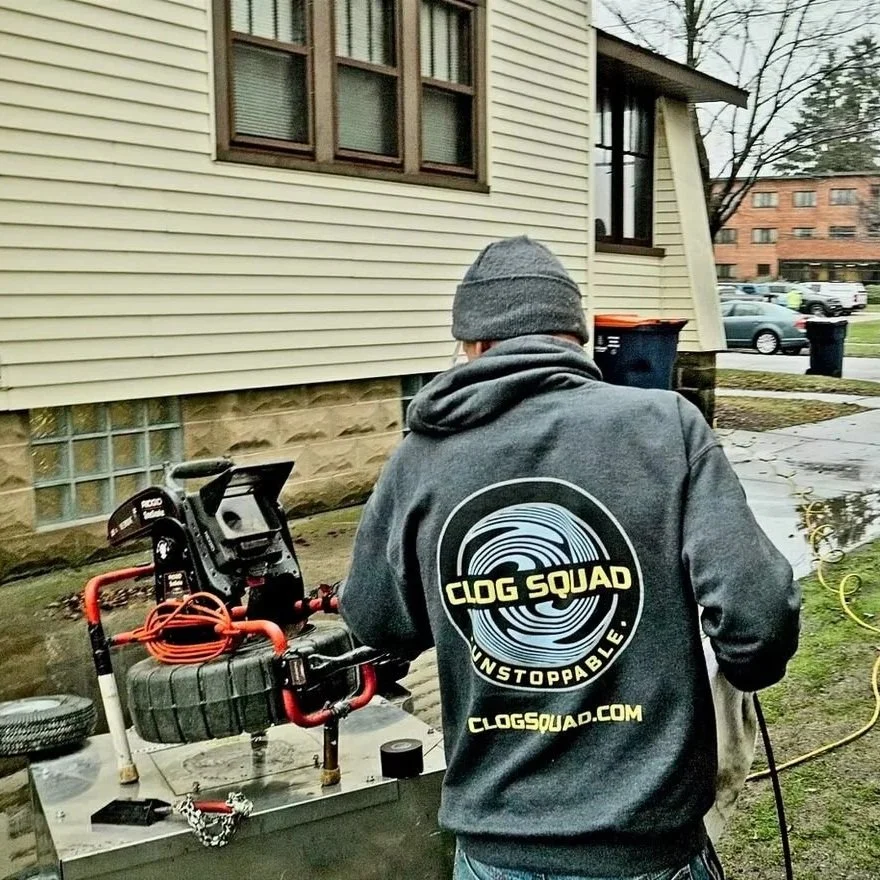
Any of those put the work outside the bathroom. The fix is a camera down the main-line cleanout to see what's actually in the pipe, followed by the cleaning method matched to the picture — a Flex-Shaft for roots at a clay joint, hydro jetting for grease and sludge, pipe milling for cast iron scale.
What to skip — caustic drain cleaners and boiling water
Two things people try on stuck toilets tend to make the situation worse.
The first is liquid drain cleaner. The sulfuric acid and sodium hydroxide products marketed for clogs are formulated for kitchen and bathroom sink lines, and the directions specifically tell you not to use them in a toilet. The reason matters. A toilet trap holds a sealed pool of water. The cleaner sits in that pool against the porcelain glaze and the wax ring under the toilet for hours. It corrodes the glaze, damages the rubber gasket between the tank and bowl, and softens the wax that seals the toilet to the flange. When a plumber finally arrives, the chemical splashes back during augering — which is a hospital trip waiting to happen. Same reason the next homeowner who lifts the lid takes a face full of acid mist.
The second is boiling water. It works on a kitchen drain because the line is 1.5-inch metal or PVC, and the water moves down quickly. A toilet bowl is porcelain, and porcelain has thermal-shock limits. Pouring boiling water into a cool bowl can crack the porcelain at the trap or the seat — a $250 plunger session that turns into a $400 toilet replacement. Hot tap water is fine if you want to try a softening pass; boiling is the line worth not crossing.
A bucket of hot tap water — not boiling — poured in a steady stream into the bowl from waist height, after squirting a quarter cup of liquid dish soap into the standing water and letting it sit for fifteen to thirty minutes, is the household equivalent that doesn't damage anything. The soap lubricates the trap walls. The heat softens any organic mass packed at the bottom. The slow pour avoids splashing or overflow. It works on light paper clogs and on the kind of organic plug a courtesy flush would have prevented. It does nothing for a foreign object lodged past the trap, a wad of so-called flushable wipes that didn't break down, or a main-line restriction further down the line. Follow the soak with another round of correct plunging — the soap is a softener, not a drain cleaning on its own.
Two other tools worth not reaching for: a coat hanger and a kitchen-sink drum snake. A coat hanger isn't long enough to reach past the trap and the wire scratches the porcelain glaze on the way down. A drum snake built for sink and floor drains has an unsleeved metal cable that gouges the inside of the bowl — and the cable isn't curved for a toilet trap, so it tends to bind against the back wall instead of feeding into the closet bend. A closet auger is the only DIY-grade tool actually built for the geometry of a toilet.
How to tell whether to keep working it or call
A short read on which path the situation is actually on:
If a single toilet is the only fixture acting up, the bowl level dropped at least a little during plunging, and ten minutes of correct technique has moved the clog partway — keep going. Another ten minutes of plunging or one pass with a closet auger usually finishes a household paper clog.
If the bowl level hasn't moved in fifteen minutes and then the auger reaches nothing — stop. The clog is past where home tools reach, and more plunging only risks the bowl overflowing.
If a second fixture is also slow or backing up, or a floor drain is wet — stop immediately. A main-line backup that's pushing water back into the lowest fixture is a same-day call. Plunging the toilet at that point can drive sewage out the floor drain in another room.
If a child put something in the toilet and it disappeared down the trap — stop plunging. The object is now either lodged in the trap or in the closet bend. Plunging risks driving it further into the line, where it has to be retrieved through a much larger access cut. A closet auger or a removal by a plumber, with the toilet pulled, is the next step.
Frequently Asked Questions
Why is the water rising in the bowl instead of going down?
+Either the clog is total — every flush adds water with no path out — or the clog is downstream of the toilet in the main line. A camera run on the main cleanout tells you which inside ten minutes. If multiple drains in the house are slow, the rise is downstream of the toilet.
When should I stop plunging and call a plumber?
+After fifteen minutes of correct plunging with the right plunger and a sealed cup, or sooner if a second fixture is also misbehaving. Past that point, you're working a clog that the plunger isn't built to reach.
Will a plunger damage the wax ring or the toilet itself?
+Normal plunging won't. Aggressive, repeated plunging on a toilet that won't move can break the seal between the toilet and the flange — the wax ring sits under the base of the toilet, and hard hydraulic pulses can shift it just enough to leak. If the floor around the toilet base is wet after a long plunging session, the wax ring is suspect.
Can pouring boiling water actually break up a toilet clog?
+Hot water can soften a paper clog. Boiling water can crack the porcelain. The temperature difference between the two is the difference between a working toilet afterward and a toilet replacement. Hot from the tap is the safe ceiling.
How long can a clogged toilet sit before it becomes urgent?
+A single clogged toilet in a house with another working bathroom can sit overnight without consequence. A house with only one toilet, or a toilet that's clogged because of a main-line restriction backing up everywhere, is a same-day call. The first scenario waits. The second escalates while it waits.
What kind of auger should I have at home for next time?
+A 3-foot vinyl-sleeved closet auger, not a cable drum snake. The closet auger is designed for toilets — the curved guide protects the porcelain, and the cable feeds through the trap without scratching the glaze. Drum snakes are for sink and floor drains and don't navigate a toilet trap well.
When pushing harder makes it worse
A plunger that isn't working has stopped being a tool and started being a way to make a small problem into a bigger one. The two failure modes — pushing a foreign object further into the line, and pushing main-line backup water out a different fixture — both get worse with effort, not better.
Fifteen minutes of correct technique is the honest test of whether a plunger is the right tool. If the water hasn't moved by then, the obstruction isn't where the plunger can reach it, and the next tool is either a closet auger or a phone call. The phone call gets shorter, cheaper, and cleaner when it happens at minute sixteen instead of after two hours of standing water on the bathroom floor.
