
Does Hydro Jetting Work on a Main Sewer Line Clog?
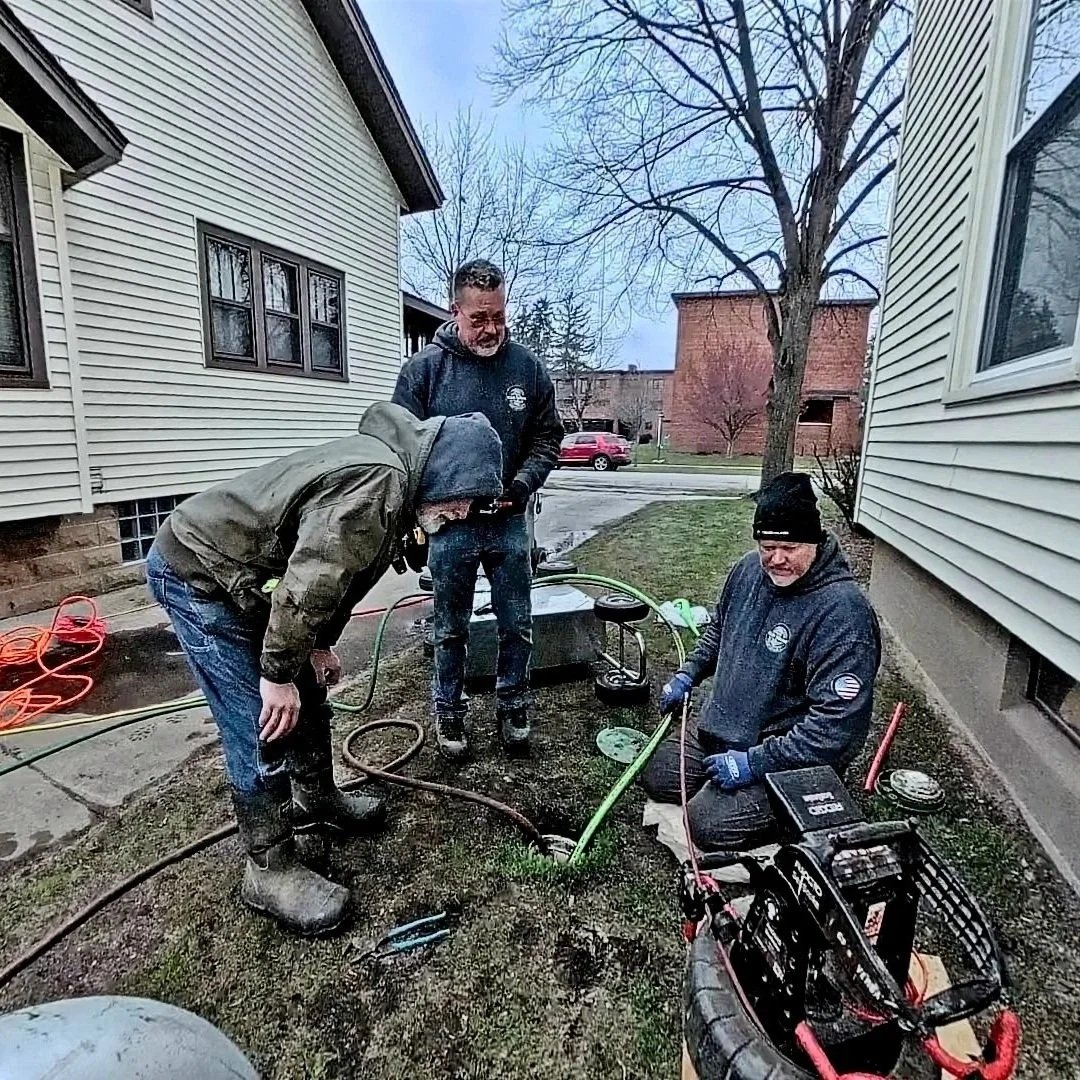
Two snake passes through the main line. Two weeks of clear flow. Then the basement floor drain was wet again on a Friday night. The plumber out on the third call had a different rig in the driveway — a trailer with a hose reel, a small engine, a row of nozzles in a steel box — and a question that sounded simple but wasn't quite. Does high-pressure water actually clear a main-line clog?
Mostly yes. Sometimes no. The difference comes down to what's in the pipe.
A main sewer line collects four kinds of trouble: grease and sludge, root masses, mineral scale, and structural damage. Hydro jetting handles two of those on its own. The other two need a different tool first, or a different fix entirely. Here's how the math breaks down by cause.
The short answer, with conditions
A residential jetter on a 4-inch main uses higher water volume than a branch-line cleaning — typically 8 to 18 gallons per minute at the nozzle, versus 2 to 6 for a kitchen drain — but pressure stays in the same 1,500 to 4,000 psi range. The volume is what does the work on the bigger line. More water flowing through a wider pipe at the same pressure carries more debris and scours a larger surface in a single pass.
The mechanism mirrors a kitchen branch. A nozzle with rear-facing jets pulls the hose forward and scrapes the inside of the pipe. A forward jet breaks up debris ahead. On a 4-inch line, the rear jets fan at a wider angle so the scour reaches the full circumference, and the line comes back to its original interior diameter.
For most main-line clogs caused by what's coating the pipe wall — grease, soap film, biofilm, sludge — jetting is the right tool and the only common one that actually cleans the wall instead of tunneling through what's stuck to it.
What a main-line jetter clears on its own
Three categories of main-line trouble come apart cleanly under high-pressure water.
The first is grease and food-waste sludge. Every fixture upstream contributes some quantity of fat to the main line. The fat enters as a warm liquid, cools against the pipe wall, and hardens into a ring that catches every solid passing after it. A year of normal cooking lays down a quarter inch of grease on the upper half of the pipe. A heavy-use household with daily frying doubles that. A wall-to-wall jetting pulls the layer off in a single pass. The grease comes out as a brown ribbon at the cleanout. The pipe goes back to bare interior.
The second is settled sediment in low spots — sand from the upstream service line, grit washed in from yard drains, decomposed paper, and organic fines. Snaking passes through that material without lifting it. A jetter flushes it because the volume of water picks up the sediment and carries it downstream to the city main. A line that's been losing capacity to settled silt often jumps back to normal flow inside an hour.
The third is biofilm — the slick organic layer that builds along the floor of any sewer line. It's responsible for most of the persistent sewer smell coming up through basement floor drains and laundry standpipes. Bleach does nothing to it. Snaking doesn't touch it. Jetting strips it because the wall of the pipe gets scoured back to the substrate.
In each case, the mechanism is the same. Water at high enough pressure to dislodge what's stuck to the wall, and high enough volume to carry it out. A cable can't do either job because it touches only the center of the pipe.
Clogs jetting clears, but only with a second tool first
Two main-line causes get partway to a fix with jetting alone and reach the rest with a different tool in the same job.
The biggest is the established tree roots. Roots find a hairline crack at a pipe joint — most often a clay-to-clay joint on a pre-1970s sewer line — and push through to the moisture inside. Once a root mass is lignified, the woody core is too dense for residential jetting pressures to cut. Smaller feeder roots flake off. The mass holds. A Flex-Shaft cutter — a flexible drive shaft with a chain head spinning at high RPM — chews the bundle edge-to-edge down to the pipe wall, and jetting follows to flush the chopped material downstream.
That order matters. Jetting alone on a root-driven main usually clears a tunnel through the soft parts and leaves the bundle in place. Two weeks later, the smaller roots have regrown. Flex-Shaft first, then jetting, removes both the mass and the conditions for fast regrowth — and even that buys time without sealing the joint the roots came in through. Trenchless pipe lining is what closes the entry point for good.
The second is a heavy, long-standing sludge load in a line that hasn't been cleaned in a decade or more. The first jetter pass can have trouble against a packed mat of sludge, paper, and root debris. A cable head sometimes runs first to break a pilot channel, and the jetter follows once water has somewhere to flow.
Where jetting won't fix the line
Two categories of main-line trouble aren't really cleaning problems. They're repair problems, and jetting either doesn't help or makes the situation worse.
A collapsed or offset pipe section is the clearest example. When a clay sewer joint shifts, an old cast iron section rusts through at the bottom, or a tree root has cracked the pipe wall enough to drop a length out of alignment, the line has a structural break. Water flows around the break until it doesn't. No amount of cleaning restores a pipe that isn't pipe anymore. A camera shows the issue immediately — a visible step in the floor of the line, a gap of soil where the pipe should be, a fracture pattern at the joint. The fix is repair or trenchless lining. Pushing a jetter against a structurally failed section can wash soil around the break and worsen the failure.
Mature scale buildup inside a cast iron pipe is the other case. Older cast iron sewers — 50 to 80 years old, common in pre-war neighborhoods — corrode from the inside out and form hard knobs of rust scale called tuberculation, the same chemistry that lines the inside of a teakettle that's never been descaled. A 4-inch cast iron line with full tuberculation can have an effective diameter closer to 2.5 inches, and the rough surface catches fresh debris fast. Residential jetting pressures do not strip that scale off the wall. Pipe milling does — a mechanical process with a rotating chain head that grinds the wall back to clean metal. Jetting follows the milling to flush the dislodged material.
A line in either of those conditions sometimes gets jetted anyway because the symptoms look like a coating problem at the surface. The clean lasts a few weeks instead of years. That's not a failure of jetting. It's a sign the cause wasn't a cleaning question in the first place. A camera ahead of the work answers the question before anyone fires up the pump.
Why pressure isn't the whole story
The number printed on jetter brochures — 4,000 psi — is the part most homeowners focus on. It's not the part that determines whether a main-line clog comes apart.
Volume matters as much as pressure on a 4-inch line. A jetter pushing 4,000 psi at 4 GPM is the right tool for a kitchen drain and the wrong tool for a sewer main. The pressure exists, but the water volume isn't enough to carry debris through a 4-inch pipe. A jetter rated 3,000 psi at 12 GPM does much more work on a main even at the lower pressure, because the volume scours wider and flushes faster.
Nozzle choice is the second variable. A penetrator tip opens packed clogs but doesn't scour the wall. A spinning nozzle adds rotational coverage and is the right tool for grease. A chain-flail or root-cutting head adds mechanical action for root masses. Running one generic flush nozzle on every job leaves coatings on the wall that a different nozzle would have stripped.
A residential main can also run 80 to 150 feet from a cleanout to the city tap, and the hose needs both the reach and the rear-jet thrust to pull that far. Smaller portable jetters built for branch lines can't always finish a main. The trailer-mounted units that handle 4-inch sewers are a different scale of equipment than what fits in the back of a van.
What a main-line jetting actually looks like
A camera goes down the line first from the main-line cleanout, usually somewhere along the foundation or in the yard. The picture either shows a discrete cause — a root mass at a joint, a heavy grease ring, a packed sludge bed — or a structural issue that takes cleaning off the table. The contractor and homeowner look at the screen together and agree on the work.
If the line is sound and the cause is one a jetter handles, the hose feeds in through the cleanout. The jetter gets pulled by the rear jets toward the city tap, with the operator controlling speed and pressure from the trailer. The hose works the length of the main and back, sometimes in two or three passes for a heavy load.
After the work, the camera goes back in. The second pass either shows a clean line — gray or black pipe wall, no coating, no remaining material — or it shows what wasn't going to come out with cleaning alone, which becomes the next conversation. A typical residential main-line jetting runs an hour to two and a half hours of pump time. No excavation, no fixture disassembly, no household downtime beyond shutting off water use during the job itself.
How often a jetted main line need maintenance
A main that's been cleaned wall-to-wall doesn't need annual jetting for most households. Cost-wise, residential main-line jetting in most US markets runs roughly $400 to $900, depending on length, access, and what the camera shows. The cheapest schedule almost always involves cleaning when the camera says so, not on a fixed calendar.
For a sewer in normal use, with no tree roots and a sound pipe, a re-camera at year three and a fresh jetting only if the picture warrants it is the lower-cost schedule. Most lines run four to six years between cleanings. For a sewer with mature trees nearby and a clay tap to the city, an annual Flex-Shaft pass with a follow-up flush keeps the line ahead of root growth. For a home with a heavy grease load — daily frying, restaurant-style cooking — a re-jetting every two to three years, paired with the kitchen branch line as needed, is reasonable.
Frequently Asked Questions
How can I tell if my main line clog needs jetting or a Flex-Shaft cutter?
+A camera tells you. If the picture shows a grease coating, sludge along the floor of the pipe, or a film of soap and organic material, jetting is the tool. If it shows a root mass at a joint — woody bundle, mesh of fine roots, visible mass blocking the line — a Flex-Shaft cutter goes in first and the jetter follows to flush. Same plumber runs both tools, but only one of them is right for any given line.
Is it worth jetting a main line that hasn't fully backed up yet?
+If a camera shows a coating or sediment building toward the point of a backup, yes. The math is in the cleanup side, not the line itself. A planned jetting runs a couple of hours on a weekday. A reactive jetting after a basement backup runs the same, plus a remediation bill. The cleaning cost is the same. Everything around it changes.
What does it mean if a jetter can't break through the main-line clog?
+Two things, usually. Either the cause isn't a cleaning problem — a collapsed section, an offset joint, a foreign object lodged in the line — or the equipment isn't matched to the job. A small jetter on a 4-inch line doesn't have the volume to clear a packed clog. If the line is structurally sound and the jetter still can't make headway, the next step is a larger machine. If the line is broken, no jetter clears it.
Are there situations where jetting a main line makes the problem worse?
+A few. A pipe with active rust-through, soil-side cracks, or visible structural failure should not be jetted at full pressure. The water finds the weakness and can wash soil into the line or worsen the break. A camera ahead of the job identifies those conditions. If the picture shows a structurally compromised section, the right move is repair or lining first, cleaning second.
When should I get a camera ahead of a main-line jetting?
+Always. A camera on a 4-inch sewer is 30 to 60 minutes of work and turns the cleaning question into a verifiable answer. The cost of the camera is a fraction of the cost of jetting a line that turns out to need pipe milling instead. Reputable shops camera every main-line job. If a plumber wants to jet without one, ask for the camera first.
How does a main-line jetting differ from a branch-line cleaning?
+Volume and nozzle, mostly. A branch-line jetter runs 2 to 6 GPM with a small hose for 1.25-to-2-inch pipe. A main-line jetter runs 8 to 18 GPM with a heavier hose and a nozzle sized for 3-to-4-inch pipe. The pressure overlap is real, but the volume is what determines whether the bigger pipe gets scoured wall to wall.
Questions worth asking before the jetter shows up
The jetter is the right tool for most main-line clogs that aren't structural — but the right tool used the wrong way still doesn't clean a line. Three questions move the work from a hopeful pass to a verifiable one.
First, does a camera run before the cleaning? Without one, equipment selection is a guess. The picture decides. Second, what nozzle and what GPM are being used on a 4-inch line? The answer is the difference between a wall-to-wall clean and a flush that leaves the coating in place. Third, what does the follow-up camera show after the work? A clean line on a screen at the end of the job is proof the cleaning actually cleaned.
Jetting works on a main sewer line clog. It doesn't work on every cause, and it works best when the diagnostic picture and the equipment are matched to the line. The cleaning that gets matched correctly is the cleaning that lasts.
