
What a Broken Sewer Line Does to Your Yard and Foundation
Quick Answer: Water escaping from a broken sewer line carries fine particles out of the surrounding soil, leaving a cavity that widens upward until the ground above collapses. It links a sunken patch, a sinkhole, and a stair-step foundation crack back to the pipe.
Some of the strongest evidence that a sewer line has failed never shows up at a drain. It shows up outside, and later in the house itself: a strip of grass greener than everything around it, a dip that was not there last spring, a diagonal crack stepping through the mortar of a block wall. Those three signs share one cause, and it is not the pipe cracking. It is what the escaping water does to the soil the pipe, the yard, and the footings all sit in.
Indoors, a failing line gives itself away by repetition: an ordinary clog you clear stays cleared, while a structural defect re-blocks on a repeatable interval of weeks to months. Outside, it gives itself away by grade. Reading the ground is worth learning, because by the time the surface moves, the line has been leaking a long while and the repair has grown past the pipe.
How a Leaking Line Carries the Soil Away
Every sewer line fails at a specific weak point, and the pipe material decides where. Cast iron is the one worth understanding in detail, because it does not wear evenly around the pipe. It corrodes from the invert, the lowest strip of the inside wall, where wastewater sits and moves whenever the line is not running full. Sulfides in the flow and constant wetting attack that strip and very little else, so the wall thins from the inside out along the bottom while the crown overhead still looks sound. Cast iron can pass a visual check from outside and still have a channel eaten through the bottom, which points the opening straight down into the material the pipe rests on. Clay gives way at its many short joints, and Orangeburg flattens under load instead of splitting, but both deliver water to the same place.
Once there is an opening, water leaves the pipe whenever the house drains, and groundwater flows back the other way between uses. Soil is not one material. It is a mix of coarse grains with finer silt and clay packed into the spaces between them, and moving water is selective about what it picks up. The fines go first. Each pass lifts a little of that fine fraction out of the ground around the pipe and carries it down the trench or into the line itself, leaving the coarse grains behind, with nothing to fill the gaps between them.
That loosened pocket does not stay where it started. As fines keep leaving, grains at the top lose their support and drop into it, and the cavity works upward one small collapse at a time, the way wet sand slides into the space left behind when you pull a stake out of the ground. The surface holds far longer than the soil beneath it, because packed topsoil, root mat, and pavement all bridge a gap for a while. That is why a yard can look normal for months or years while a void forms beneath it, and why the day the ground moves is not the day the pipe broke.
A Lush Stripe and a Sunken One Say Different Things
Two patches of grass over the same run can mean opposite things.
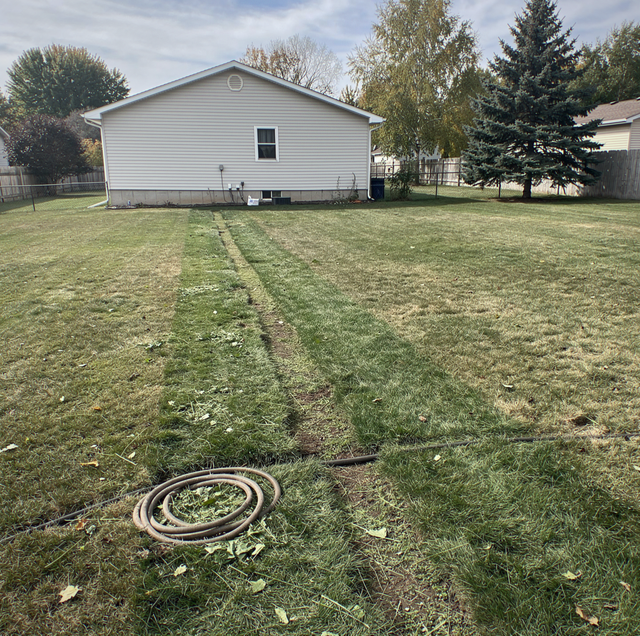
A stripe that stays greener and thicker than the rest of the yard, tracing the line from the house outward, means wastewater is reaching the root zone and feeding it: household waste carries the same nitrogen and phosphorus lawn fertilizer is built from. The soil under a lush stripe is usually still soil, wet and enriched and holding together. That points to a slow escape, often a hairline crack or a joint just starting to open.
A stripe that is wet but bare or yellowed reads differently. Enough volume is coming out to waterlog the root zone rather than feed it, which means a larger opening, not a smaller one.
A patch that has gone soft, spongy underfoot, or visibly lower than the ground beside it is the most advanced of the three. Color may not be part of it at all. What matters is that the ground gives when you step on it, or sits below the grade it used to hold: the fines have been carried out from under it, and the surface is settling into the space they left. A lush stripe tells you water is escaping. A sunken one tells you soil has gone with it.
Raw sewage carries bacteria and other pathogens, so keep children and pets off any wet ground or standing water above a suspected break. Nobody should reach into a cleanout, into a crawl space holding sewage, or into an open excavation.
When the Surface Finally Drops
A depression along the pipe's run is the void reaching daylight, and its scale is what people misread. The surface is the last part of the cavity to fail and is usually the smallest part. Soil bridging the top holds until the span gets too wide to carry itself, then a saucer-shaped area sags or a hole punches through, while the cavity underneath can be wider than the depression and much deeper than it looks. A dip you can step across without noticing may sit over something you would not want to park on.
Pavement changes the timing, not the mechanism. A walk, driveway slab, or patio spans a void far longer than turf can, so over paved ground the first evidence is often a slab that has cracked and dropped along one edge, or a section that sounds hollow underfoot.
A depression or open hole above a sewer line may cover a cavity that is wider and deeper than the surface indicates. Keep people, pets, and vehicles off it, and leave it unfilled until someone has confirmed what is underneath.
Stair-Step Cracks and Other Reports From the Structure
Not every crack in a foundation traces back to plumbing, but one pattern is worth connecting to the sewer line whenever drain trouble sits in the same picture.
Block and brick walls are strong through the units themselves and weak along the mortar joints between them. When soil under one part of a footing loses its bearing, and that part settles while the rest of the wall stays put, the wall has to break somewhere, and the break follows the weakest available path: up one head joint, across one bed joint, up the next, producing the diagonal staircase that masons and inspectors read as differential settlement.
The direction of the step carries information. The crack opens wider toward the side that dropped and closes toward the side that held, so the staircase points back at the settling corner. When that corner is also the side of the house where the sewer lateral leaves, the two facts belong in the same sentence.
A poured wall or a slab reports the same movement differently: a diagonal crack running out from the corner of a window or door opening, a slab edge separating from the wall it used to meet, or doors in one corner that start to bind. Each says the ground under part of the house has moved, which is what a leaking line under that ground produces.
Why Washed-Out Soil Makes This a Structural Repair
A footing works by spreading the house's weight across enough soil to support it. It does not have to be strong soil, but it does have to be consistent: a wall settling uniformly by a small amount does no damage, while the same amount unevenly cracks it. Pulling the fines out from under one stretch of footing is how consistency is lost, and a sewer trench is a good place for that to happen: trench backfill is looser than the undisturbed ground beside it, so escaping water travels along it easily and takes material with it.
The pipe loses its own support at the same time. A sewer line is bedded on compacted material that maintains a steady fall, and that bedding is the first thing the escaping water removes. With the bed gone in one stretch, the pipe sags into the space, flattening its slope, leaving waste standing in the low spot, and opening the joints at either end of the sag. More water leaves, more soil goes, the sag deepens. The pipe defect and the soil defect feed each other.
That loop also decides which repairs are still available. A cracked or root-invaded line that has kept its round shape can usually be lined, because a resin liner is cured against the inside of the host pipe and needs it as a form. A stretch that has lost its bedding and deformed, bellied, or crushed out of round no longer offers a round form to press against, so a liner has nothing to hold it true and replacement becomes the honest answer.
The last part surprises people. Fixing the pipe does not put the ground back. Whatever cavity the leak carved remains after the line is sound, and it has to be filled and compacted in lifts or grouted before the surface above it can be trusted.
Proving the Water Came From the Line
A dye test settles the one question that a wet or sunken patch cannot answer on its own: whether the water in that spot came from the sewer or from the ground.
A technician introduces a bright, water-soluble tracer dye at a fixture or a cleanout, runs enough water behind it to carry it down the run, then watches where escaping water would be expected to surface: the depression itself, a sump pit, a foundation crack, a basement wall seam, a nearby ditch. Dye appearing in any of them is direct evidence the line is discharging there.
What a positive result gives you is a location and a confirmation, not a diagnosis. It says water is leaving the line and reaching that spot. It says nothing about whether the opening is a hairline crack, a separated joint, or a collapsed section. A camera run through the cleared line supplies that half.
A negative result carries less weight than a positive one. Dye only reveals water that escapes during the test, so a defect that leaks under heavy load, or one whose water surfaces where nobody was watching, can pass and still be exactly what is wrong.
Frequently Asked Questions
You can, with two caveats that decide whether the result means anything. Food coloring is the usual choice and the wrong tool: it dilutes past visibility in the volume a sewer run holds, while plumbing tracer dye stays visible at high dilution. The dye also needs sustained flow behind it, rather than a single flush, so run a tub or a laundry cycle to push it along the line.
Timing and water quality separate them. An irrigation break wets the ground only while that zone runs, with clean water. A supply-line break runs constantly and shows on the meter with every fixture shut off. A sewer leak tracks household use, produces dark, greasy, sour-smelling soil rather than clean mud, and leaves the meter still.
No. Differential settlement has ordinary causes, including a downspout discharging against the wall, poorly compacted backfill from any utility trench, and clay soils shrinking through a long dry stretch. What raises the sewer line as a suspect is coincidence in place and time: the crack sits on the side where the lateral leaves, and appears while a drain is acting up.
Yes, and the delay is normal. A root-matted or frozen surface can bridge a cavity for a long time and drop only when the load on it changes: heavy rain saturating the soil, frost leaving the ground in spring, or a vehicle crossing where none used to. The collapse date reflects when the bridge failed, not when the pipe did.
Not necessarily. Turf re-establishes itself over settled ground quickly and hides the grade change under fresh green, making color a poor way to judge whether movement has stopped. Lay a straight board across the patch, measure down to the soil at intervals, then repeat weeks later. That comparison tells you far more than the grass does.
Usually not. A camera inspection maps how much of the run is actually damaged, and a failed joint or short broken section is often a small share of the total length, with the rest still round and worth keeping. That is what allows a spot repair or a partial liner, rather than replacing the sound pipe.
Find out whether your yard is telling you the sewer line is broken — Get a camera inspection before the ground above it drops any further. Clog Squad serves Holland, Grand Rapids, and Grand Haven. Call (616) 779-7675.
