
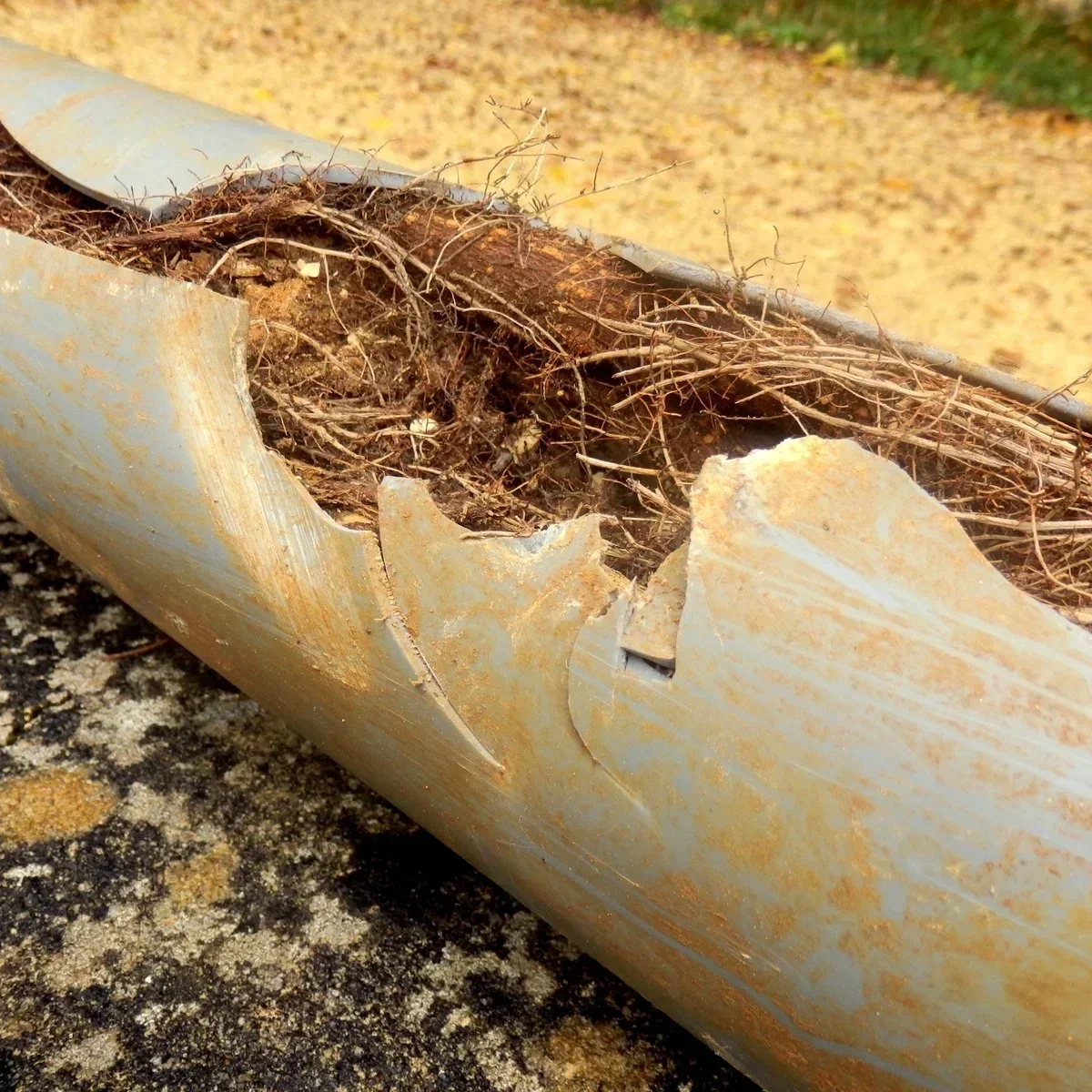
The silver maple in the front yard turned twenty-eight this summer. Wider than the driveway, taller than the chimney, shading the porch from late May through October. It also taps into the sewer lateral eleven feet under the lawn — and has, on a contractor's best guess, for the past fourteen of those summers.
That intrusion didn't happen because the tree went looking for a pipe. Roots don't do that. They go where the moisture is, and a residential sewer lateral leaking a few teaspoons of water vapor an hour at a single cracked joint is the most consistent water source in fifty feet of dry soil.
Knowing why roots end up inside the line shifts the conversation. The tree isn't the villain. The joint is. And the joint opened up for reasons that have very little to do with the tree above it.
Roots aren't hunting the pipe. They are following a leak.
A tree's root system is a chemical-sensing network. The fine feeder roots at the growing edge of the tree detect water-pressure gradients in the surrounding soil — moisture differentials measured in fractions of a percent. A root tip that enters a zone with even slightly higher humidity than the surrounding soil grows toward the gradient. That's the entire mechanism. Tropism. The tree doesn't know a pipe is there.
A sound sewer line leaks nothing. The pipe wall holds, the joints seal, and roots passing within inches of an intact line have no signal to follow.
A leaking joint is the opposite. A clay tile coupling with a hairline mortar gap loses a constant trickle of water vapor into the surrounding soil — not visible from the surface, but plenty to register on a feeder root reading the gradient from three or four feet away. The root follows the trail back to its source, threads itself into the gap, and crosses into the pipe. Inside the line, it finds standing wastewater, warmth, and a nutrient mix it would never encounter in open soil. A fan of finer roots explodes off the first one, and a mesh starts forming.
That whole sequence runs on a leak the homeowner didn't know existed. The intrusion isn't aggression. It's chemistry working the way it's supposed to.
What a sewer leak actually smells like to a root
The signal a feeder root reads isn't just water. It's a chemical bouquet; the rest of the soil doesn't carry.
Wastewater contains dissolved nitrogen from urea, phosphorus from waste solids, organic carbon from food residue, and ammonia from protein breakdown. Those are the same compounds a fertilizer truck would spread on the lawn at a hundred dollars a bag. A pipe joint leaking a few cubic centimeters of liquid an hour is, from the root's perspective, a slow-release fertilizer station running twenty-four hours a day.
The temperature side reinforces the signal. A sewer line carries wastewater at fifty-five to seventy degrees year-round — warmer than frost-line soil in winter, slightly warmer than the deep clay surrounding the pipe in summer. The warmer microclimate around a leaking joint reads as more habitable than the dirt three feet to either side. Combine the nutrients, the consistent moisture, and the warm pocket, and the joint isn't a vulnerability for a root — it's prime real estate. Once the larger root system has registered the find, the tree keeps sending growth back to that spot.
Why pipes open up in the first place
The pipe-side question matters more than the tree-side question. A tree above an intact line is a non-event. A tree above an opening line is a recurring service call.
Clay tile sewer pipe — the dominant residential material from the late 1800s through the early 1970s — was installed in two-to-three-foot sections joined with mortared collars or oakum-and-cement seals. Watertight on install day. Decades of soil settlement, freeze-thaw cycling, and small ground movement work the mortar loose at a fraction of a millimeter a year. Forty years in, a hairline gap has opened at the top of the joint. Fifty years in, the gap is wide enough that the camera shows daylight through it.
Cast iron drain pipe corrodes from the inside out at the joints. The bell-and-spigot connections used in pre-1980 installations rely on a packed lead seal that holds for decades but eventually erodes as wastewater chemistry changes the seal interface. Once a thin gap forms, soil moisture pulls the bond apart from the outside.
PVC and ABS lines installed since the late 1970s are more forgiving but not immune. Solvent-welded fittings can hairline-crack after a hard winter when the soil around the line freezes harder than normal. A glued joint with poor solvent flow on install day will weep within five years. Orangeburg pipe — the tar-impregnated wood-fiber material used in lower-cost installations from the 1940s to the early 1970s — fails differently: the pipe wall itself softens and deforms, and roots find openings everywhere along the run rather than at a single joint.
The common thread is that pipes don't usually fail at the wall. They open at the seam between two sections, in slow motion, on a calendar measured in decades.
How far roots actually reach for a moisture source
Most homeowners under-estimate the working radius of a mature tree's root system. The visible canopy is a poor proxy.
A healthy mature tree extends a feeder-root network outward to roughly two to three times the canopy radius. A silver maple with a forty-foot canopy can have feeder roots active eighty to a hundred and twenty feet from the trunk, in any direction the soil permits. The roots aren't a uniform circle — they follow gaps in the subgrade and run along old utility trenches where the soil was disturbed and re-compacted loose.
That radius means a sewer lateral on a quarter-acre lot is almost certainly within reach of every mature tree on the property, plus most mature trees in adjacent yards. A line with no tree directly above it can still get intrusion from a neighbor's elm three lots over if a leaking joint sends out enough signal. The species above the lawn matters for risk, not for reach.
| Tree group | Relative root aggressiveness in sewer lines | Why it shows up on camera |
|---|---|---|
| Silver maple, willow, cottonwood, poplar | Highest | Wide, shallow feeder networks tuned to seek water; small fine-root diameter that fits the smallest hairline gaps |
| Elm, sycamore, sweetgum, mulberry | High | Large mature root systems and prolific fine-root production at the growing edge |
| Oak, hickory, ash, birch | Moderate | Deeper taproot pattern with secondary surface roots; slower to colonize a leak but persistent once established |
| Fruit trees, ornamental cherry, dogwood, redbud | Lower | Smaller root mass overall; meaningful only when planted close to the lateral |
| Spruce, pine, fir, arborvitae | Lowest | Resin-rich roots, narrow soil exploration radius, less tropic to wastewater gradients |
The table runs as a probability ranking, not an absolute. Any species can reach a leaking joint that's inside its root-extension distance. The high-aggressiveness group is just the one camera surveys see most often, year after year, in West Michigan yards built before 1980.
Why a yard with no big trees still gets root intrusion
A surprising fraction of intrusion cases come from yards that look root-free at the surface. Three causes do most of that work.
The first is the neighbor's tree. A mature silver maple two lots over has a feeder-root reach that crosses the property line easily. The roots don't know where the surveyor's pins are. A leaking joint on your lateral becomes the closest water source for a tree you don't own and can't remove.
The second is shrubs and small ornamentals on top of the line. Boxwood, yew, juniper, hydrangea, lilac — foundation plantings develop denser root systems than they look like at the surface. A row of hedges along the lateral's path can send fine roots into a joint within five to eight years.
The third is roots from trees removed decades earlier. A stump ground out twenty years ago leaves a network of decomposed root channels in the soil. New growth from any tree within range exploits those existing channels — easier passage than through compacted virgin clay — and reaches the lateral on a faster timeline than the tree's age would suggest. A camera survey on a "no trees" property with recurring backups almost always finds roots. The intrusion source just isn't on the property the homeowner is standing on.
What happens at the joint after the first root crosses through
A single fine root entering a leaking joint changes the joint's failure trajectory. Once anchored in the gap, the root thickens over the next two to three growing seasons. A hair-thin filament becomes a pencil-diameter woody root, and the growth pressure pries the mortar collar apart further — not by chopping, but by hydraulic force as the root cells expand. A clay joint that lost half its mortar collar over forty years can lose the other half over the next ten if a heavy root takes hold.
Each new gap millimeter increases the moisture leak. Each moisture increase strengthens the signal to the rest of the root system. More roots arrive, more pressure on the collar, more leak. The line is now on a positive-feedback loop that doesn't break on its own.
This is why repeated cable cutting doesn't reset the clock. The cable shreds the mass currently in the line. The joint stays open, the leak signal stays on, and the regrowth window is set by the growing season above — heaviest March through June and August through October. A line cabled in April is re-rooted by September. The cycle breaks only when the joint stops leaking, either because the gap is sealed from inside or because the failing section is replaced. Removing the tree doesn't end it.
Frequently Asked Questions
How can I tell if a tree on my property is reaching my sewer lateral?
+The camera answers the question. A push-camera survey down the cleanout shows root intrusion at the source joint and the direction of the entering filaments — combined with a yard map of where the lateral runs, that locates the source root system to within a few feet. Surface signs help when present: a strip of greener grass over the lateral in summer, an unusually lush stretch during a dry July, or a tree on the property with feeder roots known to reach the line's depth. Without a camera, intrusion is a guess.
Does removing the tree above the line stop new root intrusion?
+Partially, and not as much as most homeowners expect. Roots already inside the pipe die back over a year or two after the tree comes down, and growth from that specific tree ends. The leaking joint stays open, though, and other root systems within reach — neighbor trees, shrubs, distant mature trees — will register the moisture signal and grow toward it. Tree removal helps; it doesn't end the cycle unless the joint is also sealed.
How long does it take for a new root intrusion to cause symptoms?
+Eighteen months to four years from the first fine root crossing the joint to a noticeable backup. The mesh has to grow to roughly a quarter of the pipe diameter before catching enough solids to slow flow. A camera run during that pre-symptom window catches roots when they're a single-cleaning job instead of a cleaning-plus-lining job. Homes with mature trees over the lateral benefit from a baseline camera every three to five years.
How far from a sewer line should a new tree be planted?
+For most species, a thirty-to-fifty-foot setback from the lateral is a reasonable starting rule. For the high-aggressiveness group — silver maple, willow, cottonwood, poplar, elm — eighty to a hundred feet is closer to safe, and even then a leaking joint can pull roots in. Mature size matters too. A small ornamental at ten feet is lower risk than a big shade tree at fifty. Planting away from the line is cheaper than dealing with the intrusion later.
What's the difference between roots entering at a clay joint versus through a cast iron crack?
+Joint intrusion in clay is the common pattern — a wide gap at a coupling, a thick root mass at one specific depth, the rest of the pipe clean. Cast iron intrusion comes through corrosion holes in the pipe wall itself, often at the underside where soil moisture has eaten through. Multiple small entry points along a run, finer root threads at each one, and a more diffuse mesh. Clay-joint intrusion is usually a candidate for trenchless lining at the affected section. Cast iron wall-failure intrusion often signals the pipe is at end of life.
Are some sewer pipe materials genuinely root-proof?
+Closer to root-resistant than root-proof. Modern HDPE and high-quality PVC with fully sealed gasketed joints are extremely difficult for roots to enter while the joints stay sealed. A cured-in-place pipe liner — a continuous fiberglass-and-resin sleeve cured inside an existing host pipe — has no joints at all along its run and offers the closest thing to a permanent root barrier currently available for residential laterals. Installation quality and ongoing joint integrity matter as much as the pipe spec.
Working with the tree and the pipe in the same yard
The mature tree above a sewer lateral and the sewer lateral itself can coexist for a long time, as long as the line stays sealed. The framing that helps homeowners most is recognizing that the tree isn't doing anything wrong. It's running its normal moisture-seeking program. The pipe is the part that decided to leak.
Removing a healthy tree to "fix" a sewer problem usually doesn't fix it — another root system finds the same leak inside a couple of years. Sealing the leak, by trenchless pipe lining or by spot replacement at the failing joint, ends the cycle whether the tree stays or goes. For homes with a mature tree above a known leaking line, the realistic plan is a camera survey to confirm the joint's location and condition, a one-time wall-to-wall cleaning to clear the existing mesh, and a sealing repair at the source. Physical root barriers — high-density polyethylene panels buried vertically between a tree and the lateral — buy time on a sound line by deflecting roots away from a known vulnerable section, but they don't seal an already leaking joint. Standard homeowner's insurance treats root-intrusion damage as a maintenance issue, not a sudden loss, so the repair cost almost always sits with the property owner. Maintenance after the seal becomes a check-in camera pass every few years, not a yearly clearing. The tree keeps the shade. The pipe stops feeding it.