
What Causes the White Crusty Buildup Inside Drain Pipes?
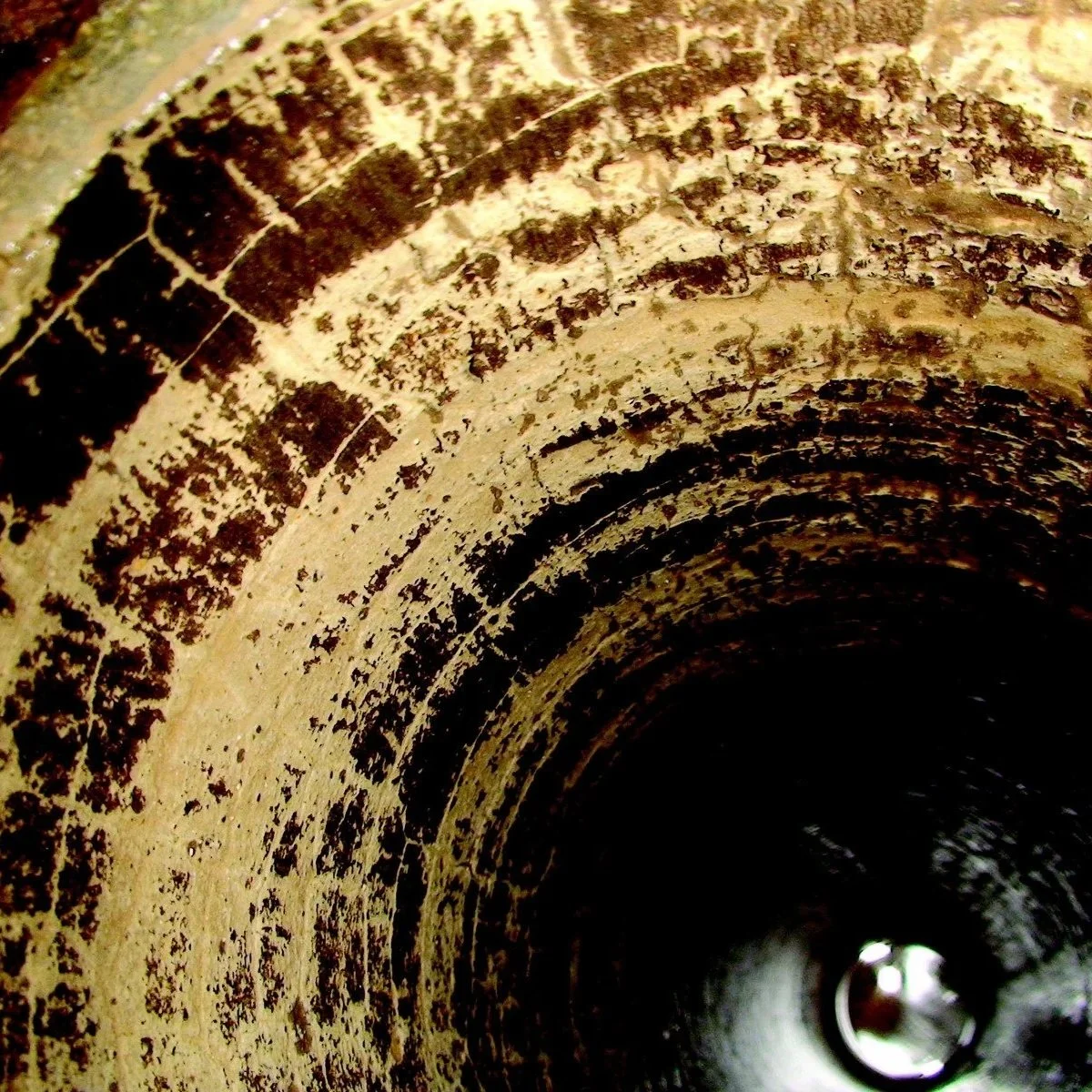
Pull the slip nut on a kitchen P-trap that hasn't been touched in fifteen years and you see it the moment the trap clears the tailpiece — a ring of white, chalky crust on the inside of the pipe, sometimes flaky, sometimes hard enough that a fingernail leaves a scratch but no powder. It isn't grime. It isn't grease. It looks like the inside of a teakettle, because that's roughly what it is.
The technical name for it is mineral scale. In a kitchen trap, around a toilet rim, at the waterline of a floor-drain weep, anywhere water sits and evaporates inside a drain system, the same process is running. Hard water carrying dissolved calcium and magnesium loses its temperature, loses its dissolved carbon dioxide, and drops the minerals back out as a solid layer on the pipe wall. Every gallon after that lays a thin coat on top.
In West Michigan, where municipal and well water both run through limestone bedrock, this is one of the most common pipe deposits a homeowner ever sees. It's also one of the most often mistaken for "old buildup" that snaking should clear. Scale doesn't snake out. A cable runs straight through a scale-coated pipe the way a drill bores through a cinder block — the hole opens up briefly, the wall stays intact, and the line catches the next round of debris exactly the same way as before.
What the white crust actually is, in chemistry terms
Hard water is groundwater that has picked up calcium bicarbonate and magnesium bicarbonate on its way through limestone and dolomite. The bicarbonate form is what keeps the minerals dissolved. As soon as the water loses dissolved carbon dioxide — heat will do it, sitting open will do it, agitation will do it — the bicarbonate breaks down and calcium carbonate drops out of solution.
Calcium carbonate is the same compound as the inside of a teakettle and the white spots on a glass after the dishwasher. In a drain pipe, the deposit thickens wherever water lingers and evaporates — most of all at the meniscus line where the standing water in a trap meets air.
In a toilet trap and rim, the deposit can also include struvite — magnesium ammonium phosphate — formed from the chemistry of urine reacting with hard water. Struvite is gray-white to amber, more crystalline than calcite, and grows fast at the underside of toilet rim jets where water sits at the worst possible angle to wash itself out. For our purposes, the two compounds behave the same way: they coat the pipe, they bond to the wall, and they don't dissolve back into water once they have set.
Where the deposit actually forms inside a drain system
Drain scale doesn't form evenly along a pipe the way grease coating does. It builds heaviest where the water-air interface meets long contact time.
The kitchen P-trap, around the waterline ring. The bathroom sink tailpiece just below the threads. The underside of a floor-drain grate where rinse water beads and dries between uses. The waterline of a toilet bowl and the underside of the rim where jet water sits between flushes. The first six inches of a vertical drop after a fixture, where splash from the trap stays on the pipe wall.
Anywhere the drain system holds standing water and has air contact, the scale layer thickens. Anywhere the water stays moving — the middle of a vertical stack, the inside of a fully flowing main line — scale either doesn't form or stays thin enough that flow carries it out.
Why the layer bonds to the pipe instead of washing away
A calcium carbonate crystal forming inside a pipe doesn't sit loose. It nucleates against the wall — anchors to a tiny irregularity, a scratch, a fleck of rust, a manufacturing defect, the edge of a previous deposit — and the next crystal grows interlocked with the first. Over months, the layer becomes a continuous matrix bonded to the pipe.
cast iron drain lines give scale the best foothold of any material in a typical house. The inside of an aging cast iron pipe is already covered in rust ridges and pitted corrosion, and every irregularity becomes a nucleation site. Scale and rust form a composite layer mechanically tougher than either one alone. A pipe-milling cutter taken to a coated cast iron line comes back with a mix of red, gray, and white debris in the chain teeth — that's the rust-and-calcium composite breaking off in flakes.
PVC and ABS pipes still scale, but the smooth interior gives the crystals fewer footholds. The deposit forms a thinner, looser layer that's easier to dislodge mechanically. Hardness of the source water still drives the rate, but the bond strength is a fraction of what builds up inside cast iron.
The longer the layer sits, the harder it gets. Fresh scale, months old, is chalky and breaks under a thumbnail. A year old scale is dense crystalline calcite, harder than a fingernail. Five year scale on cast iron, mixed with rust, can dull a steel pipe-milling chain after a few hundred feet of cleaning.
What scale does to a drain's flow once the layer thickens
A 2-inch kitchen branch line carries about 21 gallons per minute at full bore. A scale layer of one-eighth inch around the entire inside drops the effective diameter to 1.75 inches and the carrying capacity falls about 25 percent. A quarter-inch ring drops it closer to 45 percent. The drain still works, but every shave, every dishwash, every shower runs against a smaller pipe.
The bigger trouble isn't the diameter loss itself. It's what the scaled surface does to anything else moving through the line. Soap scum, hair, grease, and small food solids that would slide past a smooth wall catch on the rough scale layer and start their own coating on top. By the time a homeowner sees a slow drain in a heavily scaled line, the pipe is narrower than it should be and a secondary layer of organic deposit has formed on top of the mineral one.
Toilets show the effect at the rim. Scale around the rim jets restricts the water pattern coming out and weakens the bowl scour. The fix gets called a "weak flush" and a flapper or fill valve gets replaced. The actual issue is mineral deposit choking the rim channel, and replacing the valve doesn't change the jet pattern at all.
How to spot a scaled line without opening the pipe
Scale inside a drain doesn't have to be visible to be diagnosed. The same hard water laying down deposits in a buried branch line is also leaving them where a homeowner can see — and the visible deposits track closely with how much is happening inside the pipe.
Unscrew a faucet aerator and look at the screen. White pebbly debris in the mesh, the kind that crumbles between fingers, is scale that has shed off the supply side. A drain line running on the same water supply is laying down its own version of the same coating. If the aerator is heavily fouled, the kitchen P-trap will usually show a matching ring when it comes apart.
Hot water lines scale faster than cold lines, because calcium carbonate is less soluble at higher temperatures and drops out of solution sooner. A house where the hot side of a bathroom sink runs noticeably weaker than the cold — both faucets open at once — shows the asymmetry directly. The drain line below catches hot-line discharge from every shower, dishwasher cycle, and load of hot laundry, so the trap on a hot-heavy line scales faster than the same trap on cold-only flow.
Galvanized steel supply lines, common in homes built before the early 1960s, scale and corrode together in a way that magnifies the problem on both sides of the meter. If the supply runs galvanized and the drain runs cast iron, every pipe in the house is on a faster scale timeline than the same house with PVC and copper.
The cast iron-and-hard-water case is a project, not a one-time clean
In a West Michigan home with original 1940s-to-1970s cast iron drainage and well or municipal water that hasn't been softened, the inside of the drain stack tells the story by middle age. A 4-inch cast iron stack carrying a quarter-inch scale-and-rust layer reads as roughly three-and-a-half inches of effective diameter. Half an inch and the line is functionally a 3-inch pipe. Cable snaking that line clears a tunnel through the deposit, but the wall stays coated, and the next round of grease or paper catches exactly where it caught before.
The work that restores a cast iron drain to original interior diameter is mechanical scouring against the pipe wall — a pipe-milling cutter run on a flex-shaft, with rotating carbide chains that strip the scale-rust layer off the iron back to bare metal. The chains shave the wall instead of tunneling through the coating. The pipe goes from three-and-a-half effective inches back to four, and the drain stops catching the soft deposits that needed a rough surface to grip.
That's an hour-or-two job on a single branch and a half-day job on a full main, depending on length and condition. A camera pass after confirms the wall came clean — without that, the scale layer can break off in chunks during the work and leave patches that look clean in a couple of test runs but re-coat within months.
Why a softener doesn't undo what's already in the pipe
A whole-house water softener cuts the calcium and magnesium content of incoming water before it ever reaches a fixture or a drain. Over time, that means new scale layers form at a fraction of the prior rate — most softeners drop the working hardness from the 12-to-20 grains per gallon range typical in West Michigan groundwater down to under 3 grains, and at that level fresh scale takes years to grow a layer thick enough to matter.
What the softener doesn't do is undo what's already in the pipe. Existing scale, once it has crystallized and bonded, is essentially a solid mineral inside the drain. Soft water flowing over it doesn't dissolve it back into solution at any meaningful rate. The pipe needs a mechanical or chemical descaling pass to clear the existing layer, and then the softener keeps the new layer from rebuilding fast.
A common homeowner sequence is the right one in the wrong order — softener gets installed first, no improvement is seen in a slow kitchen drain, and the conclusion is "the softener didn't work." It worked. The existing scale was the actual problem.
Frequently Asked Questions
What's actually inside this white crust?
+In a kitchen or laundry drain, it's almost entirely calcium carbonate — the same mineral that forms inside a teakettle. In a toilet trap or rim, the deposit can include struvite, which is magnesium ammonium phosphate formed when hard water reacts with the chemistry of urine. Both compounds look similar to the naked eye, both bond to the pipe wall the same way, and both are removed by the same descaling methods.
Does a water softener stop the scale from coming back?
+A whole-house softener cuts the calcium and magnesium content of the incoming water enough that new scale forms at a fraction of the rate — often slow enough that a homeowner doesn't see noticeable buildup for many years. It won't dissolve scale that's already in the pipe, though. The existing layer has to come out mechanically or chemically before the softener does its job on the prevention side.
How often does scale rebuild after a descaling?
+It depends almost entirely on water hardness. On a softened-water system, a fully descaled drain line can stay essentially clear for ten to fifteen years. On unsoftened West Michigan groundwater, depending on pipe material and load, noticeable buildup can return in three to seven years. Cast iron lines on hard water rebuild fastest because the rust pits give scale a starting foothold every time.
Can vinegar dissolve scale inside a drain pipe?
+For surface deposits at the trap level — the visible white ring you can see when the trap is open — yes, household vinegar held in contact for a few hours will dissolve a thin layer. For scale formed inside a buried branch line or stack, no. The contact time and acid concentration would have to be far higher than household products provide, and even commercial descaling acids need long dwell times under controlled conditions to break a thick layer. Mechanical scouring is the practical method.
Are there pipe materials that resist scale better than cast iron?
+PVC and ABS resist scale meaningfully better than cast iron — the smooth interior offers fewer nucleation sites, and the bond between scale and pipe is weaker than between scale and rusted iron. Copper drain pipe, common in higher-end homes a few decades ago, sits in the middle. No drain material is fully scale-proof on hard water, but the rate of buildup and the difficulty of cleanup vary by a large margin between plastic and cast iron.
What happens if I leave the scale alone?
+In a plastic-pipe house on softened water, often nothing serious for decades. In a cast iron house on unsoftened water, scale narrows the line, traps secondary deposits, and pushes the drain toward recurring backups. The work eventually needed gets larger every year — what's a routine descaling at fifteen years can become a major branch-line rebuild at thirty, because the pipe wall itself starts losing structural cross-section to the corrosion underneath.
What the chalky ring tells you about the rest of the line
The white band on the inside of a P-trap is the visible part of a process that's running everywhere water sits inside the drain system. It builds at the waterline, in the rim jets, on cast iron walls, on every nucleation point a hard-water household provides. Mechanical scouring is the only method that restores original interior diameter once the layer has set, and a camera pass after confirms the wall actually came clean.
For older homes with original cast iron drainage on unsoftened water, scale is the deposit category that decides whether a line lasts another ten years or becomes a replacement project. A pipe-milling cleaning, run before the corrosion eats into structural pipe wall and paired with a softener on the supply side, turns a recurring backup line into a system that mostly stays out of mind.
