
What Can a Sewer Camera Actually See Inside Your Pipes
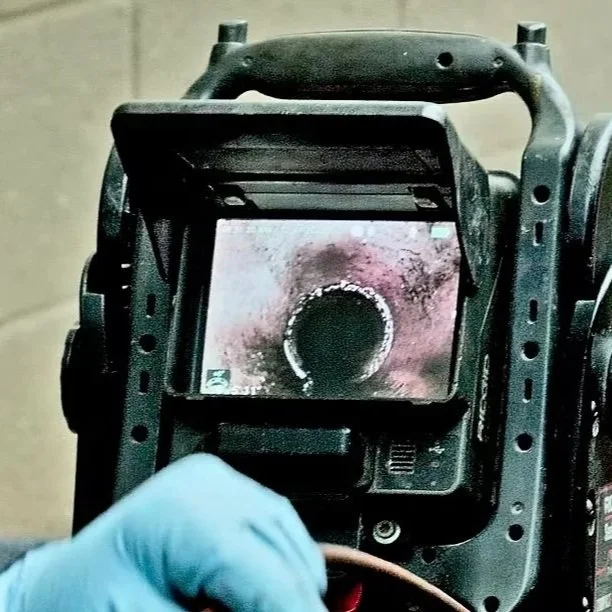
The monitor sits on a tripod next to the cleanout, plugged into a coil of orange cable that disappears down a black hole in the floor. The screen is mostly dark at first — just the lit edge of a metal head moving through standing water at the bottom of a P-trap. Then the head clears the bend, the LEDs reflect off pipe wall instead of the water surface, and the picture goes bright. A tan-brown crust at the four-o'clock position. A clean strip along the top. A reflection three inches ahead where something interrupts the curve.
Twenty seconds in, the camera has shown more about the line than two hours of guessing could.
A sewer camera isn't a clog-finder. It's a survey instrument that reads the interior of the pipe — wall condition, material, defects, grade, branch locations — and what it shows shapes every repair decision that follows. Most homeowners haven't watched the screen during one of these surveys, so the picture of what it actually sees lives mostly in the operator's head.
The picture on the screen — what a sewer camera actually shows
A push-camera setup is a small high-resolution lens with an LED ring around it, mounted at the end of a stiff fiberglass rod with a screen at the surface end. The lens is the size of a quarter. The LEDs throw a few feet of light. The screen shows the lens's view in real time, with depth and orientation overlays around the picture.
Frame by frame, what that picture contains is the lit interior of a single foot of pipe at a time. Over the length of a typical 50-to-80-foot residential lateral, the operator builds a continuous mental map of wall condition, scale, joint placement, debris, water level, and the location of every branch and defect along the run.
The picture is a video, not a photograph. The operator watches for change frame to frame — a color shift from gray to rust-orange, a new shadow at the bottom, a sudden rise in water level that means the head just hit a low spot. A good camera report has the full footage attached, not just a summary.
How the camera moves through the line
A push camera is the workhorse for residential laterals — the rod is stiff enough to navigate most fittings and bends, runs on cable lengths from 100 to 300 feet, and reaches from the cleanout to the city tap on any normal property. A self-leveling head keeps the picture right-side-up regardless of how the rod rotates. Without it, the picture spins every time the rod twists, and reading wall condition becomes much harder.
A crawler robot is the option for larger commercial mains — 6-inch lines and up, driven on small treads with video sent back to the surface. Below that diameter, the crawler doesn't fit, so residential laterals are almost always push-camera work.
The third tool is a locator — a handheld device that picks up a radio signal from a transmitter at the camera head and tells the operator where the head sits underground. That signal is how a defect on the screen gets matched to a spot in the yard.
What a healthy pipe looks like on camera
Before the screen can show what's wrong, the operator has to know what right looks like in that material.
Clay sewer pipe in sound condition reads as a continuous brown-to-tan interior with visible joint rings every two to three feet. The joints are darker bands where two sections meet, sometimes with a hairline of mortar showing. A clean clay line has no roots at the joints, no daylight gaps, and water passing through clean enough to see the pipe wall below it.
Cast iron drain in good shape shows as a dark gray to black interior, smooth in texture, with a thin even film. The film is normal biofilm and isn't a defect. The wall reads as solid metal at every joint where two sections couple together.
PVC and ABS — the plastics used in residential construction since the late 1970s — show as a uniform light-gray interior, glossy, with sharper joint marks where solvent-welded fittings meet pipe. A 30-year-old PVC drain on camera looks close to the way it looked on install day.
The baseline for the host material is the first read. Every defect after that is a departure from it.
What scale, grease, biofilm, and stray objects look like
Three of the most common findings on a residential camera survey show up by texture and color rather than by any single landmark.
Mineral scale on cast iron reads as a rust-orange to dark-brown crust that builds out from the wall in ridged layers. On a scaled line, the interior is rough enough to catch light unevenly, and the diameter is visibly smaller than the joint coupling at the surface end. Severe scale narrows a 4-inch line down to a 2.5- or 3-inch effective bore, and the camera shows the constriction directly when the lens compares wall to fitting.
Grease coating on a kitchen branch reads as a smooth tan-to-cream layer at the lower half of the pipe, with the bottom of the bore narrower than the top. The texture is softer than scale, more uniform, sometimes with a slight sheen where fresh kitchen water has re-melted the surface. On a horizontal kitchen branch with months of grease deposits, the lower half of the pipe looks like a candle melted into a half-cylinder inside a glass jar.
Biofilm is the dark slime layer that grows wherever wastewater sits between flushes. A small amount is normal; a heavy build is a sign the line isn't draining cleanly between uses. On camera, heavy biofilm reads as a dark, glossy coating that absorbs light instead of reflecting it.
Foreign objects show up surprisingly often — a child's toy lodged at the P-trap, a paint stir stick from a renovation, dental floss tangled into a mass at a hub. What looks like a permanent clog often turns out to be an object the snake never identified.
How root intrusion shows up on screen
Roots are the most identifiable defect on a sewer camera, and they show up in four patterns the operator catalogs as the head moves through.
The first is fine hair roots at a joint — thin white-to-tan filaments coming through a gap between two clay sections. They don't restrict flow much in their first months, but they're the easiest sign that a joint has opened up.
The second is a root mass — a tangle of larger roots that has grown out of the original joint into a dense mesh inside the pipe. A mature mass can block half the bore or more. This is the configuration that catches debris and turns a line into a recurring backup site.
The third is a root ball — a single point of growth where the root has wrapped around the inside of the pipe in a dense knot. Cable snaking sometimes punches through a root ball without removing it. The camera shows the difference between a snaked-through hole and a cleared joint.
The fourth is root intrusion through a fracture — a hairline crack in the pipe wall, not at a joint, with one or two fine roots coming through. This pattern is rare on clay and more common on the underside of failing cast iron, where soil acidity has eaten an entry point.
Each pattern carries different implications. The camera is what separates a root ball that needs cutting from a fracture-fed intrusion that signals the section is structurally compromised.
Cracks, offsets, and bellies — structural defects only video confirms
A longitudinal crack runs along the length of the pipe and shows on camera as a dark line in the wall, sometimes with daylight visible through the gap. A circumferential crack runs around the diameter at or near a joint and shows as a thin shadow at the joint band, often with displacement on one side.
A joint offset is the step where two pipe sections no longer line up. Small offsets show as a quarter-inch lip the camera passes over. Severe offsets show as a hard edge the head bumps against, sometimes with daylight past the seam where soil shows through.
A belly is a low spot where grade has settled below level, and water pools in the dip. The camera reads a belly directly: water level rises ahead of the head, the lens enters the standing water, and the picture goes dark. Bellies are the defect lining can't fix — a liner follows the host pipe exactly, including its slump. The only fix for the grade is digging the section out and resetting the pipe at the proper slope.
How the operator finds where on the property the defect sits
A defect on the screen is useful. A defect tied to a marked spot in the yard is what makes the next step actionable.
The transmitter at the camera head broadcasts a signal that the surface locator picks up. As the operator walks the yard with the handheld locator, the signal peaks directly over the head. A flag goes down at that spot. The depth comes off the locator; the distance from the access matches the cable counter on the rod.
The result is a survey that says, in concrete terms: fractured joint 36 feet from the cleanout, 3 feet deep, 8 feet west of the back porch. A contractor with a camera-marked location is quoting a specific small dig instead of a 30-foot trench-of-uncertainty.
When a homeowner should actually call for a survey
Camera surveys aren't a six-month fixture, and they aren't only for emergencies. The situations that earn the call: recurring backups or slow drains on more than one fixture; a single line that keeps backing up six weeks after the last snaking; gurgling toilets when other fixtures drain; wastewater smell at a floor drain or near the foundation outdoors; a pre-purchase inspection on a house built before 1980, especially with mature trees in the yard; any unexplained wet spot in the lawn that lines up with the lateral path.
The threshold is whether snaking the symptom keeps fixing the same symptom on the same calendar. When it does, the line is asking for a look.
What the camera can't see — and when another tool has to answer
The camera is the best diagnostic in residential drain work, and it isn't unlimited.
It can't see leaks from inside the pipe. The lens reads what's inside the bore. It does not read what's escaping the bore into the surrounding soil. A pipe with visible cracking on camera might be leaking and might not. Confirming a leak requires a separate test — a hydrostatic pressure test, a smoke or dye trace, or a static-level test. A camera survey alone that's used to sell a leak repair is the wrong tool for that question.
It can't see through standing water past about an inch — the picture goes murky, and the operator drains or jets the section before re-running the camera. It can't read wall thickness from inside; ultrasonic measurement from outside the pipe is the supplemental tool there. It can't pass through a hard collapse. And it can't predict what's not visible yet — a line that surveys cleanly today can develop a defect next year, which is why warranty-driven shops camera the line before and after every job. The baseline lets later surveys catch what's changed.
Frequently Asked Questions
Can sewer cameras see through standing water in the pipe?
+Only at very shallow depth — about an inch. Anything deeper, the picture goes murky, and the operator drains or jets the standing water before re-running the camera.
How is a push camera different from a crawler robot?
+Size and access. A push camera is a flexible rod with a small lens at the tip, designed for residential pipe sizes from 2-inches up. A crawler is a self-driven robot that fits 6-inch lines and larger, used mostly on commercial and municipal mains. For a typical house lateral, the push camera is what comes off the truck.
Will the camera record footage I get to keep?
+Every reputable shop records the survey and provides the footage on a USB drive or a shared link. The footage is the report. A camera survey without retained footage is a service the homeowner can't verify and a finding the next contractor has to redo.
Does a camera survey prove there's a leak in the pipe?
+No. The camera reads inside the bore only. A crack or hole on screen may or may not be passing water. Leak confirmation requires a separate hydrostatic or dye-trace test on the line. A contractor selling a leak repair based on camera footage alone is using the wrong instrument for that diagnosis.
Can the camera tell where the pipe is under my yard?
+Yes — via the radio locator. The camera head carries a transmitter; a handheld locator on the surface picks up the signal as the operator walks the yard. Marker flags go in over the head's position, and the depth reading tells the crew how deep to dig.
Will a camera inspection scratch or damage the pipe?
+No. The rod is stiff fiberglass with a smooth head, designed to pass through fittings without scraping wall. The LED ring is sealed and waterproof. The assembly is built for repeat use, often hundreds of times a month on different lines.
Why the survey settles arguments the diagnosis can't
A sewer camera changed what plumbers can confidently say about a pipe they can't otherwise reach. Before video survey was standard, the diagnosis of a problem line was inference — symptoms upstairs, age of the house, what the snake hit at 22 feet. The repair quote was a best guess on those inputs.
With camera footage, the inference is replaced by a picture. The kitchen branch is grease-coated for 14 feet, then clean for the next 8, then meets the main at a joint with a half-inch offset. The lateral is structurally sound for the first 31 feet, then shows root intrusion at the clay-to-cast iron transition. The reading is specific to that property and dated to that morning. Two contractors disagreeing on what the line needs can be settled by playing the footage.
A camera survey isn't every plumber's standard step, and it should be. A reputable drain cleaning job includes a baseline pass before the work starts and a verification pass after — the baseline to scope the cleaning correctly, the verification to confirm the line came back to original diameter. The footage from both passes belongs in the homeowner's hands at the end.
The pipe used to be the part of the house nobody could see. Now it isn't.
