
Why Are All Your Drains Slow at Once?
Quick Answer: When all the drains in your house are slow at the same time, the cause is usually the main sewer line that they all share, rather than a clog in any one drain. The main line carries all your home's wastewater, so a partial blockage there — from buildup, tree roots, or pipe damage — slows everything draining through it. A single slow drain is typically a local clog, but whole-house slow drainage points to the shared main line. This is worth addressing promptly, because a partial main line blockage can progress to a full backup of sewage into the home. A professional can inspect the main line (often with a camera) and clear or repair it.
It's one thing for a single sink to drain slowly — that's usually a local clog. But when every drain in the house seems sluggish at the same time, something bigger is going on. Whole-house slow drains point to a shared cause, and understanding what that is helps you address the right problem before it gets worse. Here is what is usually going on when all your drains slow at once.
All Drains Share the Main Line
The key to this problem is that all your home's drains ultimately connect to a single main sewer line, which carries wastewater to the municipal sewer or septic system. Each fixture has its own drain, but they all feed into that single main line. So, when the main line has a problem, it affects everything draining through it, which is why all your drains slow down together. This is the distinction that matters: a single slow drain is usually a local clog in that fixture's drain, but multiple or all drains slow at once point to the shared main line they have in common. Recognizing this means looking at the main line rather than individual drains.
What's Slowing the Main Line
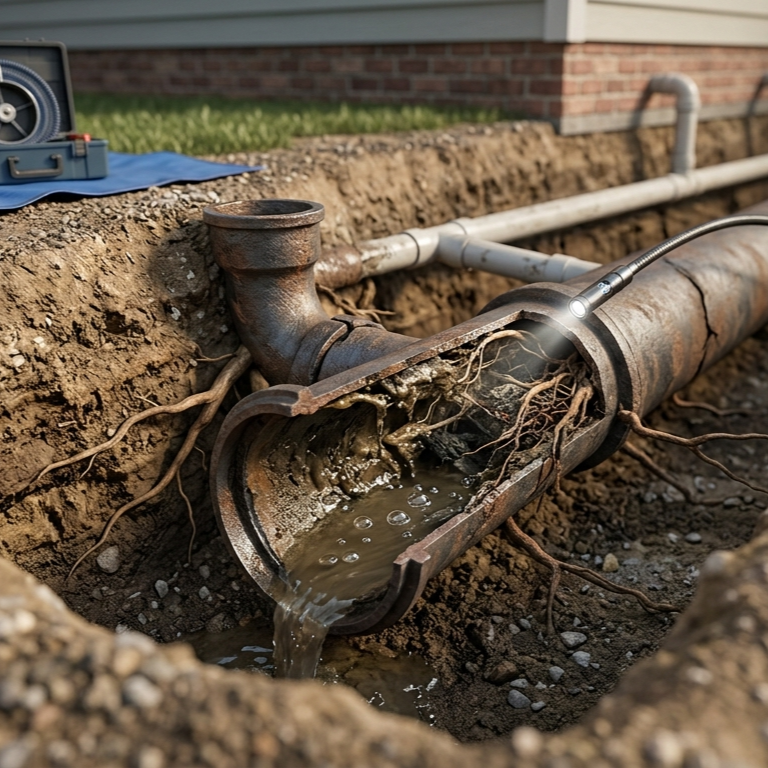
When the main line is the cause of slow drainage, it's usually because the line is partially blocked or obstructed. The water can still get through — which is why the drains are slow rather than fully backed up — but the flow is restricted. Several things can cause this partial blockage. Buildup of grease, debris, and other material can narrow the main line. Tree roots can intrude into the line through joints or cracks, partially obstructing it and catching passing debris. Pipe damage, sagging, or partial collapse can restrict the flow. So, all your drains being slow usually means the main line is partially blocked by one of these, slowing everything down. The partial nature is why you get slow drainage rather than a complete stop.
| Cause of slow main line | What's happening |
|---|---|
| Buildup in the main line | Grease/debris narrows the pipe |
| Tree root intrusion | Roots partially block and catch debris |
| Pipe damage or sagging | Restricts flow through the line |
| Partial blockage overall | Water gets through slowly |
Why It's a Warning Sign
Whole-house slow drains are an important early warning, because a partial main line blockage tends to worsen over time. What's slowing your drains now can progress to a complete blockage, at which point wastewater has nowhere to go and backs up into the home — a sewage backup, which is messy, unhealthy, and a much bigger problem than slow drains. So slow drains across the house are essentially a heads-up that the main line is partially obstructed and heading toward a backup if not addressed. This is why it's worth taking seriously rather than living with: catching it at the slow-drain stage lets you have the main line cleared before it backs up. The slowness is a warning before the backup.
Don't Mistake It for Individual Clogs
A common mistake is treating whole-house slow drains as a series of individual clogs — plunging or clearing each fixture's drain. But if the cause is the main line, clearing individual drains won't fix it, because the problem is the shared line downstream, not each fixture. The drains will stay slow until the main line itself is cleared. So recognizing that all drains slow points to the main line saves you from chasing the wrong fix at individual fixtures. Instead, the main line needs to be addressed. This is why distinguishing a local clog (one slow drain) from a main line issue (multiple or all drains slow) matters — it directs you to the actual cause.
Notice the pattern. If just one drain is slow, it's likely a local clog at that fixture. If multiple drains or the whole house are slow at the same time — and especially if you also hear gurgling or notice odors — that points to the main line, and clearing individual drains won't solve it. The main line needs attention.
What to Do
If all your drains are slow at once, the right step is to have the main sewer line inspected and cleared, rather than working on individual drains. Because the main line is below ground and the cause could be buildup, tree roots, or pipe damage, a professional is needed to diagnose the issue — often using a sewer camera to inspect the line and identify the cause — and to clear or repair it. Methods like hydro jetting can clear buildup from the main line thoroughly, while root intrusion or pipe damage may need specific approaches. Addressing the main line promptly, while the drains are still just slow rather than backed up, is the goal. A plumber can inspect the main line, determine the cause, and clear it, restoring proper drainage throughout the house and preventing a backup.
Frequently Asked Questions
Because all your drains share one main sewer line, and a problem with that line affects everything draining through it. A partial blockage in the main line — from buildup, tree roots, or pipe damage — slows all the drains at once. A single slow drain is usually a local clog, but whole-house slow drainage points to the shared main line rather than any one fixture.
Usually, yes. When multiple or all drains are slow at the same time, it points to the main sewer line they all share, rather than individual clogs. The main line carries all the home's wastewater, so a partial obstruction there slows everything. This is distinct from a single slow drain, which is typically a local clog. So, whole-house slow drains are a strong indicator of a main line issue.
A partial blockage or obstruction in the main line. This can be a buildup of grease and debris narrowing the pipe, tree roots intruding through joints or cracks and partially blocking it, or pipe damage, sagging, or partial collapse restricting flow. The blockage is partial — water still gets through slowly, which is why you get slow drainage rather than a complete stop. A camera inspection can identify the specific cause.
No, if the cause is the main line. Clearing individual fixture drains won't fix a main line problem because the obstruction is in the shared line downstream, not at each fixture. The drains will stay slow until the main line itself is cleared. This is why recognizing that all drains slow points to the main line is important — it directs you to address the actual cause rather than each drain.
It can be. A partial main line blockage that's slowing your drains now tends to worsen over time and can progress to a complete blockage, at which point wastewater backs up into the home — a messy, unhealthy sewage backup. So, whole-house slow drains are essentially a warning that the main line is obstructed and heading toward a backup, which is why addressing them promptly is worthwhile.
Have the main sewer line inspected and cleared, rather than working on individual drains. Because the main line is below ground and the cause could be buildup, roots, or pipe damage, a professional is needed to diagnose it (often with a sewer camera) and clear or repair it. The goal is to address the main line while the drains are still just slow, before a backup.
Whole-House Slow Drains Mean the Main Line
When all your drains are slow at once, the culprit is usually the main sewer line they all share, partially blocked by buildup, tree roots, or pipe damage. It's a warning sign, because a partial blockage can progress to a full sewage backup. Clearing individual drains won't fix a main line problem — the main line itself needs to be inspected and cleared. Acting promptly at the slow-drain stage, with a professional, prevents the messier backup that follows.
All your drains slow at once? — Get the main sewer line inspected and cleared before it backs up. Clog Squad serves Holland, Grand Rapids, Grand Haven. Call (616) 779-7675.
