
Why Does My Basement Drain Back Up? 6 Real Causes
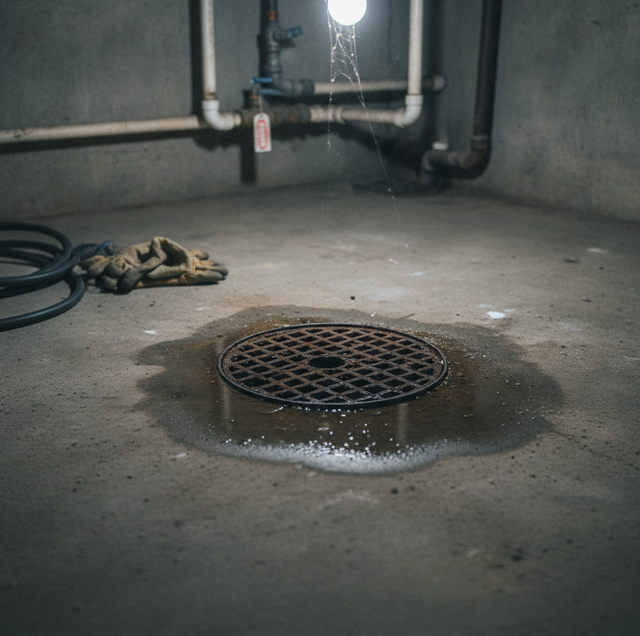
Quick Answer: Your basement floor drain is the lowest opening in the house, so whenever the drainage system cannot move water out fast enough, water surfaces there first. The backup means one of a few things: a clog in the main sewer line, tree roots in the buried lateral, a broken or bellied pipe, storm and groundwater overwhelming the system, or a municipal main backing up toward the house. What comes up (and whether it smells) tells you which one you are dealing with.
You run the washing machine, take a shower, or a hard rain rolls through, and then you find it: water pooling around the round metal drain in the basement floor. Sometimes it is clear, sometimes it is dark and foul. Either way, the basement floods while the sinks and toilets upstairs seem fine. That pattern is not random, and it is the single biggest clue to what has gone wrong.
Why The Basement Drain Floods First
Think of your home's drainage like a set of stadium seats sloping toward a single exit at the bottom. The basement floor drain sits lower than every sink, tub, and toilet in the house. Wastewater from all of it flows downhill and exits through one main sewer line that runs to the street or to a septic tank.
When that main line cannot move water out, the water has to go somewhere. It backs up through the pipe until it reaches the lowest opening it can find, which is almost always the basement floor drain. So the basement fills before the upstairs even hiccups. The floor drain is not the problem. It is the pressure gauge telling you that the system downstream of it is blocked or overwhelmed.
That is also why a backup here is worth taking seriously right away. By the time water reaches the floor drain, the blockage is usually in the main line serving the whole house, not in a single isolated fixture.
The Real Causes, And How To Tell Them Apart
Several different failures all end the same way, at the floor drain. The trick is reading the clues so you know which one you have.
A Clog In The Main Sewer Line
This is the most common cause. Grease poured down a kitchen sink, cools, and hardens on the pipe wall. "Flushable" wipes, paper towels, and hygiene products snag and mat together. Over months or years, a pipe with a slight sag (a "belly") collects debris in the low spot until the channel closes off.
The tell: it backs up whenever you use water, not just during storms. Run the washing machine and the floor drain gurgles or overflows. Flush a toilet, and you hear bubbling in the basement. Multiple fixtures act up at once because they all drain to the same blocked line. The water that surfaces is usually sewage, dark and foul, because it is household wastewater with nowhere to go.
Tree Roots In The Buried Lateral
The lateral is the section of sewer pipe buried between your house and the city main. Roots are drawn to the moisture and nutrients inside it, and they find their way in through joints and cracks. Older homes often have clay tile or, in some cases, Orangeburg (a tar-and-fiber pipe used mid-century), both of which develop the gaps that roots exploit. Once inside, roots form a fibrous mat that catches everything flushing past.
The tell: backups that start slow and get worse over months, sometimes shifting with the seasons as roots grow and go dormant. Roots cannot be confirmed by guessing. A camera inspection, in which a technician feeds a waterproof camera down the line, shows the intrusion directly and pinpoints how far out it extends.
A Collapsed Or Bellied Pipe
An old pipe does not last forever. Clay and cast iron crack, shift with the soil, or sag into a low spot that traps water and solids. Freeze-thaw cycling through the seasons stresses the ground around a shallow lateral, and constant soil movement finishes the job over years, not just in one cold snap.
The tell: recurring backups that come back quickly even after the line is cleared. If snaking the line gives you a few clean days and then the trouble returns, the pipe itself, not just its contents, is likely the issue. A camera confirms a break, offset joint, or belly.
Heavy Rain And Groundwater Overwhelming The System
Sometimes the drain only backs up when it rains. Heavy rainfall and a high water table make groundwater a genuine factor. If downspouts, footing drains, or a failing sump pump route stormwater into the same pipes that carry sewage, heavy rain can push more water through than the line can handle. In some older neighborhoods, storm and sanitary lines are combined, so a saturated system sends water straight up the floor drain.
The tell: the backup lines up with the weather, not with your water use. The water is usually clean or lightly tinted rather than raw sewage. If the basement stays dry until a downpour, look at the stormwater and the sump system, not a clog.
A Municipal Main Backing Up
Occasionally, the blockage is not on your property at all. When the city main gets overloaded or blocked, sewage can push backward toward your house, and again it exits at the lowest opening: your floor drain.
The tell: you did nothing, no heavy water use, and sometimes no rain, yet sewage appears. Neighbors on the same street may see it too. This is where a backwater valve earns its keep, because it is designed to close against reverse flow from the city side.
A Dry Trap Letting In Odor
One cause is not a flood at all. That floor drain has a trap beneath it, a curved section that holds a plug of water to block sewer gas. In a basement that rarely sees water, the trap can evaporate dry, and then sewer smell drifts up.
The tell: a rotten, sulfur odor with no standing water. The fix is usually as simple as pouring a bucket of water (a little mineral oil on top slows evaporation) down the drain to refill the trap. If the smell persists after that, the venting or a cracked line may need a look.
Clean Water Or Sewage: Read The Difference
Before anything else, identify what is coming up, because it changes both the urgency and the cleanup.
Clean or lightly cloudy water that appears during or after rain suggests stormwater, groundwater, or a sump issue. It is still a mess, but it is not a biohazard.
Dark, foul water with solids or a sewage smell points to a main-line clog, roots, or a city backup. That is contaminated wastewater, and it is a biohazard. Do not wade into it, do not try to bail it with household buckets and rags, and keep kids and pets away. Sewage carries bacteria and viruses that make proper containment and disinfection necessary.
A quick field checklist:
- Only when it rains, and clean water? Stormwater, groundwater, or sump.
- Every time you use water, does it smell? Main-line clog.
- Multiple fixtures gurgling together? Main line, not a single fixture.
- Just the floor drain, no water use, sewage appears? Suspect roots or a city-side backup.
What Actually Fixes Each One
The right repair depends on the cause, which is why diagnosis comes first.
A local or moderate clog usually clears with a drain snake or powered auger that cuts through the blockage and pulls it back. For grease buildup, a heavy root mat, or a line that keeps clogging, hydro jetting scours the full inside diameter of the pipe with high-pressure water, which a snake alone cannot do. Recurring trouble is the signal to run a camera inspection and stop guessing.
If roots are confirmed, options range from cutting and treating them to lining or replacing the damaged section of the lateral. A cracked, offset, or collapsed pipe generally needs a spot repair or a liner, because clearing it only buys time. For repeated municipal backups, a backwater valve installed on the main line closes automatically when flow tries to reverse, keeping city sewage out of your basement. And when the culprit is stormwater, the fix lives outside the sewer: redirecting downspouts away from the foundation, correcting grading that slopes water toward the house, and servicing or upgrading the sump pump so groundwater goes where it belongs.
Frequently Asked Questions
It decides both your safety and your cleanup. Clear water from rain, groundwater, or a sump is unpleasant but not hazardous, and it can often be dried and dehumidified. Dark, smelly water is raw sewage and a biohazard: it carries E. coli, hepatitis, and other pathogens, so it needs professional-grade disinfection, and porous items it soaks (cardboard, carpet pad, drywall bottoms) usually cannot be salvaged. Reputable drain crews disinfect their equipment between jobs for exactly this reason.
Timing separates a stormwater problem from a sewer clog. If the drain only floods during or after rain, water is entering the system faster than it can leave, usually because downspouts, footing drains, or a struggling sump feed into the drainage system, or because an older neighborhood runs storm and sanitary flows in a single combined pipe. A clog behaves differently: it backs up on your schedule, whenever you run the washer or shower, regardless of the weather outside.
A backwater valve is a one-way gate installed in your main sewer line, usually near where it leaves the house. It has a flap that hangs open for normal outflow and swings shut when water tries to flow backward, which is exactly what happens during a municipal main surge. It is one of the few things that specifically blocks city-side backups. It does not fix a clog on your own line, and it needs occasional inspection to ensure the flap seats cleanly and that no debris props it open.
Yes, and in older lateral pipes, it is one of the leading causes. Roots sense moisture and nutrients in the sewer and grow through hairline cracks and loose joints, then spread into a mesh that traps waste. You confirm it with a camera inspection: a technician feeds a waterproof camera down the cleanout and watches the intrusion on a monitor, which also shows where the roots sit and whether the pipe around them is cracked or intact. That footage is what separates a simple root cut from a pipe that needs relining.
Generally, you own the lateral, the buried pipe running from your house to the connection at the city main, and the municipality owns the main in the street. So a clog or root intrusion in the lateral falls to the homeowner, while a blockage in the public main is the city's. The exact property line where responsibility shifts varies by municipality, and a camera inspection helps establish where the problem actually sits, which matters if you need to document it for the city.
Stop adding water immediately: no flushing, no laundry, no running taps, because everything you send down comes right back up at the floor drain. If the water is or might be sewage, do not wade into it, and if it has reached anywhere near outlets, appliances, or the panel, cut power to the affected circuits at the breaker before you step into a wet basement (only if you can reach the panel safely and dry). Keep people and pets out of the water, note whether it is clean or has sewage in it and whether rain triggered it, and call a drain professional so the line can be cleared and the cause diagnosed before it happens again.
Call for 24-hour drain and sewer service — get the line cleared, camera-inspected, and the real cause fixed. Clog Squad serves Holland, Grand Rapids, Grand Haven. Call (616) 779-7675.
