
Why Do All My Bathroom Drains Run Slow at the Same Time?
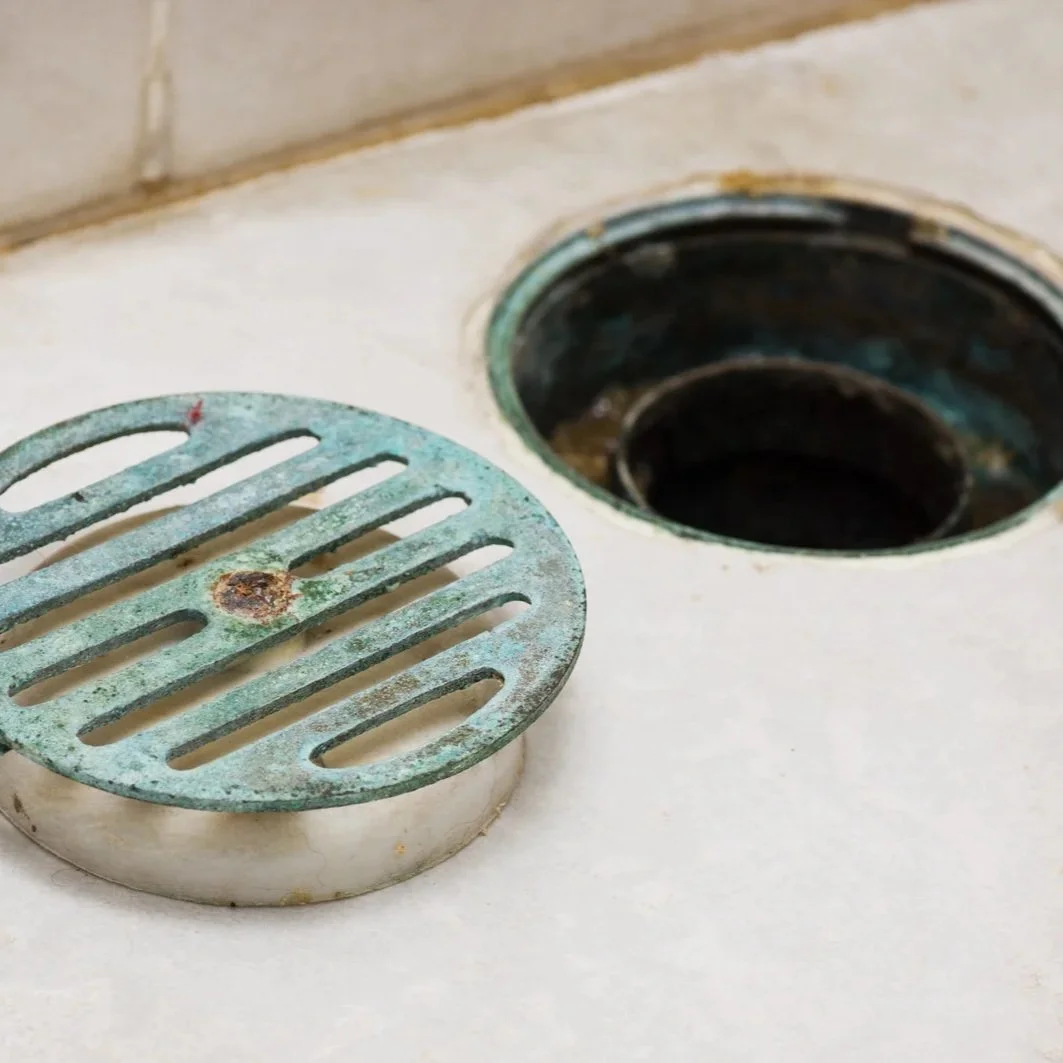
You step out of the shower. Water is still pooled around the drain instead of swirling out. You walk to the sink and rinse — the basin holds onto half an inch of water longer than it should. You flush the toilet on the way out and the bowl refills at half-speed, with that low sucking pull at the end that wasn't there last month.
Three fixtures. One bathroom. Same week.
A single slow drain is usually a fixture-level problem — hair in a stopper, paper in a trap, a soft clog in the first elbow. When every fixture in the same bathroom slows together, the cause isn't at any one of them. It's downstream, where their lines come together, or upstream in the air supply that lets them drain at all.
What "all at once" actually tells you about the line
A house drains in a tree. Each fixture has its own short branch arm — a few feet of pipe from the trap into a wall. Those arms join into one larger horizontal pipe, the bathroom group's branch drain, which feeds the soil stack and then the main line.
When one fixture slows and the others stay fine, the restriction sits in that fixture's own branch arm. When the sink, the tub, and the toilet all slow together, the restriction sits past the point where their lines join — the combined branch, the soil stack, the main, or the vent system that supplies air to all three.
Nothing in any one fixture trap fixes it. The tool has to reach past where the lines come together, and the diagnosis has to name which of four likely causes is actually at work.
The shared bathroom branch is the usual answer
In most houses, the sink, the tub, and the toilet feed a single 2-inch horizontal branch line that runs to the soil stack. That branch is the longest horizontal stretch in the bathroom, and it sits behind a wall or under a floor where nothing about it is visible.
A coating inside that branch slows every fixture above it. Soap scum from the shower. Toothpaste sediment and hair from the sink. Mineral scale from local hard water. The layers stack on the upper half of the pipe — soap film on the wall first, hair caught in the soap, more soap on top, scale binding the mass — until effective diameter drops by a third or more.
The pattern is recognizable. Fixtures slow at the same rate over weeks, no sudden event. The tub holds water at the drain longer than it used to. The sink runs slow with a clean stopper and trap. The toilet refills sluggishly because the bowl can't move water out fast enough during the second half of the flush. A snake from any one fixture clears flow for a few weeks, then the slowdown returns — the cable bores a tunnel through the soft center of the coating and leaves the layer on the wall.
The fix is a wall-to-wall cleaning. A Flex-Shaft cable with a chain head, or a hydro-jet pass, strips the coating edge-to-edge and restores original diameter. Done right, the bathroom runs normally for one to three years.
A vent restriction looks the same from above
The second cause is the one most homeowners never check.
Every drain in a house connects to a vent stack that runs up through the roof. The vent doesn't carry water — it carries air. When water leaves a fixture, an equal volume of air has to come in behind it, or the water pulls a vacuum and chokes its own flow. Same physics as the straw with a thumb on top.
When a vent restricts — a bird nest at the roof terminal, ice in deep winter, a wasp nest in the cap, leaves and pine needles packed into the top — every drain on that vent runs sluggish. Water still falls down the pipe, but with a glug-glug pulse instead of a smooth pour.
The tell that separates a vent problem from a branch coating is sound. A coated branch slows water silently. A blocked vent makes drains audibly gurgle, especially when one fixture drains and another is full. If the sink burps when the toilet flushes, or the tub releases bubbles when the toilet refills, or air bubbles appear in the toilet bowl with nothing else running, the vent is on the suspect list. The fix is at the roof — clear the cap, pull the nest — and the drains speed up the same day.
A main-line slowdown rises into the lowest fixtures first
The third cause is bigger than the bathroom. A restriction in the main sewer — the 4-inch pipe carrying the house out to the city tap or septic — backs flow up into every branch above it.
A main cause shows two extra signals. The basement floor drain sits lower than every upstairs fixture, and a restricted main backs up there first — visible water, or a strong sewer smell pushing through. The laundry standpipe is the second tell. A washing machine pumps a lot of water fast, and a restricted main can't take it — the standpipe gurgles, backs up partway, or pushes brown water across the basement floor.
If the kitchen sink is also slower than it used to be, the restriction sits past the point where every house branch joins the main. Main-line restrictions come from two materials in residential work — grease that worked down from the kitchen, or tree roots that found a hairline gap at a clay or cast iron joint and grew a mesh inside the line. A third less-common cause is a "belly" — a sagging low spot in the buried main where soil settlement has pulled the pipe into a U-shape that holds wastewater and traps solids. A camera shows all three. Cleaning that holds depends on the cause — a hydro-jet for grease, a Flex-Shaft cutter (often paired with trenchless pipe lining) for roots, spot excavation for a belly.
Old cast iron scaling on every line at once
The fourth cause is structural and shows up in older houses with original cast iron drain pipes from before the mid-1970s. Cast iron rusts and scales from the inside on a known schedule. Decades of warm wastewater deposit iron oxide and mineral scale on the interior wall, narrowing every line at once because every line ages at the same rate.
A camera inside an aged cast iron drain shows the picture — rough, pitted, crusty, like the inside of a teakettle that's never been descaled. Pipe that started at 2 inches across can lose a quarter inch off every wall by year fifty, dropping effective diameter by about 25 percent. The rough wall catches everything that passes — hair, soap, lint, paper — and a biofilm forms on top that catches more.
Every drain in this kind of house runs a little slow, all the time, no single fixture standing out. Snaking buys days, not weeks. The cause isn't a coating that can be scraped off — it's the pipe interior itself. Pipe milling grinds the layer back to bare iron with a carbide cutter. Sometimes that's the end of the story for another decade. Sometimes the milling reveals pipe thin enough underneath that lining is the next step.
What you can test in five minutes
A few quick checks narrow the suspect list before any service call.
Run the bathroom sink alone, full hot, for thirty seconds. If the basin pools while the tap is open, the slowdown is past the trap. If water keeps up until the tap shuts off then drains slow, the restriction is downstream of the trap but reachable through the branch.
Flush the toilet and immediately watch the sink and tub. If both gurgle or release bubbles as the toilet refills, the vent isn't supplying air fast enough — the toilet's outflow is pulling a vacuum that reaches back through the bathroom branch. That's a vent symptom.
Walk to the basement and look at the floor drain. Standing water or a strong sewer smell points at a main restriction with the bathroom symptoms downstream. A dry, odorless floor drain points the diagnosis back to the bathroom branch or its vent.
Run the kitchen sink and washing machine. If they drain normally, the cause is local to the bathroom. If they're also slower than they used to be, the restriction sits downstream of every branch — the main.
These tests don't fix anything. They tell the next person on the phone which truck to send and what to bring.
Why snaking one fixture won't fix the group
The instinct on a slow bathroom is to grab a hand snake at the sink. That misreads the geometry.
A hand snake fed through the sink trap travels into the sink's own branch arm — a few feet before it hits the tee where the sink joins the larger branch. The cable's reach ends roughly where the slowdown starts. A pass from the tub and a pass from the toilet hit the same junction from different directions, none of them past it. Each fixture clears for a few days, the slowdown returns.
The cleaning has to start past the bathroom branch — at the soil stack cleanout in most houses, or at the main-line cleanout in the basement. From there the tool runs back up the branch toward the fixtures, cleaning wall to wall, and exits past the trap arms with the coating off the pipe interior.
For a vent issue, no in-line cleaning helps. The fix is at the roof terminal — physically opening the vent so air moves through again. The right starting point matters more than the tool.
Frequently Asked Questions
Does it matter if the toilet is the slowest fixture or the sink is?
+Some. The toilet draws the most water in the shortest burst, so a partial restriction shows up there first — the bowl refills slow and pulls hard at the end of the flush. The sink and tub show the restriction once it's worse. A bathroom where only the toilet is hesitating is the early version of the same problem.
Could a clogged vent really make every drain in one bathroom slow?
+Yes — especially after winter. Ice forms at the roof terminal when warm sewer air condenses and refreezes overnight, sometimes sealing the vent by February. Bird nests build up in spring. Wasp nests appear in summer. Any of those restricts air supply and slows every fixture on the vent stack.
Why does the basement floor drain matter when the problem is in the bathroom?
+It's the lowest opening connected to the main line. If the main is restricted, the floor drain is the first place backup water finds its way out. A wet or smelly floor drain alongside a slow upstairs bathroom is the giveaway that the bathroom slowdown is a downstream symptom, not a bathroom problem.
Should I keep using the bathroom while it's draining slow?
+For a few days, fine. Past a week or two, the risk shifts. A coating thick enough to slow three fixtures is close to the point where the next dose of hair or paper turns it into a full clog. A vent problem can let sewer gas creep in. A main restriction will back up the basement floor drain sooner rather than later.
How quickly does a camera identify the actual cause?
+The picture answers the question in three minutes. A push camera through the soil-stack cleanout shows the bathroom branch from the inside — coated walls look like a smooth tan ring narrowing the diameter, scale looks rough and crusty, roots in the main show as fine threads at a joint downstream. A dark vent stack with no daylight at the top is a blocked vent.
Are there situations where the fix turns out to be simple?
+Often. A vent cleared at the roof is a thirty-minute job, and the drains run normally the same day. A branch cleaned wall-to-wall through a single cleanout is one visit. The expensive cases are the ones where the bathroom symptoms turn out to be downstream of a rooted main or a failing cast iron lateral — and even those move from open-ended to specific once the camera shows the cause.
Reading the bathroom as one system
A bathroom slowing on every fixture at once is not three problems. It's one problem in three places. The branch line shared by the sink, the tub, and the toilet. The vent supplying air to all three. The main line carrying everything downstream. Or an old cast iron pipe aging across the whole house.
The water isn't slow because something is in the way of one fixture. It's slow because the geometry past the fixtures has changed. The diagnosis starts with a camera that shows the wall instead of guessing through a snake head.
Once the cause is on screen, the fix is straightforward. Wall-to-wall cleaning on a coated branch. A clear at the roof for a blocked vent. A Flex-Shaft or jetter on a restricted main. Pipe milling on aged cast iron. All faster and cheaper than a year of snaking from the sink cabinet, hoping the next pass is the one that lasts.
