
What Hydro Jetting Actually Does Inside a Pipe
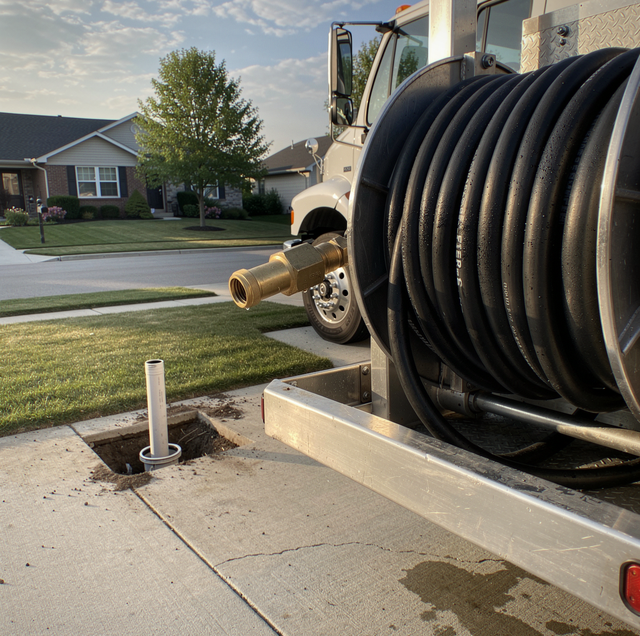
Picture a firehose small enough to thread through a four-inch pipe, but strong enough to strip grease off cast iron. That's closer to what hydro jetting actually is than the name suggests. A technician doesn't punch a channel through a clog and call the job finished. The hose runs the full length of the line, from the cleanout to wherever it ties into the main, and the water does something no blade ever touches: it strips the pipe wall itself, not just the spot where the water stopped moving.
How Water Pressure Becomes a Cutting Force
There's no blade inside a jetting hose. No auger head, no rotating cutter, nothing that grinds against the pipe. The cleaning occurs because water under high pressure, forced through small nozzle openings, becomes more like a cutting tool than a stream. At the nozzle tip, that pressure converts into velocity, and the velocity is what shears grease, scale, and root hair loose from the pipe wall.
This works because of two different forces acting in the same stream. Down the center of the pipe, that water carries flow velocity, moving loosened material toward the main. At the pipe wall, the same water applies shear stress, a dragging force strong enough to peel grease, scale, and root hair off the surface it passes over. It's also why the hose barely needs to be pushed by hand: the nozzle's jets fire backward and outward at an angle, and that backward thrust is what pulls the hose forward through the pipe on its own. Water doesn't need to touch a clog to break it apart. It erodes it, the way a river cuts through rock given enough force and enough time, except a jetting pass does in minutes what a river does in centuries.
How Much Pressure and Flow It Actually Takes
Pressure and flow: A residential jetting job typically runs somewhere in the 1,500 to 4,000 PSI range, moving water at 4 to 8 gallons per minute through a hose sized for household drain and lateral lines. Commercial and mainline work runs up to about 4,000 PSI, but at far higher flow, commonly 40 to 80 gallons per minute on truck-mounted mainline jetters, because a wider pipe needs volume, not just pressure, to carry the loosened material out.
Pressure alone isn't the whole story. Flow rate matters just as much, because the water has to carry loosened debris out of the pipe as it goes. A jetter that hits hard but doesn't move enough water leaves the scoured-off material sitting in the line instead of flushing it toward the main.
The Nozzle Does the Real Work
The hose is just a delivery system. The nozzle on the end decides what actually happens inside the pipe. A penetrating nozzle fires most of its jets forward, built to push through a blockage and get the hose moving down the line first. Once the nozzle clears the clog, the hose comes back out, and a different nozzle head goes on, and this is where the cleaning really happens.
A rotating or chisel-style nozzle fires its jets backward and outward at an angle as the hose is pulled back out of the pipe. That spray pattern is the whole point. Instead of blasting straight ahead like a garden hose, the water sprays sideways in a spinning or fanned pattern that contacts the entire circumference of the pipe wall as the nozzle travels. Every inch of pipe the nozzle passes through gets hit by water from multiple angles, not just the center of the flow path.
Why It Cleans the Whole Pipe, Not Just the Clog
Opening a path through a blockage solves the immediate obstruction. It doesn't touch the grease film coating the pipe six feet upstream, or the scale narrowing the pipe's diameter along its entire run.
Hydro jetting works differently because the nozzle physically travels the length of the pipe, usually pulled back slowly and then passed through again once or twice more to catch anything the first pass missed. That backward-and-outward spray pattern means the pipe wall gets scoured from the point nearest the access opening all the way to wherever the line was jetted to. The result isn't a hole through the clog. It's the pipe interior that's closer to its original diameter along its entire length, not just at the one spot that was blocked.
Grease Lines Need a Different Kind of Clean
A restaurant's grease line rarely clogs at one single point the way a tree root does. Hot grease and fats go down the drain, cool as they move through the pipe, and coat the interior wall in a layer that thickens with every shift the kitchen runs. That layer builds along the entire run of pipe, not just near a joint or a bend.
Opening a narrow channel through that buildup leaves most of the coating still stuck to the wall, narrowing the pipe again within days or weeks. Jetting strips the grease film from the entire interior surface, which is why commercial grease line maintenance relies on hydro jetting. The water doesn't just open a path. It removes the coating that caused the path to close in the first place.
Root Hair and the Problem With Older Clay and Cast Iron
Tree roots don't wait for a wide-open crack to get into a sewer line. A joint in older clay pipe that's shifted even slightly, or a hairline fracture in aging cast iron, lets in enough moisture and warmth to draw roots straight to it. What starts as a few root hairs threading through a gap can turn into a dense mat that catches paper and grease, slowing the whole line.
Jetting shears the root hairs off the pipe wall and flushes the debris out, clearing roots along the whole section the nozzle passes through rather than just the thickest clump. It won't close the crack the roots are growing through. That's a separate repair, which is why a line with heavy root intrusion often gets paired with camera work to determine whether pipe lining or another trenchless repair is needed once the roots are cleared.
Cast iron brings its own version of the same problem. Decades of mineral buildup, sometimes called scale, forms rough ridges on the interior wall that snag debris and slow flow even when nothing is technically blocking the pipe. Jetting's scouring action knocks that scale down. In a pipe with especially heavy buildup, a technician might follow up with pipe milling, which uses a mechanical cutter to grind away buildup that's hardened past what water pressure alone will strip.
Why a Camera Goes First
Full jetting pressure isn't something a technician points down a pipe blind. Older clay and cast iron pipe can be fragile in ways that aren't visible from the surface, and a section that's already cracked or badly corroded can be damaged by pressure that a sound section of pipe handles without issue. That's why a sewer camera inspection so often comes before jetting rather than after.
The camera shows what the pipe is actually made of, where the joints are, and whether there's a crack, an offset, or a soft spot that calls for a gentler pass rather than the highest available pressure. It's also how a technician confirms the cause of a slow drain in the first place, whether that's roots, grease, scale, or something structural that jetting won't fix on its own. Slow-drain diagnostics and camera work go together for exactly this reason: you clean smarter once you know what you're cleaning.
What a Clean Pipe Wall Actually Buys You
A pipe that's had its full interior scoured, not just its center channel reopened, stays open longer. Grease has less of a rough surface to cling to on the next pass through the kitchen. Scale that's been knocked down doesn't offer roots as easy a foothold. That's the real difference between a line that gets jetted occasionally as part of preventive drain maintenance and one that only gets attention after it's already backed up.
None of that means jetting replaces every other service on a sewer line. A cracked pipe still needs lining or repair. A line with a bad enough offset still needs to be addressed structurally. What jetting does is give you a pipe that's clean along its whole length, so whatever comes next- a camera inspection, a repair, or just routine maintenance- starts from an accurate picture instead of one clouded by years of buildup.
Frequently Asked Questions
PVC generally tolerates the full pressure range without issue, but older or already-cracked clay and cast iron sometimes need a lower-pressure pass or a different nozzle, and in some cases loose debris inside a damaged pipe is actually helping hold a crack together until trenchless sewer pipe repair or pipe lining can be scheduled.
For a typical residential lateral, the jetting itself runs roughly 30 to 60 minutes once the cleanout is open and the hose is ready to feed in. Most of a service visit's total time goes to setup and camera work rather than the pass itself.
It can cause a mess even on a sound pipe if access isn't accounted for first. Jetting a line with an unlocated cleanout or a blocked vent can push water backward through a floor drain or another low fixture instead of forward toward the main. A technician confirms where the water has to go before the nozzle goes in.
It clears root hairs and root masses off the interior wall along the jetted section, but roots often return through the same joint or crack within a growing season unless that opening is sealed, which is a separate repair from the jetting itself.
There's no single schedule, but commercial kitchen grease lines typically need it far more often than a home sewer lateral does, since grease reaccumulates on the wall every time hot fat goes down the drain, whereas a residential line without root or grease issues might go years between passes.
No excavation is involved. The hose and nozzle go in through an existing cleanout or other access point already built into the plumbing, the same opening a camera or cable would use.
Grease, scale, and root hair don't stay confined to one spot in a pipe, so cleaning that only addresses one spot rarely holds. Water pressure applied the right way, with the right nozzle, on a pipe whose condition you actually know, is what gets you a line that's clean end to end instead of just open enough to pass for it.
Schedule a hydro jetting service — get your pipe scoured clean along its full length, not just unclogged at one point. Clog Squad serves Holland, Grand Rapids, and Grand Haven. Call (616) 779-7675.
