
Can Hydro Jetting Crack Old or Weakened Pipes?
The camera on the laptop shows a rusty brown tunnel narrowing by the foot. The technician slides it back through twenty feet of basement cast iron and freezes the frame on a pitted section. He says the line needs a real cleaning, and the word that comes next is "hydro jet." The first thought back is the wrong one — four thousand psi blasting through pipe that's been in the ground since the Truman administration.
It's a fair question. Hydro jetting can crack a weakened pipe — under the wrong conditions, with the wrong nozzle, on a wall that was already compromised before the hose entered the line. It also runs safely thousands of times a day on aged cast iron, clay, and decades-old PVC. The difference between the two outcomes isn't the tool. It's the part of the diagnosis that happens before the jetter fires.
What a hydro jetter actually does inside a pipe
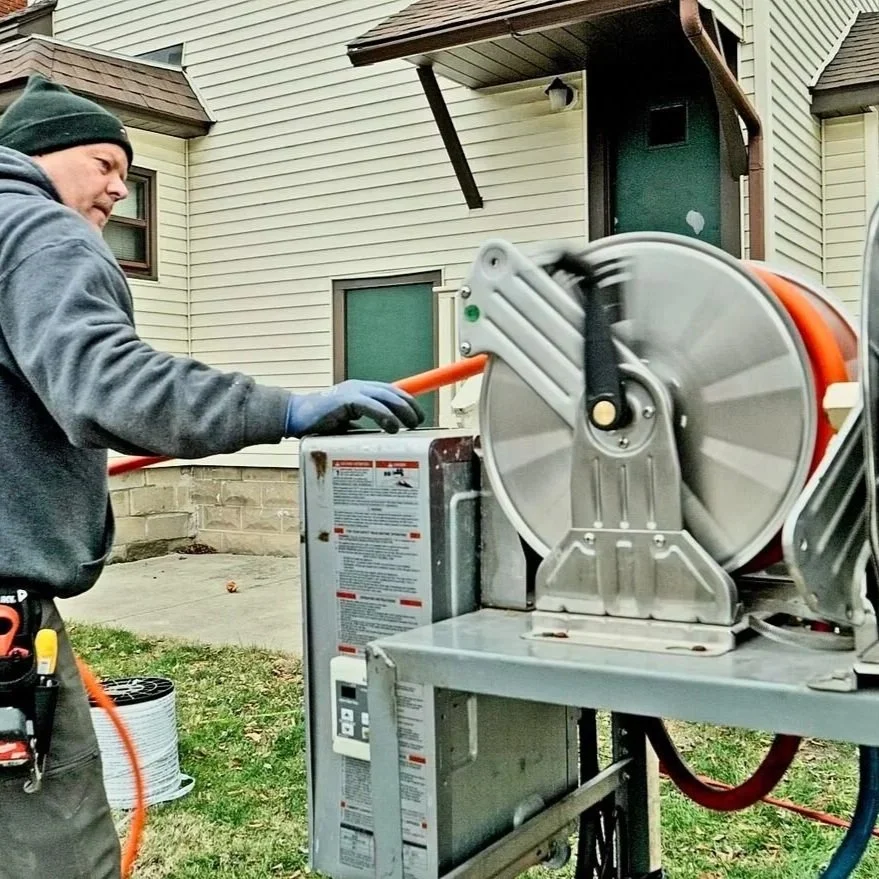
A jetter pulls a half-inch or three-quarter-inch hose through the line under high-pressure water flow. The business end is a metal nozzle drilled with jets — usually one forward jet to break through obstructions and several rear-facing jets angled backward at roughly twenty degrees. The rear jets do the cleaning. They push the nozzle forward and shear material off the inner wall in a 360-degree pattern.
Pressure at the nozzle on a residential jetter runs 1,500 to 4,000 psi, with flow rates of 4 to 18 gallons per minute. The force the pipe wall actually experiences isn't the pressure on the dial — it's the impingement force of those rear-facing jets at the angle they strike, distributed across the spray pattern. A jetter running 4,000 psi at the nozzle delivers something closer to 200 to 400 psi of actual impact on the pipe wall at typical standoff distance — enough to shear grease and soft scale, not enough to crack intact pipe of any material in common residential use.
Why "the pressure" isn't where the risk lives
Most homeowners hear "four thousand psi" and picture a fire hose hitting drywall. That picture is wrong in two ways. The jets aren't hitting one square inch — they spray outward across the full circumference, then slide forward as the nozzle moves. Energy per square inch on the pipe wall is a small fraction of the rated nozzle psi. And the force shearing the wall is shear force, not impact force. The jets are angled to scrape, not to punch. They peel material off in a tangent rather than hammering it straight on.
The real risk isn't pressure. It's pipe condition. A jetter passing through a pipe wall that's already compromised — a pinhole eating through the metal, a longitudinal crack waiting for any disturbance, a section of clay missing chunks at a joint — can finish the work corrosion already started. Pressure doesn't break sound pipe. It opens defects in pipe that was already failing.
The pipes most at risk from a high-pressure pass
A handful of conditions move a line from "safe to jet" into "operator needs to make a decision before the hose goes in."
Cast iron that's lost wall thickness to interior corrosion is the most common. Iron rusts from the inside as warm wastewater oxidizes the surface year after year. By year forty or fifty, the wall can be a third thinner than installed, with pinhole zones where corrosion has eaten almost through. A jet pass stripping the scale off the inside doesn't crack the pipe — but it can blow out a pinhole the scale was sealing, turning a hidden leak into an active one. The pipe failed first. The cleaning revealed it.
Clay tile sewer pipe with cracked or offset joints is the second category. Clay is brittle. A joint that has shifted or fractured is a stress riser, and water pressure during the pass can push fragments further apart. Roots often hold the fragments in place; cutting the roots and jetting the line can free fragments the roots were anchoring.
Orangeburg — the bituminous fiber pipe used between roughly 1945 and 1972 — should never see a jetter. Most Orangeburg lines have already deformed into an oval or partial collapse, and the material delaminates under modest pressure. A camera shows Orangeburg immediately, and the recommendation is replacement or lining, not cleaning.
Galvanized steel branch lines from mid-century homes corrode internally on the same schedule as cast iron, with interior scale in irregular bumps. A jet pass on heavily scaled galvanized can dislodge sections of scale that take pipe wall with them. In each case, the pipe already had a problem. The jetter exposed it.
Pipes that handle jetting without difficulty
The other category is much larger.
PVC and ABS plastic drain lines, regardless of age inside their service window, handle residential jetting at any standard pressure without concern. The wall is uniform, the interior is smooth, and the material flexes under shear without cracking. A 30-year-old PVC sewer takes a 4,000 psi pass the same way a new one does.
Sound cast iron — pipe with intact wall thickness, even if scaled — handles jetting safely. A camera survey before the cleaning confirms the wall hasn't been eaten through, and at that point, the cleaning is routine. Heavily scaled cast iron is often safer cleaned with pipe milling, but a hydro-jet pass at moderate pressure is also defensible when the wall thickness is confirmed.
Sound clay tile sewers — intact joints, no offsets, no missing fragments — handle a jet pass at moderate pressure. The clay itself doesn't flex, and a properly directed nozzle doesn't load it laterally. The trouble cases are the ones the camera already flagged for joint damage. Concrete and high-density polyethylene sewers in newer subdivisions are jetted as routine maintenance with no concern. In all of those, the jetter is removing what's in the pipe and leaving the pipe itself alone.
How a camera changes the safety question before the jetter fires
The single decision that moves jetting from a guess into a controlled operation is whether a camera went in before the hose did.
A pre-jet camera pass takes ten to fifteen minutes through a residential lateral. The picture shows pipe material — clay, cast iron, PVC, Orangeburg, galvanized. It shows wall condition — smooth, lightly scaled, heavily scaled, pitted, holed. It shows joint condition — sealed, offset, cracked, missing fragments. It shows defects the jetter shouldn't be near.
After that picture, the operator knows two things the dial alone can't tell them: what pressure is appropriate, and whether jetting is the right tool at all. A pipe with confirmed thin spots gets dialed back and run with a softer nozzle. A pipe with active pinholes gets flagged for repair or lining before any cleaning. An Orangeburg section ends the cleaning conversation and starts a replacement conversation. Pressure that's conservative on intact pipe is excessive on a compromised one, and pressure that's safe on a compromised one is too low to clean intact pipe in any reasonable time. The camera is what closes the gap.
What an experienced operator does with the dial
Pressure isn't a single setting on a residential jetter. It's a working range the operator adjusts based on what the camera showed and what the line is doing during the pass. A known PVC main runs at 3,000 to 4,000 psi. Confirmed cast iron with intact walls and heavy scale opens up at 2,500 to 3,500 psi. Sound clay tile sewer gets jetted at 2,000 to 3,000 psi. Any wall-condition concern walks the dial down to 1,500 to 2,000 psi with a flush nozzle rather than a cutting one.
The nozzle matters as much as the pressure. A penetrator nozzle punches through soft clogs. A flusher nozzle lifts debris without cutting at the wall. A root-cutting nozzle uses tungsten-carbide chain finishers at moderate pressure. Matching the nozzle to the cause keeps the dial conservative.
A reasonable operator also listens to the line during the pass. A pipe taking pressure normally feels neutral on the hose — the nozzle pulls itself forward, water returns to the cleanout in clean flow. A pipe in trouble talks back. Pressure dropping at the gauge means water is finding somewhere it shouldn't be — a hidden crack, a separated joint, a hole through to soil. The pass stops, and the camera goes back in. A second camera pass at the end is what closes the diagnostic loop. Buildup hides defects on the first run; the post-jet picture documents what the wall actually looks like with the grease and scale gone, and catches any condition that wasn't visible before.
Failure modes when jetting meets a compromised line
When jetting causes damage, the failure mode usually falls into one of three patterns.
Pinhole expansion is the most common. A cast iron line with corrosion pits eating most of the way through the wall has zones where the remaining metal is paper-thin. Scale over the pit acts as a temporary patch. A jet pass strips the scale, exposes the pit, and water pressure during the cleaning opens the hole the rest of the way. The cleaning didn't cause the failure — it made the failure visible.
Joint separation is the second. A clay sewer with a shifted joint is held in rough alignment by the soil around it. A jet pass introducing high-pressure flow at the joint can push the upstream and downstream sections further out of line, opening a hairline crack into a quarter-inch step.
Pipe collapse is the third, and the rarest. Orangeburg sections already deforming can fully collapse during a jet pass. Severely corroded cast iron can lose more wall material into the flow. clay tile sewers with structural cracks can drop fragments inward. These outcomes happen on lines a camera would have flagged for replacement before the cleaning started — which is why the camera before the cleaning is non-negotiable on any older home.
Each of these has a common thread. The cleaning didn't damage sound pipe. It exposed damage that was already present.
When jetting is the wrong tool no matter the pressure
A handful of situations call for something other than a hydro jet, regardless of how careful the operator is. Orangeburg requires replacement or full-line trenchless lining. Severely corroded cast iron with thin spots needs pipe milling at low aggression or lining to seal the line before any further cleaning. clay tile sewers with active joint offsets need joint repair or lining before high-pressure work. Lines with bellies clean fine but reform the problem fast unless the sag itself is corrected.
A scale-heavy cast iron line has pipe milling as a better option than jetting alone — the carbide cutter grinds scale back to bare iron in a controlled way that pressure can't match, and the wall is left intact rather than tested. Mainline root masses heavy enough to fully obstruct the line clean better with a Flex-Shaft cutter first, then a jetter for the wall pass. A jetter against a thick root mass dissipates pressure into the mass without reaching the wall.
Frequently Asked Questions
Is hydro jetting safe for cast iron pipes that are forty or fifty years old?
+In most cases, yes — provided a camera survey confirms the wall thickness is intact. Cast iron at that age usually has heavy scale but sound underlying metal, and a controlled jet pass clears the scale safely. The exceptions are pipes with visible pinholes, severe pitting, or wall thickness below what the camera operator considers structurally sound. Those get repaired or lined first.
What pressure does residential hydro jetting actually run at?
+Standard residential pressures range from 1,500 to 4,000 psi at the nozzle, with flow rates of 4 to 18 gallons per minute. The operator dials within that range based on what the camera showed — lower pressure on aged or compromised pipe, higher on intact PVC or sound cast iron with heavy scale. There's no single "residential pressure"; there's a range and a judgment call.
How does a plumber decide if my line is safe to jet?
+A camera survey first. The picture shows pipe material, wall condition, joint condition, and any defects. Sound material with intact walls — even if scaled — gets jetted at appropriate pressure. Material with structural problems gets routed to repair, milling, or lining instead. The decision lives in what the camera shows, not in a rule of thumb about pipe age.
What happens if the jetter hits a thin spot in an old pipe?
+If the spot is genuinely thin — paper-thin metal under a layer of scale, for example — stripping the scale can open a pinhole. Water pressure during the cleaning then pushes through. This isn't the jetter damaging sound pipe; it's the cleaning revealing damage that was already present. A camera before the jetter usually catches the thin spot first, and the operator dials back or recommends repair.
Should an older line be lined before it's jetted instead?
+Depends on the picture. A line with one or two specific defects is sometimes better lined first and the rest cleaned conventionally. A line with widespread thin walls gets lined as the cleaning. A line with sound walls and only a scaling problem is cleaned, not lined.
Does hydro jetting itself damage the inside of any pipe over time?
+No, on intact pipe. Water doesn't abrade smooth PVC, doesn't pit sound cast iron, doesn't erode clay. What it removes is what shouldn't be in the line — grease, scale, soap film, biofilm, debris. A careful jet pass leaves less wear behind than a year of warm wastewater flowing over scale.
Pressure isn't the question. Pipe condition is
Hydro jetting cracks the pipe in roughly the same way pulling a frayed extension cord starts a fire — it can happen, but only when something else was wrong first. Sound pipe, regardless of age or material, handles the working pressures of a residential jetter without difficulty. The pressure that gets blamed when an older line fails during a cleaning was almost never the cause. The pipe was already deteriorating; the cleaning revealed what was there.
The way to answer the safety question on any specific pipe is to put a camera in it before the hose goes anywhere near it. Pipe material, wall thickness, joint condition, and visible defects all show up on the screen in fifteen minutes. For a homeowner staring at a forty-year-old cast iron stack or a clay sewer running under an old front yard, the practical answer isn't "never jet" or "jet at full pressure." It's "look first, then clean." A camera survey costs a small fraction of the worst-case repair, and once the line is on screen, the decision about whether jetting is safe at all — and at what pressure — becomes a specific conversation about a specific pipe.
