
How Does Pipe Milling Compare to Snaking Inside Old Cast Iron?
Hot water has been running at the kitchen sink for nine minutes. The basin is half full and the swirl has stopped. A cable-machine drum sits open on the basement floor. The plumber feeds a sectional cable into the cleanout, hears it bang against something dense at the twenty-foot mark, and works the head back and forth. The sink upstairs gives one watery cough, drops two inches, and stops.
That's not a small clog the cable missed. That's cast iron scale — and a cable head against a scaled pipe is the kind of mismatch that turns into a $400 service call every six weeks for the rest of the year.
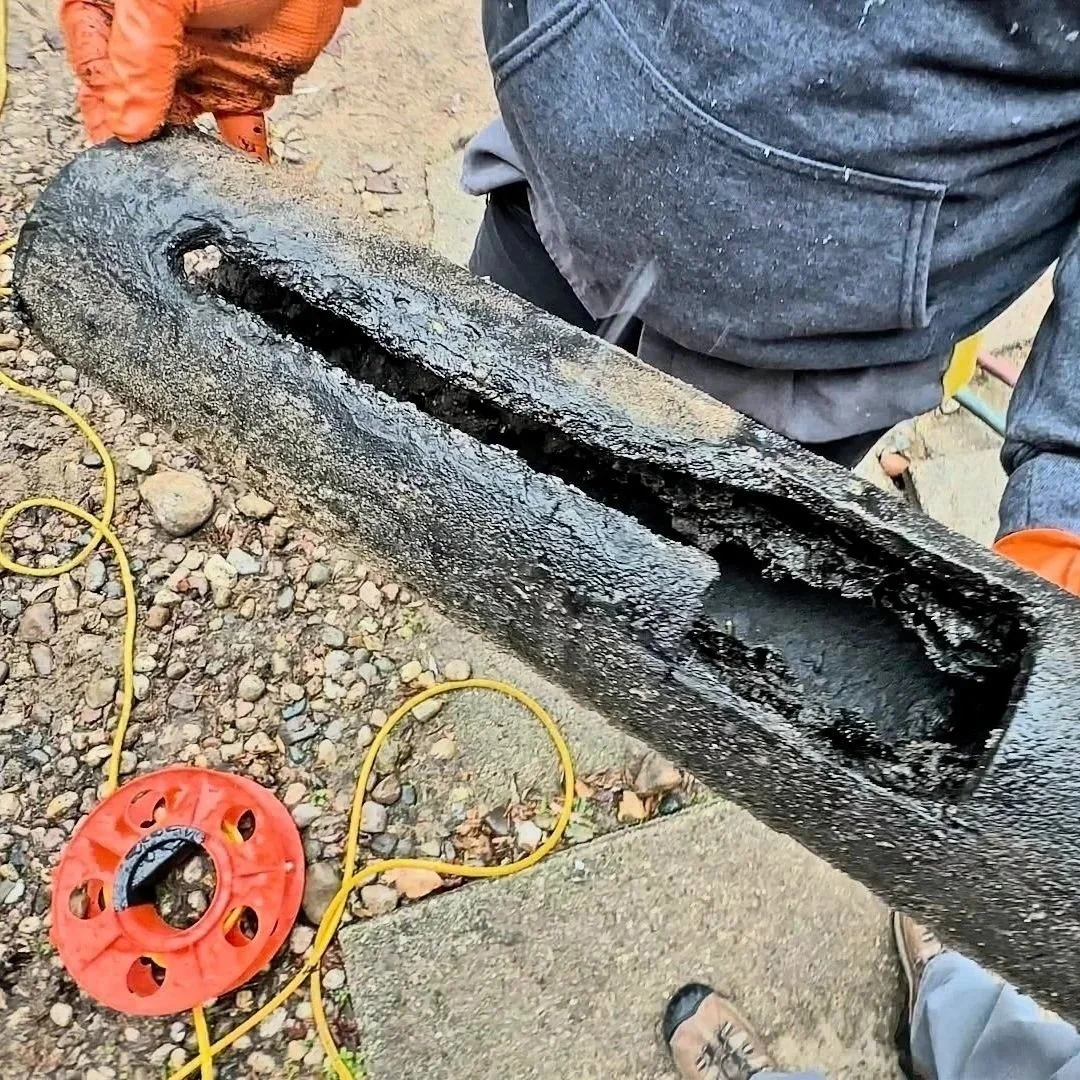
Snaking and pipe milling exist because the things blocking residential drains don't share a shape. A cable was designed for soft, central material — a hair wad, a paper tangle, a grease wad the trap held in place. Pipe milling was designed for what's bonded to the wall: scale, hardened mineral, and rusted interior in a pipe that hasn't been opened up since the Eisenhower administration. The choice isn't about quality. It's about what the camera shows inside the pipe.
Why cast iron in an old house ends up scaled from the inside
Cast iron was the standard drain pipe in American houses from roughly 1900 through the late 1970s. The metal is strong, fire-resistant, and quiet. On the outside, a section from 1955 can look identical to one installed in 2015. The interior is the part that changes.
Iron rusts when oxygen and water touch it. The inside of a drain pipe sees both, every day. Warm wastewater carries dissolved oxygen, soaps, and food acids past a cool iron wall, and the wall oxidizes a few molecules deep. Over the decades, the rust isn't lost to the flow — it builds. Iron oxide, calcium carbonate from hard water, lime soap from detergents, and biofilm bond into a rough, brittle crust that grows inward from the pipe wall.
By year forty or fifty, the interior of a 2-inch branch can be a half inch narrower than the outside dimension. A camera survey looks like the wall of a teakettle that's never been descaled — crusty, layered, irregular, dark brown to rust orange. Effective diameter can drop by 25 to 40 percent without a single visible defect from the outside. That scaled layer is what a cable head meets. And a cable head is the wrong shape for it.
What a snake actually does inside a scaled cast iron line
A drain snake is a rotating spring-steel cable with some kind of head on the end — an arrow point, a corkscrew, a small set of cutters. The motor spins the cable, the operator feeds it forward, and the head bores through whatever it runs into. On a soft clog in a clear pipe, that's the right motion. The head finds the obstruction, rotation tears it apart, debris carries downstream.
On scale, the same motion does something different. The cable meets the scaled wall on every side as it spins. There's no soft material to grab — only hard, layered crust the cable can't get a tooth into. So the head does the only thing left to it: it punches a hole through the soft center of the deposit, opens a narrow tunnel, and rides through.
That tunnel is what restores flow for the next few weeks. The pipe was 2 inches at install, narrowed to 1.25 by scale, then cored back to maybe 1.75 by the cable. The sink drains. The bill is paid. The wall coating is still on the wall.
What happens next is predictable. Fresh grease, paper, and food paste flow through the tunnel, anchor on the rough scale edges, and start narrowing it again. The pipe is back to its pre-snaking flow rate in four to eight weeks. The recurrence runs on a calendar, not on an event. A drain that needs cabling every five to seven weeks in the same fixture is almost always a scaled line — a problem the cable was never built to fix.
What pipe milling does that a snake can't
Pipe milling uses a different motion and a different cutting surface. The drive system is similar — a flexible shaft inside a cable, run from a motor on the truck — but the head is a chain of carbide-tipped cutters on a hub that spins against the pipe wall. As the head advances, the carbide grinds the scaled layer off in a 360-degree sweep, exposing the original iron underneath.
The right comparison is the difference between drilling through a frozen lake and ice-skating across the surface. The drill makes a tunnel. The skate clears the whole surface as it passes. Milling skates the wall.
During a milling pass, slurry — water, ground scale, biofilm, oxidized iron — flows back toward the cleanout the entire time the head is in the pipe. The camera shows the wall changing color as the carbide reaches bare iron: rust orange and brown giving way to gray-black metal, the original surface the pipe was installed with. Diameter restores to what it was when the plumber set the line in 1957.
After milling, the line isn't a 1.25-inch tunnel through a coated 2-inch pipe — it's a 2-inch pipe again. New deposits have nothing rough to anchor to, so buildup starts over from a smooth surface. Where snaking buys weeks, milling buys years.
How to tell whether the clog is scale or something the cable can handle
The pattern of the clog points the diagnosis before any tool goes in the line.
A scaled line slows on a calendar. The same fixture runs slow at roughly the same interval after every cleaning. Snaking restores flow briefly. The slowdown returns. Water still moves, just at a fraction of its intended rate.
A giveaway sign points specifically at scale: toilet paper catching where it shouldn't. The rough, crusty interior acts like sandpaper inside the line, snagging paper and lint that would normally flow past a smooth wall. Homes with scaled cast iron report toilet paper backing up at floor drains, paper visible in the cleanout after a flush, and the same backup happening at the same elbow over and over. That's a wall texture catching every solid that passes — not a soft-clog event.
A soft clog is an event. The kitchen sink ran fine on Thursday and is fully backed up by Saturday. There's a triggering use — a holiday meal, a poured-out fryer, a wad of paper. Once the obstruction comes out, the line runs normally for months or years.
Multi-fixture symptoms point at scale too. When several drains on the same vertical stack run slow at the same time — kitchen sink, bathroom sink, tub, laundry standpipe — the restriction isn't in any one branch arm. It's in the shared stack or main, where age affects everything that drains into it.
The definitive answer is a camera survey through the cleanout. Three minutes of footage shows whether the wall is smooth iron under a thin biofilm, lightly scaled, heavily scaled, or pitted through.
When snaking is still the right call on cast iron
Not every clog in a cast iron pipe needs milling. The cable wins on three categories.
A single soft event in an otherwise sound line is the clearest case — a holiday meal that pushed too much paste into the kitchen branch, a toy in a toilet, paper towels past a fixture they shouldn't have. A cable head removes the object and the line runs.
Light scale with no recurrence is the second case. Some older cast iron lines develop a thin tan biofilm rather than a true mineral crust, especially in houses with softened municipal water and minimal greasy cooking. The film responds to occasional snaking and doesn't return on a calendar.
Emergency access is the third. A weekend backup with sewage pushing into a basement floor drain needs flow restored now, not after a camera survey and a scheduled milling appointment. A cable opens a working channel as a temporary measure; the milling conversation happens after.
What the wall looks like after a milling pass
A camera run through the line after the cutter exits shows a continuous gray-black metal surface — no rust orange, no crusty texture, no diameter changes outside the original engineering. That post-milling picture is the verification step that makes the cleaning hold.
The camera looks for two things. First, that the diameter is uniform end to end. A short section the cutter could not fully restore — a slight joint offset, a deep corrosion pit — gets flagged for follow-up. Second, that wall thickness behind the removed scale is sound. Cast iron loses wall to corrosion the same way it gains wall to scale; a line that started at a quarter-inch wall in 1955 has lost some thickness over the decades.
If the wall is intact, the milling job is the cleaning, and the line is good for the next decade with normal use. If the wall is below structural minimum — pitted through, paper-thin in long stretches — milling becomes the preparation step for trenchless pipe lining. A cured-in-place resin sleeve installs into the cleaned line and bridges the thin sections with a new structural surface bonded to the host pipe. Together, the two procedures convert a marginal cast iron line into a serviceable pipe for fifty more years.
The cost arc over the life of an older line
The dollar comparison looks one way on a single visit and a different way over five years.
A residential snaking call on cast iron runs $200 to $450 in most West Michigan markets. A milling pass on a residential branch or main section runs $1,200 to $3,500, depending on length, access, and pipe condition. A camera survey before and after is typically included.
On paper, snaking is a fifth the price. The math changes when recurrence is added in. A coated line snaked in January is back to slow flow by mid-February. Six visits over a year at $300 each is $1,800 — the same money as a single milling pass, with the line still scaled at year-end. Thirty cable visits over five years versus one milling pass that holds eight years: the cable spent roughly $9,000 keeping an aging pipe at half its diameter; the mill spent $2,500 putting the diameter back.
Milling also undercuts full replacement. Excavating a scaled cast iron main and replacing it with PVC runs $8,000 to $20,000 in most West Michigan basements, plus floor repair when the line runs under a slab. Milling restores the same line at a fraction of that and reserves replacement for the cases where the wall under the scale is actually gone.
Frequently Asked Questions
How can I tell if my cast iron drain is heavily scaled or only lightly coated?
+A push camera through the cleanout takes three to five minutes and answers it. Lightly coated pipe looks smooth with a thin tan film. Heavily scaled pipe looks rough, irregular, and crusty, with visible diameter narrowing at the camera lens. There is no "maybe scaled" once the lens is inside.
What does the cutter on a pipe-milling head actually use to grind scale?
+A carbide chain — small tungsten-carbide tips mounted on a flexible hub that spins against the wall as the head advances. Tungsten carbide is harder than the iron oxide and mineral scale on the inside of the pipe, so the chain shaves the deposit without damaging sound cast iron underneath. The cutter is matched to the pipe's interior diameter, so it grinds back to the original wall and stops there.
Is it worth milling cast iron in a house that's only a few years from a planned remodel?
+Often, yes. A remodel opens walls and replaces visible sections but still leaves the buried main and slab runs in place. Milling those untouched sections clears the scale before the remodel adds new fixtures and new flow demand — and a scaled line under a new kitchen is harder to reach once cabinetry is in.
When should I skip milling and go straight to pipe lining instead?
+When the camera shows wall thickness already below structural sound — pitted through, paper-thin, or near pinhole — milling alone restores diameter but doesn't restore wall. Lining gives the line a new structural surface from the inside. On lines that thin, the practical sequence is one milling pass to prepare the wall, followed by a CIPP liner pulled into the cleaned pipe and cured in place.
Does pipe milling weaken the cast iron wall behind the scale?
+No, when the cutter is matched to the original diameter. The carbide grinds the deposit and stops at the host pipe; it doesn't engage sound iron. What milling can reveal is wall thinning that was already there underneath the scale — the cleaning exposes how much of it the scale was hiding.
How long does a milled cast iron line stay clear?
+Five to ten years on a residential line with normal use. The variable isn't the cleaning — it's the rate of fresh deposit, which depends on water hardness, cooking habits, and household size. A camera check every three to five years catches new scale early. A milled line never needs to return to monthly cabling.
The cable was the wrong shape for the clog
A snake against cast iron scale is one of the most common mismatches in residential drain work — and one of the most expensive over time. The pipe interior isn't a thing in the way of the water; it's the water's path made smaller by what the wall has gathered over half a century. A cable head bores a tunnel through that coating, restores partial flow for a short window, and leaves the coating to refill the tunnel.
Pipe milling treats the wall as the clog. A carbide cutter shaves the deposit off the iron in a controlled pass, returns the line to its original diameter, and leaves a smooth surface fresh material has a hard time anchoring to. The decision belongs to the camera. A three-minute push-camera survey shows what's on the wall and what the wall itself looks like underneath — and from there, the right tool is the obvious one. A cable for a soft event in a sound pipe. A carbide mill for a wall coating in aging cast iron. Lining for a wall too thin to hold up on its own. The mistake is choosing the tool before the line has been on screen.
