
Why Is My Drain Slow but Not Fully Clogged?
You stand at the bathroom sink, brushing your teeth. You rinse the brush. When you spit out the toothpaste and look down, the water you put in two minutes ago is still sitting in the basin, draining at half the speed it used to.
It's not full backup territory. The sink doesn't overflow. Nothing's bubbling up from the floor drain. But the drain is slower than it should be, and it's been slower for weeks.
A slow drain is not a non-problem. It's the early stage of a clog, and the mechanism causing the slowdown is the same one that ends in a full backup six months from now. Worth a closer look while it's still cheap to fix.
A slow drain is a partial clog
Drain pipes are designed around a specific interior diameter. A standard bathroom sink line is 1.25 inches across. A kitchen line is 1.5 inches. A shower line, 2 inches. The math of the household is built on those numbers — the manufacturer's spec on every fixture assumes the pipe is moving water at full diameter.
When a coating builds up inside the pipe — soap film, hair, grease, mineral scale — the effective diameter drops. A 1.25-inch sink line with a thin-film coating on all sides can lose 30 to 40 percent of its capacity. Water still goes down. It just goes down slower.
The trouble is that the slower water flow is also a worse cleaner. At full velocity, water carries debris out to the main line. At half velocity, water drops debris along the way. Every shave, every shampoo, every dinner cleanup adds a little more to the layer that's already there. The diameter keeps dropping. The drain keeps getting slower.
That's why a slow drain rarely stays slow. Left alone, it becomes a full clog — usually six to eighteen months later, depending on the household's load on that line.
What to check first — the stopper and the trap
About a third of slow-drain problems are local to the fixture, and they don't need a plumber. The two places to look:
The stopper. Most modern bathroom sinks use a pop-up stopper — the metal disk that closes the drain when you push the rod behind the faucet. That stopper has a lever underneath that catches hair every time it goes down. A buildup of hair and soap residue around the pop-up assembly is one of the most common slow-drain causes, and a five-minute job to clear. Unscrew the pop-up, lift it out, pull the hair mat off the lever, run it under hot water, and reinstall. If the drain runs normally after that, the problem was the stopper, not the line.
The P-trap. That's the curved section of pipe under the sink. The trap holds standing water to block sewer gas, and the bend at the bottom is where solids settle. A trap that hasn't been cleaned in years can collect a surprising amount of sediment — soap pieces, hair, toothpaste residue, hard-water mineral — that restricts flow even without forming a full plug. Pulling the slip nuts and emptying the trap into a bucket is a fifteen-minute job, and the trap is the easiest part of the system to clean by hand.
If clearing the stopper and the trap fixes the drain, the original problem was local to the fixture, and it's done. If the drain is still slow after both are clean, the cause is deeper in the line.
When the trap is clean, and the drain is still slow
A slow drain that survives a clean stopper and P-trap usually means the coating is on the branch line — the horizontal pipe that runs from your fixture to the main waste stack.
Branch lines are where slow drains live longest. They're horizontal or near-horizontal, so debris settles. They run inside walls or under floors, so a homeowner can't access them. And cable snakes don't clean them well — a snake spinning down a branch line bores a tunnel through the coating without removing it. The line drains better for a couple of weeks, then settles back to the same slow flow.
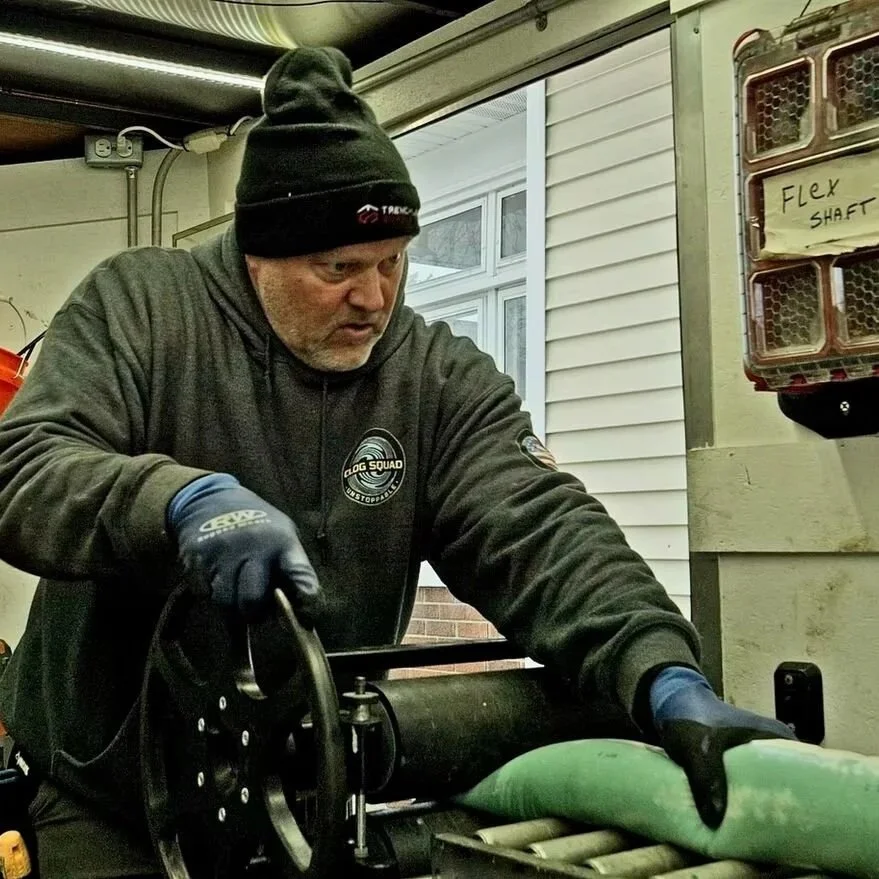
The cleaning method that actually restores branch-line flow is full-diameter cleaning. A flex-shaft cable with rotating chains scrapes the pipe's interior edge to edge, stripping the coating off the wall rather than tunneling through it. The pipe returns to its original interior diameter, which means the original water velocity returns, so the drain stops catching debris and slowing back down.
A drain that has been slow for more than a few months almost always needs this kind of cleaning. The longer the coating has been forming, the more bound to the pipe wall it becomes, and the less effective a basic snaking will be.
Slow drains in the kitchen are a different shape of the same problem
The kitchen sink is where most household slow drains start, and the cause is almost always grease.
Fats and oils from cooking go down as a hot liquid. They cool against the pipe wall — which is at room temperature, usually 55 to 65 degrees in a basement or cold space — and they harden into a wax-like layer. Every later dish wash adds a thin coat on top. After six months of regular cooking, a 1.5-inch kitchen line can have a coating thick enough to drop water flow noticeably.
A slow kitchen sink is the early warning. The full backup comes when the coating gets thick enough to catch food solids that would normally pass through.
There is one kitchen-specific cause worth checking before assuming the problem is grease coating the line. Dishwashers drain through a flexible hose that loops up to an air gap at the counter, then back down into the sink's tailpiece or disposer. If that hose develops a low spot, kinks, or partial blockage, the dishwasher slows down the sink's drainage every time it runs a cycle. Pulling the hose, checking for debris, and reseating it can sometimes fix a "slow kitchen sink" that turns out to have nothing to do with the actual drain line.
When one slow drain is actually a whole-system issue
So far, this article has assumed the slow drain is local — one fixture, one line. Sometimes it isn't.
If more than one drain in the house is slow at the same time, the restriction is downstream of where those drains meet — usually in the main line that carries waste out to the city sewer or septic. A main line that's been collecting scale, roots, or grease for years narrows the same way a branch line does, and the result is that multiple fixtures upstream of the restriction all slow down together.
The other system-level cause is venting. Every drain in a house connects to a vent stack that runs up through the roof. The vents carry air, not water. Without that air, water can't flow freely — it's the same physics as holding your thumb over the top of a straw. A blocked vent stack (bird nest, leaves, ice in winter) makes drains throughout the house run sluggishly, often with toilets gurgling when a sink is in use. If the slow drain is house-wide, the vent is worth checking before assuming the issue is buildup in a line.
Why slow drains get expensive the longer you wait
The economic case for fixing a slow drain early comes down to what the coating does to itself over time.
Soft, fresh coating — months old — comes off the pipe wall with a single flex-shaft cleaning or a moderate hydro-jet pass. The job takes an hour. The pipe goes back to original diameter, and a kitchen line stays clear for one to three years before grease starts building back up.
Hardened coating — years old, sometimes mineralized — takes longer to remove. It needs a stronger cleaning method, sometimes a degreaser pre-treatment, and the cleaning takes more passes to scrape the wall back to bare pipe. The job can cost two to three times as much as catching it early.
A fully clogged line, once water has stopped flowing, often needs emergency service — same-day work at higher rates. And if the clog is in the main line, the cleanup involves whatever has backed up into the basement or floor drains in the meantime. A slow drain caught at six months is a routine cleaning. A slow drain ignored for two years can become a weekend emergency.
The math usually favors fixing it while the coating is still soft, even if the slow drain isn't actively bothering anyone yet.
Frequently Asked Questions
How slow is too slow for a drain?
+A working drain should empty a sink basin within 5 to 10 seconds after the water source is shut off. A tub or shower should drain at roughly the rate water is coming in — you shouldn't be standing in water during a normal shower. If a sink takes more than thirty seconds to clear, or if water is collecting around your feet during a shower, the drain is restricted.
Can I fix a slow drain with baking soda and vinegar?
+For light residue on the very top of the trap, it can help temporarily. For the actual cause of a slow drain — coating on the branch line, grease in the kitchen line, scale in older pipes — baking soda and vinegar do almost nothing. The reaction is too short and the mixture too weak to break down anything bound to the pipe wall. If it works at all, the slow drain comes back within a few weeks.
What about enzyme drain cleaners?
+Enzyme-based products are gentler on pipes than acid or lye cleaners and can help maintain a drain that's already clear. They don't reverse an established coating, though — the enzymes work for hours to days, and there usually isn't enough contact time with the pipe wall to clear a serious slowdown. They're better as a maintenance tool than a fix.
Does a slow drain always become a full clog?
+Almost always, if left alone. The coating that causes the slowdown is also what catches new debris. Without cleaning, the diameter continues to shrink. The timeline varies — kitchens clog faster than bathrooms because grease builds faster than soap film — but a slow drain that's been slow for a year is significantly closer to a full backup than one that started slowing last month.
Is it worth a camera inspection for a slow drain?
+For a single fixture that's mildly slow and just needs a stopper and trap clean, no. For a slow drain that's survived basic cleaning, or for multiple slow drains in the house, yes. A push camera shows whether the cause is buildup, root intrusion, a low spot in the pipe, or scale in older galvanized lines — and the cleaning method changes depending on the answer.
Will hard water make a drain slower?
+Yes, though it's a longer timeline than grease or soap film. Hard water leaves mineral deposits inside fixtures and pipes — the same white film that shows up around faucets and showerheads forms inside drain lines, too. In areas with significant hard water, even a clean drain accumulates scale faster than it would in soft-water regions. A water softener can extend the time between drain cleanings, though it doesn't eliminate the need for them.
What to ask if a thorough home cleaning doesn't restore flow
When the stopper is clean, the P-trap is clear, and the drain is still slow, the cause is somewhere a homeowner can't reach without tools. At that point, the right question for whoever you call isn't "can you snake it" — most drain cleaners can. It's "Can you clean the line edge-to-edge, and how will you know whether the diameter is restored?"
A flex-shaft scraping the wall and a camera that can confirm the result are the combination that actually tells you the line is back to its original diameter. Without those, any cleaning is mostly guesswork about how much of the coating came off, and the slow drain tends to return.
