
How to Tell If Grease or Roots Are Behind a Recurring Clog
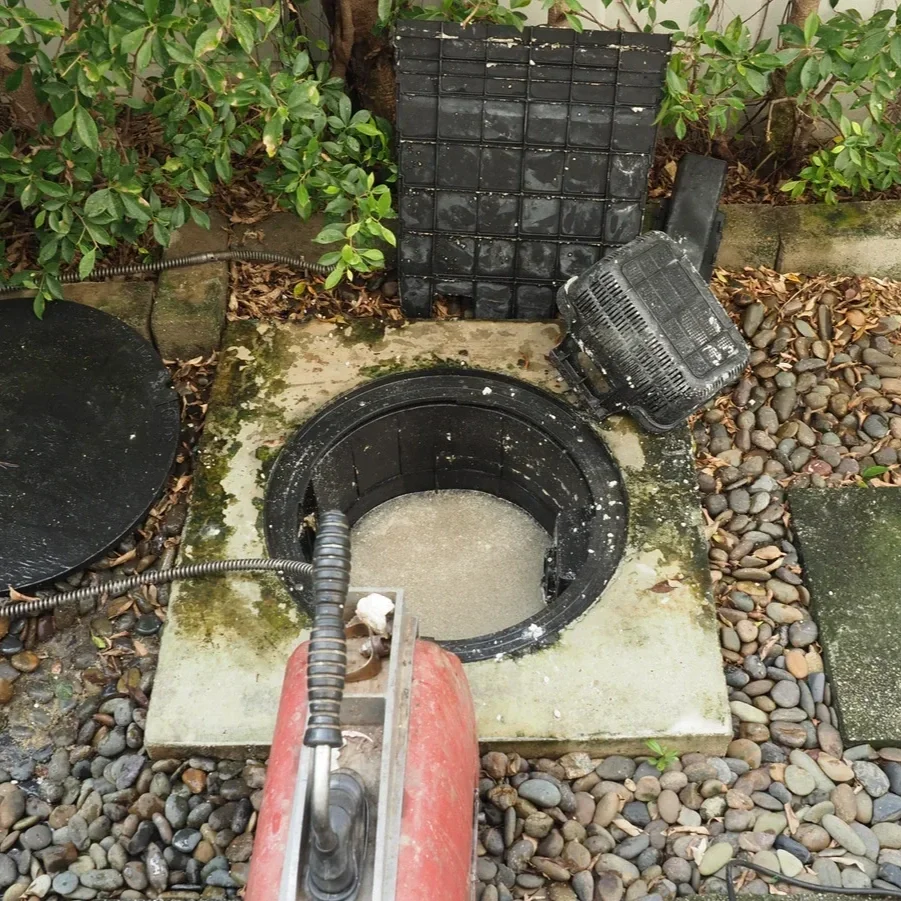
Two cleanings in six weeks. The cable came back up the second time with something dark gummed to the head — brown, slick, the texture of cold candle wax. The plumber said grease. A neighbor with the same recurrence pattern was certain it was tree roots. Two different answers, two different fixes, nothing to go on but a glob on a shop rag.
Most recurring residential clogs trace to one of those two causes. Grease coating a kitchen or main line. Or roots growing through a cracked joint in the sewer. Hair, soap film, scale, and slope problems account for the remaining slice — different conversations. For the line that re-slows every few weeks after a snaking, grease and roots are the suspects worth ruling in or out first.
The good news is they leave different fingerprints. Fixture, season, smell, regrowth interval, what comes back on the cable — each signal points one direction or the other.
Why one cabling never settles either problem
Both causes share a mechanism the cable can't reach.
Grease enters the line as a hot liquid from a sink or dishwasher. It hits a room-temperature pipe wall, cools fast, and hardens into a ring along the upper half of the pipe — the layer that catches the next round of food scraps. A standard cable bores a tunnel through the soft center of the ring, restores flow for a few weeks, and leaves the coating on the wall. New grease lays down on top of the old.
Roots come in through a hairline gap at a joint. They fan out into a mesh inside the pipe and feed on what passes through. A cable head punches a channel through the mass and trims the inner edge. The roots anchored to the joint itself stay put, and feeder shoots regrow within weeks because the entry point is still there.
Two different materials, same fail mode on a cable. That's why each signal below points at one or the other — and why the cleaning that ends the cycle is different for each.
Which fixture keeps clogging tells you the line
The cleanest diagnostic is location.
Grease hits the kitchen line first. The sink, the disposal, the laundry standpipe if the kitchen drains into the same horizontal run, sometimes the basement floor drain a foot or two downstream from the kitchen branch. Almost never the bathroom sink or upstairs toilet — those fixtures don't put fat into the line. A recurring clog confined to one kitchen line, with the rest of the house draining normally, is grease until proven otherwise.
Roots hit the main, not a branch. The main is the four-inch pipe that carries the whole house out to the city tap — the only line buried in soil where roots can find it. When roots restrict that line, symptoms show up across multiple fixtures at once. The basement floor drain backs up. The downstairs toilet flushes sluggish. The laundry standpipe bubbles when the upstairs shower runs. If only one fixture keeps clogging back, it's not roots. If two or three lose capacity on the same week, the kitchen sink is almost incidental — the cause is downstream of every branch.
What season the line runs on
The second tell is timing across the calendar.
Grease doesn't care what month it is. A kitchen line that clogs every five to seven weeks from January through December — same interval, no seasonal pattern — is grease loading the line on a household-cooking cadence. The clog returns when fresh fat builds enough thickness back up to catch debris, at roughly the same rate regardless of weather.
Roots grow on the calendar of the trees above them. Heaviest from late March through June, again from late August through October, slowing through deep winter. A drain that flowed fine all winter and slowed down every April. A toilet that started hanging in September. A basement floor drain that backed up after the first warm rain of spring. Twice-a-year slowdowns that line up with growing seasons are root activity, almost without exception.
July and early August are usually quiet for root recurrences — the woody bundle is in place but feeder growth has slowed. A line that's clogging in August but was fine in May is more likely grease, even if a homeowner suspects the maple in the yard.
What the cable brings back up
The wad on the head tells you more than most people think.
Grease pulled back from the line comes up dark brown to gray-tan, slick, room-temperature, with a soft waxy texture — like cold tallow or hardened bacon fat. Pinch it between two paper towels and it leaves an oily mark. Drop a piece in hot tap water and it softens within a minute. The smell is mild and sour. Food fragments may be embedded in it — coffee grounds, eggshell bits — but the matrix holding them is the fat itself.
Root material is fibrous and recognizable on sight. Pale yellow to tan threads if fresh, sometimes still flexible. Brown and woody if lignified — chips of bark-like material that snap rather than tear. There's no oily residue on paper, and hot water does nothing to it. The smell is earthy, not sour. A cable pulling back wet, dark grease that smears across the rim of the bucket is one diagnosis. A cable pulling back tan, stringy material that resists tearing is the other.
How fast the clog comes back
The recurrence interval is the third clear marker.
Grease in a kitchen line on a normal cooking load takes four to twelve weeks to rebuild enough thickness for the cable to be needed again. Heavy daily frying cuts that to two or three weeks. Light cooking pushes it past three months. The interval is consistent month to month — six weeks one round, six weeks the next, give or take a few days.
Roots regrow on a different curve. A cable cut through a root mass in early spring sees feeder regrowth in three to six weeks. A cut in midsummer might hold two or three months. A cut in November can hold all the way to March because the tree is dormant. If the line cleared in October and clogged again two weeks later, that's not roots — roots don't regrow that fast in cold weather.
A line that fails every five weeks like clockwork year-round is grease. A line that fails twice a year on a growing-season cadence is roots. A line that fails irregularly often has both — a rooted main intersecting a coated kitchen branch.
Smell at the basement floor drain
The fourth signal is air quality near the lowest fixture in the house.
Grease in a branch line rarely produces a strong sewer smell from outside the kitchen itself. The biofilm growing on the fat layer smells a little sour at the sink, especially after the dishwasher runs, but it doesn't push gas back through the rest of the house. The smell stays local to the fixture.
Roots in the main do something different. A mesh restricts air movement through the sewer line, and gas backs up through the path of least resistance — usually the basement floor drain or laundry standpipe, where the trap has the shortest water column. A faint sewer smell at floor level, strongest in the morning, fading through the day, returning at night, points at downstream restriction. When that smell shows up alongside a recurring slow drain elsewhere in the house, the main is the cause and the slow drain is the loudest signal.
What a camera answers in three minutes
A push camera dropped through the main-line cleanout settles the question without guessing.
Grease shows up on screen as a smooth brown coating along the upper half of the pipe, thicker in horizontal runs and at fittings, thinner on vertical drops. The pipe still looks like pipe — round, intact, just narrowed. The picture is uniform across long sections, because grease deposits everywhere the water carries it.
Roots look completely different. A bundle of fine threads hanging from a single joint, sometimes pale and feathery, sometimes woody and dark. The intrusion is localized — one joint, occasionally two adjacent, with clean pipe between them. A mature mass forms a brown mat occupying a third to half of the pipe diameter, often with visible knots where the woody core has thickened.
Grease and roots can show up on the same camera run, but as separate phenomena at separate spots. The picture turns guessing into a specific location and a specific cause before any equipment fires up.
The fix changes completely depending on the answer
The cleaning that ends a grease recurrence is wall-to-wall, not center-out. A hydro-jetter strips the cooled fat off the pipe wall as the rear-facing jets pull the hose through the line, leaving the interior at the original diameter. New grease has nothing to anchor to for one to three years in an average-use kitchen. A Flex-Shaft cleaning with a chain head does the same job mechanically on a smaller kitchen branch, scouring the coating off the wall in twenty minutes.
The cleaning that ends a root recurrence is mechanical removal at the wall, followed by sealing the entry joint. A Flex-Shaft cutter chews the mesh edge to edge down to bare pipe — but the entry crack is still there, and roots will find it again. Trenchless pipe lining cures a sleeve inside the existing pipe, bridges the cracked joint, and seals the gap the roots came in through. Once the joint is closed, the line stops leaking moisture into the soil and roots stop finding their way back.
A snake handles neither cause for long. Picking the right cleaning depends on which one the camera shows.
Frequently Asked Questions
What's the difference between grease and root material once it's out of the pipe?
+Grease is waxy, oily, dark brown to gray, room-temperature, and softens in hot water. Roots are fibrous, tan to brown, snap or tear rather than smear, and don't change in hot water. Drop a piece of each on a paper towel — grease leaves an oily ring, roots don't. One minute with both samples settles the question.
If both grease and roots are in the same line, which gets cleaned first?
+Roots, in most cases. A Flex-Shaft pass removes the bundle and clears space for the jetter to work the rest of the line wall to wall. Cleaning grease first on a rooted main risks pulling the jetter against a root mass it wasn't designed to cut. The order is Flex-Shaft, jetter, camera — with lining scheduled for the joint if the picture warrants.
Will grease damage the pipe the way roots do?
+Not structurally. Grease coats the wall and reduces the effective diameter, but it doesn't crack the pipe or open joints. Roots pry the original gap wider as the woody core thickens — a hairline crack becomes a quarter-inch gap over two years of growth, and the pipe can fracture further under the load. Grease shortens the cleaning interval. Roots shorten the life of the line itself.
How fast does grease rebuild after a wall-to-wall cleaning?
+In an average-use kitchen, twelve to thirty-six months before the next slowdown. A high-frying household — daily fried food, large family, restaurant-style cooking — cuts that to nine to eighteen months. A bare PVC line holds longer than an older cast iron line because the smoother wall gives fresh fat nothing to grip on the first cool-down.
Why do roots come back in some lines and not others?
+Because the entry point matters more than the trees above. A sound PVC sewer with intact joints can sit under a mature silver maple for decades and never see roots. A clay tile sewer with hairline-cracked joints will see roots even under a single small fruit tree, because the gap is what the root system follows. Trees are a risk factor; joint condition determines whether intrusion happens.
Two causes, two cleanings — and a camera in the middle
The recurring clog you've been paying to snake every six weeks has a specific cause sitting in a specific spot in the pipe. In the great majority of residential cases, it's a grease coating on a horizontal kitchen line, or a root mesh growing through a cracked joint in the main sewer. The two share nothing else. Different fixtures, different seasons, different look on the cable, different fix.
The reason the snake keeps failing is the same reason it can't tell you which cause it is. The cable touches the center of the pipe. The picture lives at the wall. A camera dropped through a cleanout shows whether the wall is coated or whether the joint is breached, and the cleaning that follows works because it matches the cause.
When the cause is named, the cycle ends. That's the difference between the third invoice for snaking the same line and the cleaning that holds for years.
