
How Grease Builds Up Inside a Drain Line and Causes a Clog
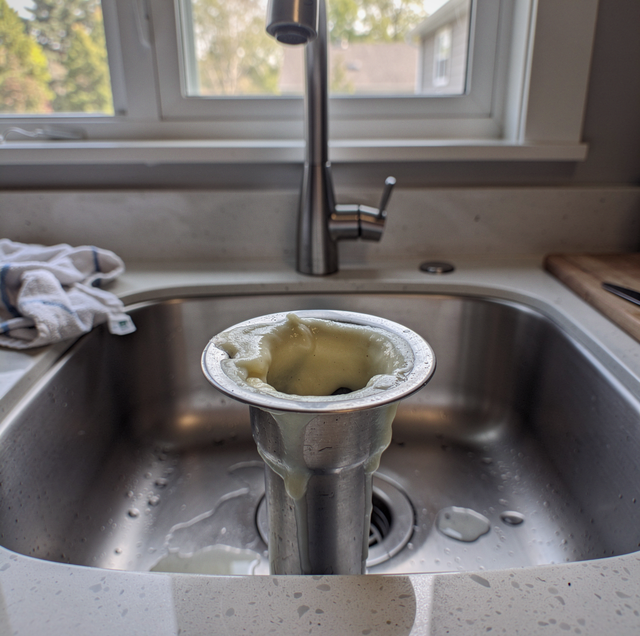
Quick Answer: Fats, oils, and grease enter a drain as warm liquid, then cool as they move through the pipe and solidify, coating the interior wall, much like melted fat hardens in a pan left to sit. Every additional pour adds another thin layer, and that layer traps food particles, soap residue, and other debris, so the coating thickens and the open channel through the pipe keeps shrinking. Left alone, the narrowing eventually closes the pipe entirely. This is a different failure than a root pushing through a cracked joint or a pipe that has physically shifted or collapsed; the pipe itself remains sound, and the problem is what has built up inside it.
A drain rarely clogs the moment something goes wrong. Far more often, it clogs because of something that has been happening quietly for months, one pour at a time, until the pipe can no longer pass water. Fats, oils, and grease are the classic version of that slow failure, and understanding how the process actually works explains why some clogs come back again and again while others clear and stay cleared.
What Fats, Oils, and Grease Actually Are
In the plumbing trade, this category gets shortened to FOG, and it covers a wider range of kitchen waste than most people assume. Bacon and sausage drippings are the obvious ones, but butter, margarine, salad dressing, gravy, cheese sauce, and the oily film left behind after frying all belong on the list. So does the greasy rinse water from a pan that looks clean but still carries fat down the drain. None of it looks dangerous going in, since it pours like a liquid and rinses off a plate easily enough.
Why Warm Grease Turns Solid Inside The Pipe
Fat behaves like a liquid only within a certain temperature range. Melted bacon fat, warm butter, and hot cooking oil flow freely while hot, which is exactly when most of them go down a drain, straight from a pan or a plate under warm rinse water. But a pipe is not a heated environment. Once that fat travels even a short distance through a cooler pipe, it gives up heat to the material around it and starts to firm back up, the same reaction that turns bacon drippings into a solid white layer in a pan left on the counter to cool.
That change from liquid to solid is what makes grease different from ordinary wastewater. Water keeps moving and drains away. Grease stops behaving like a liquid partway through the trip and clings to whatever surface it touches on the way out, which in a drain line means the interior wall of the pipe itself.
From A Thin Film To A Narrowed Channel
The first pour of grease down a drain does not clog anything. It leaves behind a film so thin it would be easy to miss with a flashlight. The trouble comes from repetition. Every time warm fat goes down that same line, it deposits another coat over the one already there, the way a wall gathers another layer of paint with every fresh application. Layer by layer, over weeks and months, that coating thickens, and the round opening water is supposed to pass through gets smaller.
This is a different kind of blockage than the sudden kind. A single dropped object or a wad of paper creates one obstruction at one point in the line. Grease buildup is more like a shrinking tunnel, a ring of hardened fat running along a stretch of pipe, narrowing the whole passage evenly instead of blocking it at a single spot. That is also why it tends to worsen gradually rather than appear out of nowhere: the pipe still lets water through for a long time before the ring closes enough to stop it.
What Grease Grabs Onto As It Grows
A hardened grease coating is sticky, and that stickiness is what turns a thin film into a real blockage. Coffee grounds catch on it and never make it any farther down the line. Small food particles that would otherwise wash straight through get snagged in the rough surface. Soap scum, formed when soap reacts with minerals in the water, sticks to the same coating and adds its own layer on top. Eggshell fragments and starchy bits from rice or pasta settle into the texture the grease creates.
None of that debris would cause a problem moving through a clean pipe on its own. It is the grease that gives it something to hold onto, and once that first layer forms, everything that comes down the drain afterward has a rough surface waiting to catch it.
Where This Builds Up In A Plumbing System
Grease buildup tends to start near its source because that is where the temperature drop is sharpest. The branch line running from a kitchen sink often shows the first coating, since the fat has barely cooled by the time it hits that section of pipe. Left unaddressed, the same process continues farther along, into a shared drain that several fixtures empty into and eventually toward the main line running out of the building.
A kitchen that runs high volumes of cooking, such as a restaurant, produces far more grease than a household ever will, which is why grease line maintenance is treated as its own ongoing service rather than a one-time fix. Many commercial kitchens run a grease trap ahead of the drain to catch fat before it reaches the pipe, but an undersized trap or one that goes too long between cleanings lets grease pass through and start the same coating process farther down the line.
How This Differs From A Root Intrusion Clog
It helps to separate this process from another common cause of a stubborn clog: tree roots. A root does not grow through solid pipe. It finds an existing opening, usually a joint that has shifted or a hairline crack in an aging section, and grows through that gap from the outside in. The pipe has to have some kind of flaw before roots become a factor at all.
Grease buildup needs no flaw in the pipe whatsoever. It happens just as readily in a pipe with tight, well-sealed joints, because the cause is entirely what travels through the inside of the line, not any weakness in the wall. A camera passed through a grease-narrowed section shows a smooth or rippled coating along the interior; a camera passed through a root-affected section shows fibrous growth pushing in at a specific joint. They look nothing alike and call for different approaches to clear and prevent.
How This Differs From A Structural Sewer Line Problem
A structural failure is a change in the shape or position of the pipe itself: a section that has bellied and sagged so debris pools in a low spot, a joint that has separated and let the pipe go out of alignment, or a length that has been crushed or partially collapsed under ground pressure. In every one of those cases, the pipe is no longer the shape it was installed in.
Grease buildup leaves the pipe's shape completely alone. The pipe is round, straight, and properly joined; the interior diameter is slightly smaller than it should be because of the coating on the wall. A structural issue usually calls for a physical repair, a spot fix, or a liner that restores the pipe's shape. A grease-narrowed pipe just needs the coating removed, and once it is gone, the pipe is back to its original working diameter with no shape to correct.
Signs The Buildup Is Getting Serious
Because the process is gradual, the signs build gradually too. Drainage that has slowed a little more each month, rather than a drain that worked fine yesterday and stopped today, points toward a coating problem rather than a single dropped object. A gurgle from a nearby fixture as water fights past the narrowed section is another common signal, along with a faint sour smell near the drain as trapped organic matter breaks down. If more than one fixture in the same area starts draining slowly at the same time, the narrowing point is likely downstream of where those lines join, not isolated under a single sink, and that pattern is worth having looked at with a camera.
Why Opening A Path Through It Isn't Enough
A plunger, a store-bought chemical, or a basic hand tool can restore flow through a grease-narrowed pipe, but those tools usually punch a channel through the middle of the coating rather than remove it. The ring of hardened fat stays bonded to the wall on every side of that new opening, and because it is still sticky, it keeps catching debris and closing back in. That is why a grease clog so often returns within weeks of being cleared using a home method. Getting the coating off the wall itself, rather than just breaching it, is what restores the pipe's full diameter and keeps it open longer, and that kind of full-wall cleaning is a job for the right professional equipment.
Keeping The Buildup From Starting
Prevention comes down to controlling what goes down the drain, since no amount of hot water keeps grease liquid forever; it only delays how quickly the fat cools once it reaches a cooler pipe. Pouring cooled grease into a can or jar and throwing it out with the trash, instead of down the sink, is the single most effective habit. Scraping fatty residue off plates and pans into the garbage before rinsing keeps most of it from ever entering the pipe. A mesh strainer over the drain opening catches food particles before they can combine with any grease film that does form. Running a disposal does not solve this, either; it grinds solids finer, but does nothing to change what fat does when it cools, and the ground particles it produces still have that same coating to stick to farther down the line.
None of these habits reverse a coating that has already formed. They simply keep a clean pipe clean, which is far easier than catching up on months of buildup after the fact.
Frequently Asked Questions
No. Hot water keeps the fat liquid only for the short distance it takes the pipe to cool it back down. Past that point, the water is no warmer than the pipe itself, and the grease solidifies the same way it would if the water had been cold from the start. The habit that actually helps is keeping grease out of the drain entirely rather than trying to flush it through with temperature.
A root clog requires an existing crack or loose joint that lets roots grow in from outside the pipe. A grease clog needs none of that; it forms purely from what travels through an otherwise sound pipe, coating the wall over repeated use. A camera inspection easily tells the two apart, since roots appear as fibrous growth at a specific joint, while grease appears as a coating running along the length of a pipe.
Grease coating is a narrowing problem rather than a structural one; on its own, it does not bend, crush, or crack the pipe the way ground pressure or a shifted joint can. The pipe stays the shape it was installed in. The risk is entirely about the shrinking channel closing off flow, not the pipe's physical condition.
There is no fixed timeline, since it depends on how much fat goes down that particular drain and how often. A household sink might take many months to build a coating thick enough to stop flow, while a busy kitchen producing large volumes of grease can narrow a line to a full stop in a matter of weeks without a working trap ahead of it. What stays consistent is that the process is gradual rather than sudden.
Not in any lasting way. Soap can break grease into smaller droplets in the sink, which makes it look like it rinsed away, but those droplets still cool and re-harden once they travel through the pipe, and the soap residue often adds its own sticky film on top rather than preventing one. The more reliable step is keeping the fat out of the drain before it ever gets the chance to cool.
Commercial kitchens face it on a larger scale because of the volume of fat they produce, which is why many install grease traps and schedule regular line maintenance. Households are not exempt; a home kitchen sink forms the same kind of coating from ordinary cooking, just at a slower pace and without a trap to catch any of it first.
Schedule a drain cleaning that removes grease buildup instead of just poking through it — a fully scoured pipe wall stays open far longer. Clog Squad serves Holland, Grand Rapids, and Grand Haven. Call (616) 779-7675.
