
How Long Does a Professionally Cleaned Drain Stay Clear?
The truck pulled out an hour ago. The kitchen sink draining like a sink should — full basin, fast swirl, gone in fifteen seconds. The invoice sits on the counter next to a credit-card slip. The real question, sitting underneath all of it, is when the next call goes back out.
That answer is not the same for every cleaning. The same word — "cleaning" — covers cable work that holds for years, jetting that holds for one to three years, milling that holds for a decade, and trenchless lining that holds for fifty. It also covers cable work on the wrong drain that holds for six weeks. The duration depends on what was on the wall, what tool removed it, and what the line is made of.
A real clog cabled out: often the life of the house
The best-case outcome for a cabling is the one most homeowners assume every cabling is.
A soft single-point clog — a wad of hair at the bathroom trap, a chunk of food past the disposal, a toy in a toilet bend — comes out on the cable head and doesn't return. The line was clean before the clog, the cable removed the clog, the line is clean after. The drain runs normally for years. Sometimes the rest of the line's useful life passes without a second call on that fixture.
That is the cabling success story. It works because the cause was a one-time event, not a process. A toy is removed and the toilet never sees it again. A holiday meal's worth of food paste tore through the kitchen elbow once and won't return on a normal cooking week.
The reason it lasts is the matching of tool to problem. A cable was built for soft, single-point, in-reach material. When that's what's actually in the line, the cable ends it. When something else is in the line, the timeline changes with it.
A snake against a coating: four to twelve weeks until the same call
The second scenario looks like the first one from above the sink. Same cable, same tear of material on the head, water moves, drain runs. The phone rings again in five or six weeks for the same line.
What happened in the pipe is mechanical. Grease in a kitchen line, soap film in a bathroom branch, mineral scale on aged cast iron — none of those are single-point clogs. They are layers along the pipe wall, sometimes feet of pipe at a time, narrowing the diameter without blocking it. A cable bores a tunnel through the soft center of that layer, restores flow for a short window, and leaves the coating on the wall. Fresh material lays down on top of the old, the diameter closes back, and the line is slow again.
The timeline is consistent. A coated kitchen drain returns to slow flow in four to twelve weeks — six weeks is the most common interval. A coated bathroom branch with soap and hair returns in six to ten weeks. Scale in older cast iron loses ground week by week, and the cable buys days, not weeks. A line that needs cabling every five to seven weeks on the same schedule is a line with a coating that the cable cannot remove.
This is the cleaning everyone assumes is the standard — and the one that produces the most repeat invoices.
Wall-to-wall on grease: twelve to thirty-six months
The cleaning that actually ends a coated kitchen line works at the pipe wall instead of the pipe center — the difference between rinsing a frying pan and scrubbing. A Flex-Shaft with chain heads scraping edge to edge is the kitchen-drain version of that scrub, and the cleaning that earns a three-year warranty on a kitchen drain.
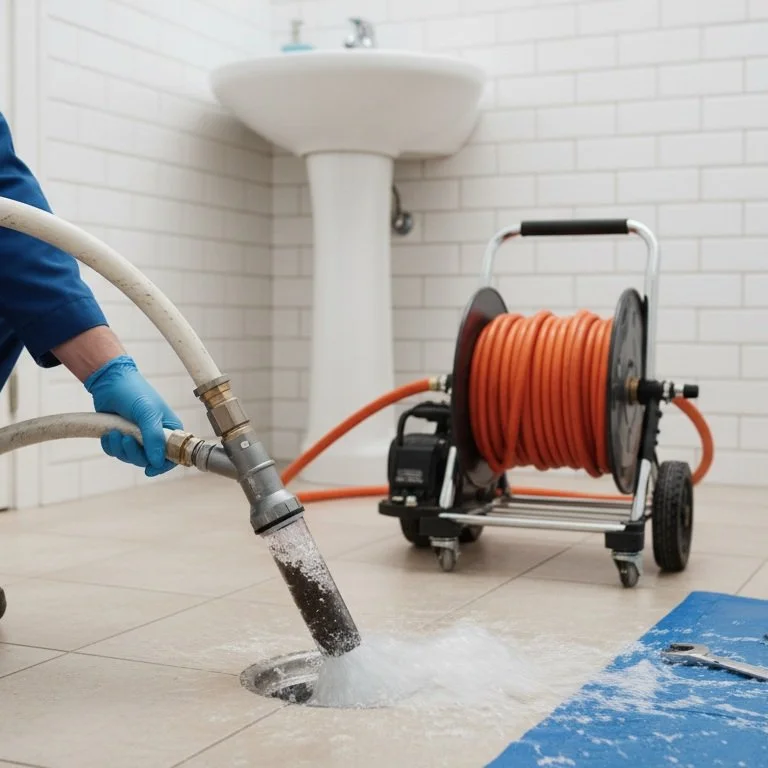
A Flex-Shaft cable with a chain head spins against the pipe interior and strips the cooled fat off the wall edge to edge — the same action as scraping wax off the inside of a glass jar with a flexible tool, until the wall is bare again. A hydro-jetter does it with water: a rear-facing nozzle on a high-pressure hose, pulling itself through the line and shearing the coating off the pipe as it goes. Either tool ends with the pipe at its original diameter, not at a tunnel through a ring of grease.
The hold time on that cleaning is measured in years on a residential line. Twelve to thirty-six months in an average-use kitchen. A heavy-frying kitchen — daily fried food, deep-fryer use, restaurant-volume cooking at home — runs nine to eighteen months. A light-cooking single-person household can push past three years. The variable isn't the cleaning. It's how fast new fat enters the pipe. Wall-to-wall kitchen drain cleanings come with a 3-year warranty because the cleaning is built to hold that long.
Root cutting alone: weeks to months, on the tree's calendar
The other recurring cause — tree roots in a main line — has its own timeline, and it isn't the same as grease.
A mechanical root cut with a Flex-Shaft cutter, or a hydro-jet pass with a root-cutting nozzle, removes the mass that was growing inside the pipe. What it doesn't remove is the entry point. The mesh fed on water through a hairline crack at a joint, and the crack is still there after the cleaning. New feeder shoots find the same gap and start growing back.
Regrowth runs on the tree's calendar, not yours. A cut in early spring sees feeder regrowth in three to six weeks. A cut in midsummer might hold two or three months. A cut in November can hold until March because the tree above is dormant. Twice-a-year recurrences — once in April, once in October — almost always point at a rooted main with no joint repair done.
A Flex-Shaft cut edge to edge gives the line a six-to-twelve-month window in the growing season, and a longer one in winter. Adding trenchless pipe lining at the joint changes the math — once the gap is sealed, roots have nowhere to come in, and the lined section stays root-free for the life of the liner. Cleaning without lining is maintenance. Cleaning plus lining is a one-time fix on the lined section.
Pipe milling on cast iron: years, often a decade
Older homes with cast iron drain pipes hit a different timeline.
Cast iron scales from the inside, as the pipe ages. Iron oxide and mineral deposits build a crusty layer along the interior wall, narrowing the diameter and roughening the surface so debris catches on every pass. Snaking buys nothing on a heavy scale — the cable rides past the layer or punches a hole through it without removing the bulk.
Pipe milling grinds the scale back to bare iron with a carbide cutter, restoring the full original diameter. Done correctly, the cleaning can hold five to ten years before fresh scale narrows the line enough to matter. The variable is the pipe wall behind the scale. A 1960s line with thick remaining wall holds longer; a 1920s line where corrosion has eaten halfway through the pipe shows thin spots after milling, and lining is sometimes the next conversation. Milling on an intact wall buys a decade. Milling on a compromised wall buys time to plan the next step.
Trenchless lining: fifty years on the lined run
Pipe lining is the only cleaning in the catalog that's structural rather than maintenance.
A cured-in-place pipe liner is a fabric-reinforced resin sleeve pulled into the existing pipe, inflated against the inside wall, and cured in place — usually with hot water, sometimes with UV light. When the resin sets, the sleeve becomes a new pipe inside the old one, structurally bonded to the host. The joint that was cracked is bridged. The corroded interior is replaced with a smooth resin surface. The line is functionally new at a fraction of the cost of full excavation.
Manufacturer service-life ratings on modern CIPP liners are 50-plus years, and the field record supports it — lined sections from the 1990s remain in service with no failures on record from intact installations. Roots can no longer enter because the joint they came in through doesn't exist anymore. Scale takes far longer to form on a smooth resin wall than on rough cast iron.
Lining isn't the right answer for every recurring clog. Hairline coatings and isolated kitchen-line grease don't need it. But on a rooted clay sewer, a corroded cast iron main, or a sewer with a known structural defect, lining is the one cleaning that exits the recurring cycle for the life of the lined section.
What changes the interval more than tool
Within any of these categories, the duration moves with a handful of variables.
The first is what's draining into the line. A kitchen drain on a household that fries daily loads the line faster than one that doesn't. A bathroom drain serving four people sees more hair and soap than one serving one. A laundry drain at a household with sand-heavy work clothing sees more grit than one with office clothing. The cleaning doesn't change. The pace of refilling does.
The second is the pipe material itself. PVC is smooth, and fresh material has a hard time anchoring to its wall — coatings come off cleaner and reform slower. Older cast iron and clay are rougher, especially in the upper interior, and fresh deposits find traction immediately. The same cleaning on PVC versus aged cast iron holds noticeably longer on PVC.
The third is what's growing above the lateral. A mature tree within twenty feet of a clay or older cast iron sewer is a recurrence factor on its own — even a thoroughly cut main returns faster than one with no roots feeding off it. Younger landscaping or a PVC sewer rarely sees the same pressure.
The fourth is whether the line was scoped before the cleaning. A camera-paired cleaning matches the tool to the cause. A blind cabling matches whatever cable was on the truck to whatever the line needs. The first one holds. The second one is the gamble.
Maintenance vs reactive
The interval also shifts based on whether the homeowner waits for a clog or schedules a cleaning before one.
Reactive cleanings happen at the point of failure. The kitchen sink backs up on Sunday night, a cable goes in Monday, the line runs for a few weeks until it backs up again. The interval is set by whatever the next clog is — and each clog has the line operating at a fraction of its diameter for weeks leading up to it.
Maintenance cleanings happen on a schedule. A wall-to-wall pass on a known-grease kitchen drain every eighteen months. A jetting pass on a known-belly section once a year. A spring root cut on a rooted main before the growing-season recurrence shows up. The household never has a Sunday-night backup.
The blanket "annual cleaning" recommendation common in the trade is a simplification. A 1995 PVC house with no mature trees doesn't need annual cleaning. A 1955 cast iron house with a maple twelve feet from the lateral may need it twice a year. The right cadence is set by what's in the pipe and what's growing above it.
The cost difference over five years is real. Three reactive cleanings on a coated kitchen drain — roughly $200 to $400 each — plus slow-drain weeks before each call, versus two scheduled wall-to-wall cleanings with the line never slow in between. The maintenance route costs less in total dollars and produces a drain that doesn't back up.
Frequently Asked Questions
How often should a kitchen line be cleaned to prevent the next clog?
+For an average-use kitchen, a wall-to-wall cleaning every eighteen to thirty months keeps the line ahead of a backup. Daily-frying households should run twelve to eighteen months between cleanings. Light-use kitchens can go closer to three years. The schedule is set by how fast fresh grease enters the line.
Does jetting actually last longer than snaking, or is that just marketing?
+It lasts longer because it does a different job. Snaking bores through soft material in the pipe center. Jetting strips the layer off the pipe wall. On a coated kitchen line, the snake holds for weeks and the jet holds for years — same line, same cause, different cleaning. On a single soft clog, both work and both hold for years. The duration gap shows up specifically on coating jobs.
What makes a cleaning hold for years instead of weeks?
+Three things. The tool has to remove the actual material — coating, root mesh, or scale — not just bore through it. The diagnosis has to name the cause so the tool matches it. And the entry point — a cracked joint, a sagging section, a failing disposal — has to be addressed if there's a structural cause behind the recurring symptom.
Can a homeowner extend the interval between professional cleanings?
+Some. Pour boiling water down the kitchen drain weekly to keep light fat moving through the line before it sets up. Use hair catchers in showers and tubs. Run cold water through the disposal during and after use so food paste leaves the elbow instead of sitting in it. None of those replace a wall-to-wall cleaning on an already-coated line — but they slow the pace of fresh deposits after one.
Will a single cleaning fix a recurring clog forever?
+Only if the cleaning matched the cause. A wall-to-wall pass on grease holds for years. A root cut paired with joint lining ends the root recurrence permanently. Milling on cast iron scale buys most of a decade. Cleanings that don't last are the ones that didn't address the cause.
Does enzyme treatment help between cleanings?
+For maintenance, yes — modestly. Enzymes break down organic matter, work on fresh deposits more than established ones, and don't damage pipe or seals. Monthly use on a kitchen line keeps fresh fat from anchoring. They are not a substitute for a wall-to-wall cleaning on an already-coated line, but they extend the interval after one.
Shelf life of a clean line
Drain cleaning isn't a single product with a single duration. It covers a dozen jobs on a dozen pipes, and how long it lasts changes with cause, tool, and material. A cable on a soft hair clog holds for years; the same cable on a coating holds a month. Wall-to-wall jetting on grease holds for years; milled cast iron, most of a decade; a lined sewer, the rest of the house's life.
The number on the calendar isn't an estimate — it's a function of what was in the pipe and what tool met it. A line clear in three years didn't get lucky. It got the right cleaning — picked after a camera showed the cause.
