
Is a Sewer Scope Worth It Before Buying a House?
The home inspection report is open on the kitchen counter. Forty-one pages bound at the corner, no major findings, recommendations for new smoke-detector batteries and a re-caulk around the master tub. The sewer line gets one line in the entire document: "Underground utility — not inspected."
That sentence is the gap. A home inspector looks at every surface and fixture they can reach. The 50-to-100-foot pipe running from the basement out to the city tap, four to six feet underground, is the part nobody opened the ground to see. A sewer scope is the fifteen-minute add-on that does — and on a house with a mature tree out front or a build date before 1980, it's often the single smartest check a buyer can pay for.
Here's what a scope actually finds, when it's clearly worth it, and where the dollar math lands when it isn't.
What a sewer scope actually shows
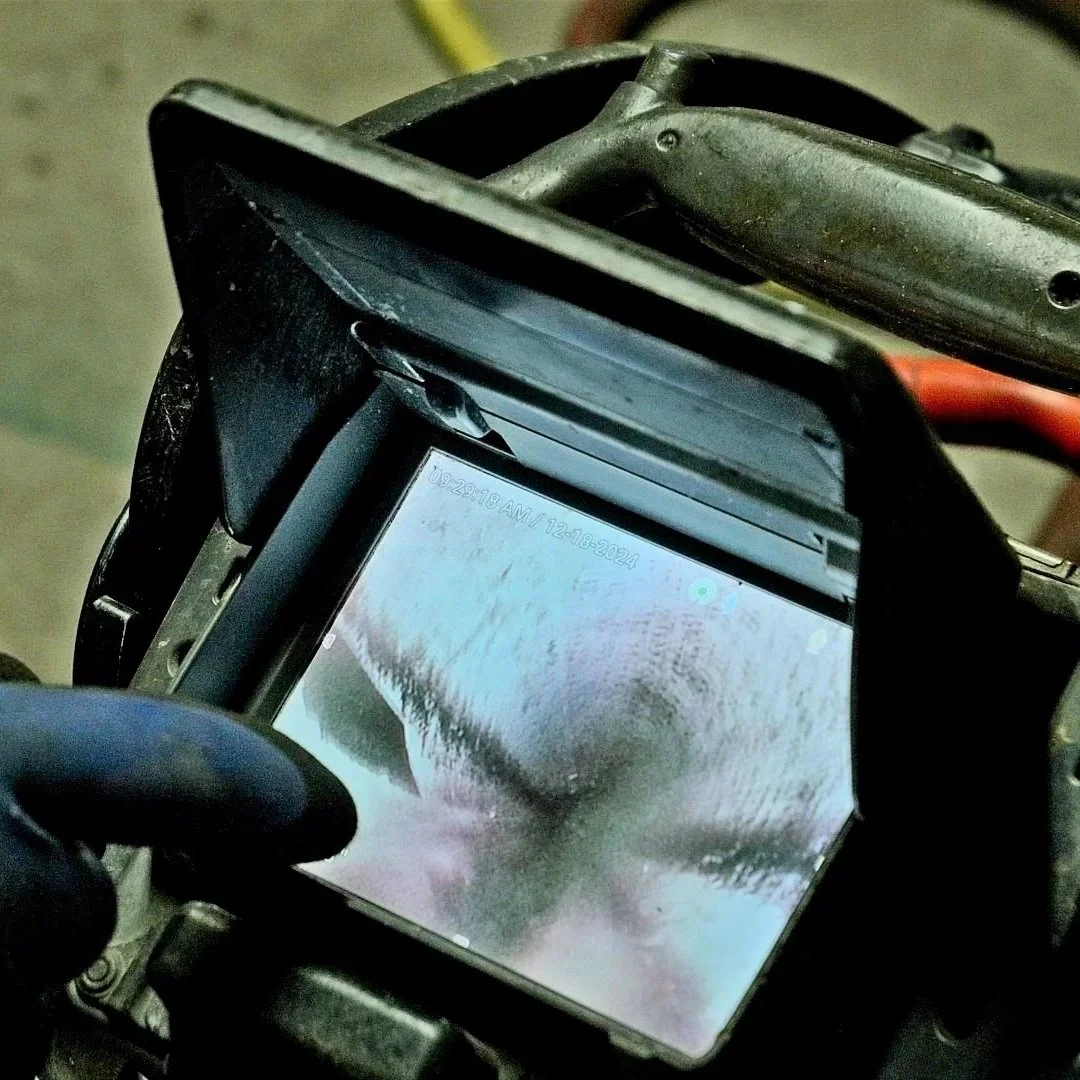
A sewer scope is the medical imaging of a lateral — a camera-on-a-cable inspection of the pipe from the house to the city sewer or septic tank. A technician feeds a high-definition camera through a cleanout or pulled toilet, runs the line, and records every foot. A locator on the camera head logs depth and distance, so any defect on the screen has a real-world location in the yard.
The picture covers what no other home inspection step covers: the inside of the buried pipe. The technician can see whether the line is clay, cast iron, Orangeburg, PVC, or a patchwork of all four. Roots growing through a joint, scale narrowing a cast iron run, a low spot holding standing water, a section dropped out of alignment, a pinhole through steel, a partial collapse waiting on one more freeze cycle — all visible on the screen.
What the scope doesn't see is the city's portion of the pipe past the property line — that's the municipality's pipe. The lateral and the joints under the buyer's future yard are where five-figure repairs come from, and that's what the scope covers.
Why a standard home inspection doesn't catch sewer-line problems
Most buyers assume the home inspector already checked the drains. They didn't — at least not in any meaningful way.
A standard inspection runs water through fixtures, watches the sinks and tubs drain in a reasonable amount of time, and confirms nothing visible is leaking. That's a flow test of the branches inside the house, not a condition test of the line in the ground. It's the difference between checking that a car engine turns over and pulling the oil pan to see whether the bearings are scored — both are inspections, only one tells you what's wearing out.
A heavily rooted lateral can pass that flow test fine. The line is restricted, not blocked, and a few minutes of light fixture use moves water through whatever opening is left. The day after closing, a load of laundry meeting a holiday meal's worth of kitchen wastewater is the event that backs the whole line up for the first time.
Inspectors also can't see what they can't reach. Crawl space access ends at the foundation wall. Slab foundations end the visible run at the bathroom drain. The pipe past those points is the underground utility the report flagged as "not inspected" — the only way to check it is a camera the inspector doesn't carry.
The picture covers what no other home inspection step covers: the inside of the buried pipe. The technician can see whether the line is clay, cast iron, Orangeburg, PVC, or a patchwork of all four. Roots growing through a joint, scale narrowing a cast iron run, a low spot holding standing water, a section dropped out of alignment, a pinhole through steel, a partial collapse waiting on one more freeze cycle — all visible on the screen.
What the scope doesn't see is the city's portion of the pipe past the property line — that's the municipality's pipe. The lateral and the joints under the buyer's future yard are where five-figure repairs come from, and that's what the scope covers.
Why a standard home inspection doesn't catch sewer-line problems
Most buyers assume the home inspector already checked the drains. They didn't — at least not in any meaningful way.
A standard inspection runs water through fixtures, watches the sinks and tubs drain in a reasonable amount of time, and confirms nothing visible is leaking. That's a flow test of the branches inside the house, not a condition test of the line in the ground. It's the difference between checking that a car engine turns over and pulling the oil pan to see whether the bearings are scored — both are inspections, only one tells you what's wearing out.
A heavily rooted lateral can pass that flow test fine. The line is restricted, not blocked, and a few minutes of light fixture use moves water through whatever opening is left. The day after closing, a load of laundry meeting a holiday meal's worth of kitchen wastewater is the event that backs the whole line up for the first time.
Inspectors also can't see what they can't reach. Crawl space access ends at the foundation wall. Slab foundations end the visible run at the bathroom drain. The pipe past those points is the underground utility the report flagged as "not inspected" — the only way to check it is a camera the inspector doesn't carry.
The defects sewer scopes find most often
A handful of conditions account for almost every problem a pre-purchase scope picks up. Each is worth a different amount of money to a buyer who finds it before closing rather than six months after.
Roots at a joint are the most common find on any home over thirty years old with a tree within twenty feet of the line. The camera shows pale threads or a woody mass hanging from a clay-pipe joint or a cast iron coupling. Cleaning runs $400 to $800 per visit; trenchless lining of the joint runs $3,000 to $8,000.
Bellies are the next category — low spots where the pipe has settled into softened soil and now holds standing water at the bottom of a sag. The camera shows water in the bottom third of the pipe instead of a clean wall. Mild bellies hold for years on a quarterly jetting cadence; severe ones need excavation and re-grading at $4,000 to $15,000.
Offsets and dropped joints are pipe sections shifted out of alignment from soil settling, freeze-thaw cycling, or root pressure on an old clay joint. The camera shows a step where the pipe transitions from one section to the next. Small offsets can sometimes be lined over; larger ones need spot excavation in the $3,500 to $12,000 range.
Scale and corrosion in cast iron is the find in homes from the 1920s through the 1960s. The line shows up rusty, rough, and narrowed — sometimes by more than half its original diameter. Pipe milling resets the wall for $1,200 to $3,000 per section.
Orangeburg — a bituminous fiber pipe used from the 1940s through the early 1970s — is the diagnosis that changes a deal. The picture shows a flattened oval instead of a round pipe, often cracking apart. Service life on most Orangeburg lines has already passed, and full replacement is the only fix. The repair number on a 60-foot run starts around $8,000 and can pass $20,000 under a driveway or mature landscaping.
Each of those defects is invisible from above ground, and each becomes the buyer's problem the moment the deed transfers.
The houses where a scope is the easy yes
A few conditions push the recommendation from "worth considering" into "schedule it before the inspection contingency expires."
Any home built before 1980. The probability of clay, cast iron, or Orangeburg in the lateral is high enough that the scope cost is a rounding error against the cost of finding any of them after closing. Pre-1950 homes are nearly guaranteed to have at least one section worth seeing.
Any home with mature trees within twenty feet of the lateral run. Maples, willows, elms, cottonwoods, and poplars find clay joints and cast iron seams reliably. A scope shows whether intrusion has started — or whether the line has stayed clean despite the proximity.
Any home where the disclosure mentions previous drain or sewer work, or where the seller's receipts show a snaking in the last three years. Recurring service tells the buyer the line is on a calendar of failures. A scope confirms what stage it's in now.
Any home with a finished basement. A sewer failure that backs up into finished space combines drywall, flooring, HVAC ducting, and biohazard remediation into $15,000 to $30,000 in restoration costs before the line itself is touched.
For any of those, the $200 to $400 inspection cost is the most efficient money a buyer spends on the whole purchase. Standard homeowners insurance typically doesn't cover sewer-line repair, so the bill lands on the owner once the deed transfers.
The houses where a scope is closer to optional
A scope isn't every home's right answer. Several conditions soften the recommendation.
New construction with a recent install date and a PVC lateral. The line is new, the joints are factory-fit, and root intrusion takes years to develop. A scope on a two-year-old PVC line shows clean pipe in almost every case.
Houses that already have a recent scope on file from a previous owner — within the last twelve months — that shows clean pipe.
Townhomes or condos where the lateral is the HOA's responsibility, not the unit owner's. The pipe still matters, but the cost of any failure won't sit on the buyer's personal repair budget. Confirming the HOA's maintenance records matters more than a private scope.
Even in those cases, a scope rarely returns information worse than "everything looks fine." The downside is a couple of hundred dollars and an hour of access; the upside is a written baseline before the keys change hands.
What the report needs to include
A pre-purchase scope is only as useful as the deliverables that come out of it. A walk-through with the technician and a verbal "looks pretty good" doesn't transfer to a real-estate negotiation.
The pieces that do: time-stamped video of the full run with distance markers showing how far from the cleanout each finding sits; a written summary listing each defect, its location in feet, its severity rating, and a recommended action; pipe-material identification for each section; locate markings on the surface where any specific defect was found — a spray-paint dot in the yard with the depth written next to it turns a video timestamp into an actionable location; and a copy of everything in a format the buyer's inspector and lender can access.
If a scope service doesn't include those, the buyer is paying for an inspection that won't function as evidence during a re-negotiation. Ask for the deliverable list before the appointment is booked.
A scope is observational, not a guarantee. The footage shows what's in the line today; defects that develop after the visit are still the new owner's problem. That's one reason a baseline at closing matters even when the screen comes back clean.
Using findings at the negotiating table
A clean scope is confirmation that no surprise is sitting under the lawn. A scope with findings is a negotiation lever.
For a structural repair item — a section needing replacement, an Orangeburg find, a significant offset — a buyer typically requests one of three concessions. The seller pays for the repair before closing, the seller credits the cost at closing, or the purchase price drops by the estimated repair number. A written estimate from a licensed contractor — not a guess off the back of an envelope — is what carries weight on the seller's side.
For a maintenance item — roots that need cutting, a belly that needs jetting, a coating that needs descaling — the standard request is a one-time cleaning credit or a smaller price adjustment.
For an informational find — slight roughness on cast iron with no visible defect, a small belly with no water held — acknowledgment and a note for future planning is usually the right move. Pushing on a finding that isn't a current defect tends to lose more goodwill than it gains.
In hot markets, findings sometimes don't yield concessions at all. In balanced markets, a finding usually moves the needle. Either way, the buyer who knows what’s in line is the buyer who can decide what they're willing to spend on it.
The cost math — scope now vs surprise after closing
A pre-purchase sewer scope runs $200 to $400 in most markets, with same-day video and report delivery. The inspection itself takes about an hour.
A backed-up sewer line discovered three months after closing runs a different scale. Emergency cleaning of a fully blocked main: $400 to $1,200. Sewage cleanup if the line backed up into a finished basement: $3,000 to $15,000 for restoration. Lateral replacement on an Orangeburg or fully failed cast iron line: $8,000 to $25,000. Pipe lining as an alternative: $4,500 to $14,000.
Roughly one in five pre-purchase scopes on pre-1980 homes find a repair item worth more than $1,000. One in twenty finds a repair item over $5,000. For the houses where it has something to find, a scope returns ten to fifty times its cost. For the ones where it doesn't, the buyer has a clean baseline on file at closing.
A camera dropped through a drain cleaning access point at the basement cleanout settles the question in an hour. The answer either confirms what the inspection report assumed or changes the price the buyer should be willing to pay.
Frequently Asked Questions
Is a sewer scope something the buyer pays for or the seller?
+Almost always, the buyer, as part of due diligence during the inspection contingency. Once the report exists, any repairs flagged become a negotiation item that may shift cost back to the seller — but the inspection itself is buyer-paid.
When in the buying process should the scope happen?
+During the inspection contingency window, alongside the general home inspection or within a few days of it. Scoping after the contingency expires removes the buyer's right to renegotiate or walk away on findings. In competitive markets, some buyers schedule the scope during the inspection visit itself to compress the timeline.
What if the seller refuses to allow a sewer scope?
+A refusal is information in its own right. Sellers who decline a scope on a property with a mature yard or a pre-1980 build date are often aware of an issue they don't want on the record. Options are to walk, to price the worst-case repair into the offer, or to make access a condition of the contract. Reputable sellers in non-distress sales rarely refuse — the scope takes an hour and damages nothing.
How much does a sewer scope cost?
+Most pre-purchase scopes land between $200 and $400, with $250 a common midpoint. Same-day video delivery and a written report are standard. Some companies bundle scopes with home inspections at a slight discount; standalone scoping is also widely available.
Are sewer scopes worth it on a newer house?
+Less critical, but still useful. New PVC lines installed correctly rarely show defects within their first decade. The scope on a newer home is mostly a baseline document — proof the line was in good shape at the time of purchase, which becomes useful evidence if a defect appears later or at a future resale.
Do older houses with replaced sewer lines still need a scope?
+Yes, with a different focus. The scope confirms the replacement was complete to the property line, that connections to the city tap are clean, and that the new pipe wasn't tied into a section of legacy line that wasn't replaced. Partial-line replacements are common, and the leftover original section is often where the next problem develops.
The small invoice that prevents the much larger one
A sewer scope sits in the same category as a roof inspection on a thirty-year-old shingle. A small expense that confirms or rejects an assumption the rest of the purchase price quietly depends on. The lateral under the yard is one of the highest-dollar items that won't show on a walkthrough, and the inspection that catches a problem before closing is the cheapest version of that problem the buyer will ever see.
The scope either confirms the line is fine, in which case the buyer closes with one fewer unknown, or it surfaces a repair item that becomes a negotiation point. For most pre-1980 homes and any home with mature trees over the lateral, the answer is yes — before the inspection contingency closes, with the report and footage in writing.
