
What Causes Recurring Bathtub Clogs Even With Hair Catchers
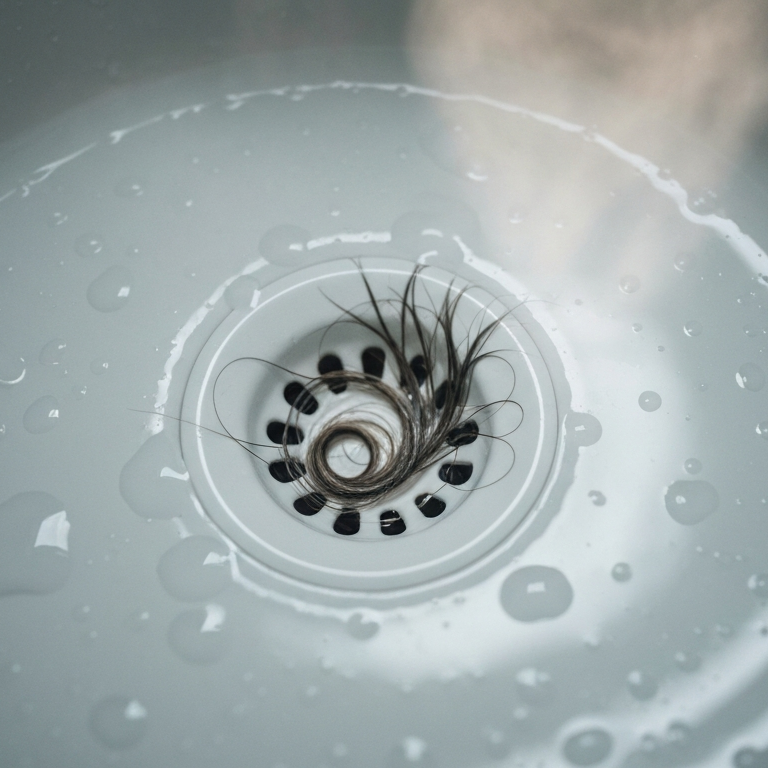
The hair catcher comes out of the drain dripping. The mat of brown strands on top gets rinsed into the trash, the silicone disc goes back into the strainer well, and the next morning the shower water is ankle-deep again at minute six. The catcher caught what it was supposed to catch. The clog formed anyway.
Most homeowners hit this point after the third or fourth time it happens. The strainer is doing its job. The drain isn't.
What's happening is a different clog from the one a strainer was designed to prevent. The hair part is mostly handled. What's coating the pipe past the catcher is soap, body oil, hard-water residue, and the fine hair the strainer never caught in the first place — bonded into a layer the catcher does nothing about.
What a hair catcher actually catches — and what slips past
A hair catcher is a mechanical strainer that sits in the drain throat. The good ones — silicone domes, mushroom-shaped inserts, fine-mesh discs — trap visible strands before they enter the trap. They work on long hair, on the kind of clump that looks like a small animal when you pull it out, on anything thick enough to wrap around the screen.
What slips past is the rest of it. Fine hair under about an eighth of an inch — broken shafts, eyelash-length pieces, beard trim — passes between the strainer's openings into the trap arm. Shaved hair from legs, face, and head goes straight through. Pet hair from a dog rinse passes through. Anything narrower than the screen spacing isn't filtered.
The bigger leak is the rest of what goes down the drain. Soap film, shampoo and conditioner residue, body oils, dead skin cells, exfoliant scrub particles — none of that touches the catcher. It rides past every shower and lands in the pipe downstream, where the catcher has no view and no reach.
A catcher reduces the hair load by 80 to 90 percent. It does roughly nothing for the chemistry of what builds inside the pipe wall.
Soap scum, conditioner, and the coating that forms past the strainer
The coating that grows inside a bathtub drain after the catcher is mostly soap and oil chemistry, not hair.
Bar soap is the worst offender on the chemistry side. Traditional bar soap is made from fats reacted with lye, and the fatty acids in it react with calcium and magnesium ions in tap water to form calcium stearate — a sticky, wax-textured solid that doesn't dissolve back into water. That reaction is what soap scum actually is. Every shower lays down a fresh thin film of it on the inside of the trap arm and the horizontal pipe past the trap.
Conditioner adds a second layer to the same problem. Most conditioners contain silicones and quaternary ammonium compounds that coat hair and rinse off in the shower. The rinse water carries them into the drain, where they smear against the soap scum already on the pipe wall and add a second slick film. Body oil, lotion residue, and oil-based body washes contribute their own layer.
The mix builds over months. A clean PVC bathtub drain might run a year before the first noticeable slowing. A line already coated from years of bar soap and bath products can be a quarter restricted before the homeowner notices anything wrong. The catcher above doesn't know any of this is happening underneath.
Why hard water turns soap into a pipe-coating layer
Most of West Michigan runs on hard groundwater — calcium and magnesium dissolved out of limestone aquifers, in the 8 to 18 grains per gallon range depending on the town. That hardness is the catalyst for the soap-scum reaction.
Soft-water households still get soap scum, but at a lower volume per shower. Hard-water households build the coating two to three times faster. The reaction between fatty acids and dissolved minerals is direct — hot shower water carries more calcium in solution than cold tap water, and the warmer the rinse, the more aggressively the scum lays down on the pipe wall as the water cools through the trap arm.
The result on the inside of the pipe is a tan-to-cream layer that looks a little like candle wax melted along the bottom of a glass jar. It's sticky enough to catch the fine hair the strainer missed, slick enough that snake cables slide past without scraping it off, and stubborn enough that hot water alone won't melt it once it's set.
That coating is the real reason a hair-catchered bathtub still backs up.
The P-trap — where everything past the strainer lands first
The first place the coating shows up is the P-trap under the tub. That's the U-shaped fitting between the drain and the wall, holding a couple of inches of standing water that blocks sewer gas from coming back up the pipe.
A bathtub P-trap is the lowest, narrowest, slowest-flowing section of the entire bathtub run. Water entering it from the drain has to make two 90-degree turns and rise back up the other side. Velocity drops on every turn. Anything not staying in solution — fine hair, soap scum, conditioner residue, biofilm — finds the P-trap a comfortable place to settle.
The standing water in the trap is also where bacterial biofilm grows. A black-to-dark-brown slime layer that thickens between showers and gets fed by every new round of soap and body oil. Biofilm by itself doesn't restrict a bathtub line meaningfully. Biofilm bonded to soap scum is sticky, dense, and a frequent ingredient in the recurring kind of slow drain.
Snaking through the P-trap punches a tunnel through whatever is sitting there. It doesn't strip the wall clean. The water runs again for a few weeks. Then the coating closes back in over the tunnel, and the next slowdown comes on roughly the same schedule.
Older drum traps — a worse version of the same problem
A meaningful number of West Michigan bathrooms still run on drum traps instead of P-traps. Drum traps are the cylindrical fittings used in residential plumbing roughly from the 1920s into the 1960s — a wider chamber with the inlet at the bottom and the outlet near the top, sealed by a brass cap on the floor or wall.
Drum traps were never great. They hold more standing water than a P-trap and have a larger surface area for soap, biofilm, and hair to settle on. A drum trap with thirty years of bath products in it can be more than half full of slick wax-textured paste with hair embedded in it, smelling faintly of decades of conditioner.
A snake doesn't reach a drum trap cleanly. The cable enters the drum, bounces inside, and exits without scrubbing the wall. The cap has to come off and the chamber has to be cleaned out by hand or by a tool fitted to the geometry — neither of which a hair catcher affects in any way. Houses built before 1965 have the highest probability of a drum trap behind a recurring bathtub clog.
The horizontal branch line and the vent connection
Past the trap, the bathtub drain becomes a horizontal branch line — 1.5-inch pipe in most residential construction, running at minimum code slope to the wall stack. That branch line is the section that picks up the same coating the trap arm collects, just spread out over a longer run.
A coated branch line slows water differently from a coated trap. The trap throttles flow at one point. The branch throttles it over six to twenty feet. The result looks similar — slow draining, water rising at your ankles — but the source is different, and a snake reaching only to the trap fixes the wrong section.
The vent stack matters too. Every bathtub branch ties into a vent that lets air into the line as water drains. If that vent is partially blocked — by leaves at the roof, a bird nest, ice during a cold snap — the line drains under partial vacuum and water moves slower than it should. A bathtub that backs up while the sink across the hall gurgles is usually a vent issue, not a trap-arm coating. The catcher has nothing to do with that scenario.
Why snaking through the drain stopper rarely lasts
The version of the fix most homeowners pay for first is a snake pushed down through the drain. It usually works for a week or two, then doesn't.
The reason is the geometry of what a small cable does to a coated pipe. A cable enters the trap, hits the bottom of the curve, deflects sideways through the second leg of the trap, and exits into the branch arm. Where it touches the wall, it scratches off a strip of coating. Where it doesn't touch the wall — most of the circumference — the coating stays exactly where it was.
What the homeowner sees is the cable coming out with a wad of gunk on the head. What's still in the pipe is everything the cable didn't drag past. The line runs cleaner for a few showers because the bored channel through the coating is wider for a while. Within weeks, the soap scum re-coats the channel, the fine hair re-collects on the sticky wall, and the slowdown returns.
A wall-to-wall cleaning is the alternative — a powered flex-shaft cable with chain knockers, or a low-pressure jet head sized for a 1.5-inch line, that contacts the pipe wall edge to edge as it spins. The coating comes off the wall instead of being tunneled through. A bathtub branch cleaned that way runs significantly longer between slowdowns — typically two to four years on a coated line that had been on a six-week recoating cycle.
What actually clears a coated bathtub line
A real cleaning on a recurring-clog bathtub line covers three things the snake alone misses.
The trap gets pulled apart and cleaned by hand or jetted clean — biofilm and soap paste out of the U-bend, the inside walls back to bare pipe. A drum trap, where present, gets the cap pulled and the chamber cleared properly.
The branch line gets a wall-contacting tool from the trap to the wall stack — a flex-shaft with chains or a 1.5-inch jetter nozzle. The coating strips off in one pass. A camera afterward confirms the pipe is back to its original interior diameter, not a tunneled-through interior with a new coating already starting to bridge it.
The vent gets checked if the symptoms point that way — gurgling fixtures, slow drain across multiple bathroom fittings, a tub that runs fine until the toilet flushes nearby. The fix on a blocked vent isn't down the drain; it's up the stack from the roof.
After a wall-to-wall cleaning, the hair catcher becomes a useful tool again. The pipe stays clean enough that the catcher's 80-to-90 percent capture rate keeps the line moving. The catcher works when the pipe is clean. The pipe being clean is the part the catcher can't do.
Frequently Asked Questions
Do hair catchers stop bathtub clogs from forming?
+They reduce the hair load on the line by most of it — typically 80 to 90 percent of long hair gets caught above the trap. What they don't stop is soap scum, conditioner, body oil, and fine hair below the strainer's filtering threshold. On an already coated line, a catcher slows the next recurrence but doesn't fix the existing layer. On a clean line, a catcher helps the pipe stay clean longer between cleanings.
What does soap scum actually do inside the drain line?
+It bonds to the pipe wall. Bar-soap fatty acids react with calcium and magnesium in hard tap water to form a sticky, wax-textured solid that doesn't dissolve back into water — calcium stearate. The reaction lays down a thin film on the inside of the trap and branch line every time the tub is used. Over months and years, the film thickens, catches fine hair the strainer missed, and builds the coating that eventually slows the line.
Is there a way to dissolve soap scum without chemical drain cleaners?
+Partial yes. Enzyme-based drain treatments break down organic biofilm and some of the soap-bound material on the wall, applied regularly over weeks. They don't strip the calcium-stearate scale that hard water produces — that's a mineral, and enzymes don't touch it. For a coated line, the realistic options are mechanical removal using a flex-shaft or jet, and enzyme maintenance after the line is back to bare pipe. Enzyme alone on a heavily coated pipe rarely catches up.
What kind of cleaning actually removes the coating from a bathtub line?
+Wall-to-wall mechanical cleaning. A powered flex-shaft cable with chain knockers, or a small-diameter hydro-jet nozzle sized for a 1.5-inch branch, contacts the pipe wall and strips the coating off as it moves through the line. A standard cable snake tunnels through the coating; a wall-contacting tool removes it. A camera pass after the work confirms the pipe is back to original interior diameter.
Why am I getting clogs only months after I've been using a catcher faithfully?
+Because the coating that's restricting the line was forming long before the catcher went in. A bathtub line that's been collecting soap scum, biofilm, and fine hair for years doesn't reset when a strainer gets added on top. The catcher stops new long hair from adding to the layer. It doesn't remove what's already there. The recurring backups continue on the schedule the existing coating produces.
Why the catcher is half the fix, not all of it
The hair catcher is one of the better small investments in a bathroom. It pulls visible hair out of the drain throat before it can join the existing coating, and on a clean line it extends the time between professional cleanings significantly. As a prevention tool it earns its place above the drain.
What it doesn't do is reach the section of pipe where most recurring bathtub clogs actually form. The trap, branch arm, and any older drum trap or restricted vent sit downstream and outside its scope. A line coated for years with bar soap, conditioner, and hard-water residue keeps backing up no matter how clean the catcher is kept.
The right read on a hair catchered bathtub that still clogs is that two problems are stacked. The strainer is doing its part on hair. The pipe past it needs the part the strainer can't do — a wall-to-wall cleaning that takes the coating off the trap and branch line, and a camera pass to confirm the pipe is back to original diameter. A bathroom drain cleaning done at that level changes the cycle from a backed-up tub every few months to a line, the homeowner mostly stops thinking about.
